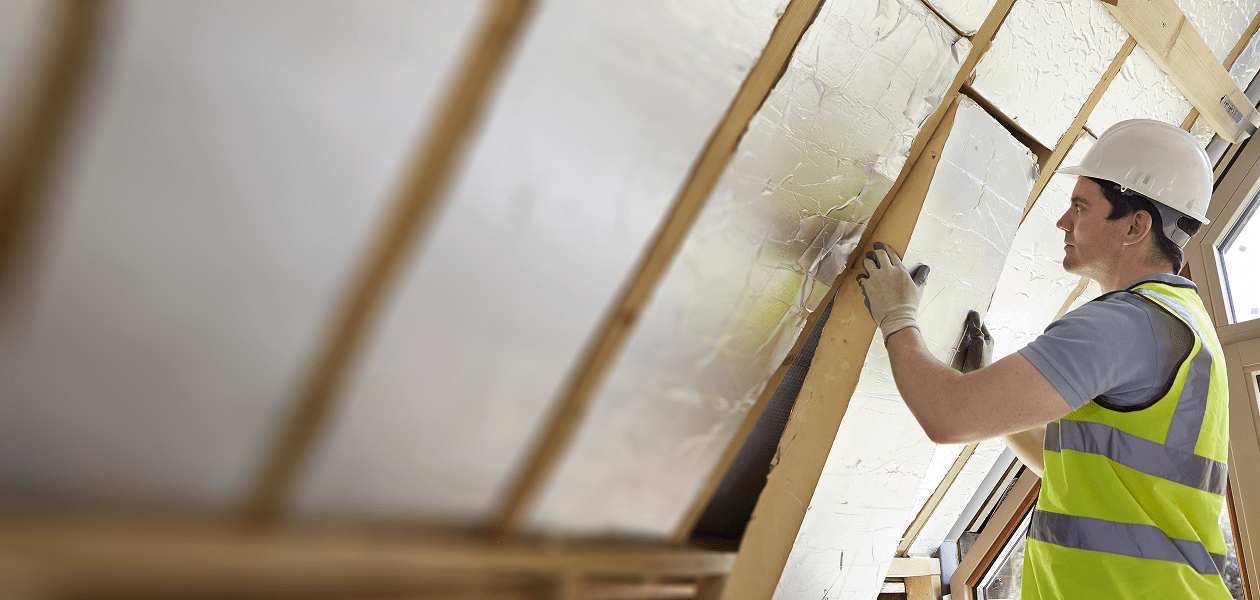
Built-up metal cladding is its own discipline. A twin-skin roof or wall is not a masonry cavity and it is not a loft: you have a shallow-profile metal liner sheet, a rail and bracket spacer system creating the cavity, a higher-profile weather sheet on the outside, and a quilt that has to fill the space between them without slumping, tearing or leaving voids at the spacer bars. Get that layer wrong and the U-value you calculated on paper is not the U-value the building ends up with.
Knauf FactoryClad Roll 40 (Uncut) is built specifically for that job. It is an unfaced glass mineral wool roll with a declared thermal conductivity of 0.040 W/mK, manufactured 1200mm wide to suit the rail and bracket systems commonly used in twin-skin profiled metal cladding and standing seam roofs, and supplied in long uncut rolls with high tear strength so it survives being pulled across a roof.
Two things set it apart from the foam composite alternatives. First, it is non-combustible with a Euroclass A1 reaction to fire classification, the best available. Second, being mineral wool, it knits to the substrate and adapts to slight imperfections rather than leaving the air gaps that rigid boards leave behind. Add ECOSE® Technology, Knauf's plant-based binder, and eleven thicknesses from 80mm right up to 300mm, and you have a range that covers everything from a light industrial refurbishment to a low-energy new build chasing notional Part L figures.
Insulation UK stocks the full range. Here is how the eleven thicknesses compare, what the numbers actually mean once the spacer bars are in, and how to pick the right one.
The range at a glance
Every thickness shares the same 0.040 W/mK declared thermal conductivity and the same 1200mm roll width. What changes is depth, thermal resistance and how much you get per roll. Note that coverage falls as thickness rises, which matters when you are pricing a big roof by the square metre rather than by the roll.
| Thickness | Thermal resistance | Roll length | Coverage per roll | Coverage per pallet |
|---|---|---|---|---|
| 80mm | 2.00 m²K/W | 14.10m | 16.92m² | 406.08m² |
| 120mm | 3.00 m²K/W | 9.40m | 11.28m² | 270.72m² |
| 140mm | 3.50 m²K/W | 8.02m | 9.62m² | 230.98m² |
| 160mm | 4.00 m²K/W | 7.05m | 8.46m² | 203.04m² |
| 180mm | 4.50 m²K/W | 6.26m | 7.51m² | 180.29m² |
| 200mm | 5.00 m²K/W | 4.85m | 5.82m² | 139.68m² |
| 220mm | 5.50 m²K/W | 4.35m | 5.22m² | 125.28m² |
| 240mm | 6.00 m²K/W | 4.70m | 5.64m² | 135.36m² |
| 260mm | 6.50 m²K/W | 3.70m | 4.44m² | 106.56m² |
| 280mm | 7.00 m²K/W | 3.45m | 4.14m² | 99.36m² |
| 300mm | 7.50 m²K/W | 3.20m | 3.84m² | 92.16m² |
All rolls are 1200mm wide and supplied one roll per pack, 24 packs per pallet. Dimensions are nominal. Figures are taken from the Knauf FactoryClad Rolls datasheet valid from September 2025.
Which thickness should you choose?
Eleven options can be paralysing, so it helps to think in bands. Your calculation and your spacer depth decide the answer, but this is roughly how the range breaks down in practice.
80mm to 120mm: refurbishment, light duty and acoustic linings
R-values of 2.00 to 3.00 m²K/W. This band is where you land when the existing spacer system is shallow, when the building is unheated or only lightly heated, or when the driver is acoustic control rather than heat loss. It is also the band with the best coverage per roll, so you cover ground quickly and cheaply. Look at 80mm or 120mm for storage, workshops and canopy soffits where the target is modest.
140mm to 180mm: the mainstream commercial band
R-values of 3.50 to 4.50 m²K/W. This is the volume band for standard heated industrial and commercial twin-skin walls and roofs on conventional bracket depths. 140mm and 160mm tend to suit wall applications where the limiting U-value is more forgiving than the roof, while 180mm is a common starting point for roofs once bridging corrections are applied. If you are not sure where to begin, start here and let the modelled U-value push you up or down.
200mm to 240mm: hitting new-build roof targets
R-values of 5.00 to 6.00 m²K/W. Once you are working to notional new-build roof figures rather than limiting values, and once the bridging correction for a rail and bracket system is taken off, this is the band that gets you there in a single layer. 200mm is the workhorse; 220mm and 240mm give you headroom when the calculation comes back tighter than expected. Check your spacer depth before committing, because this band needs the cavity to accommodate it uncompressed.
260mm to 300mm: maximum performance in one layer
R-values of 6.50 to 7.50 m²K/W. The deep end of the range, for low-energy specifications, BREEAM-driven projects and deep standing seam build-ups where the target U-value is well below the regulatory minimum. 300mm declares 7.50 m²K/W, the highest single-layer resistance in the Roll 40 range. Coverage per roll is lowest at this end, so allow for more rolls and more handling on a large roof if you are specifying 260mm or 280mm and above.
All eleven thicknesses are in stock and priced online, with free UK delivery on orders over £500 ex VAT.
Shop the rangeWhy FactoryClad Roll 40 stands out
There is nothing exotic about 0.040 W/mK. Plenty of glass mineral wool sits in that range, and Knauf itself offers FactoryClad Roll 32 and Roll 35 if you need better lambda in a shallower cavity. So the case for Roll 40 is not built on the thermal figure alone. It is built on four things that matter once you are actually on a roof.
- Depth range. Eleven thicknesses to 300mm is unusually broad for a cladding quilt, and it means you can hit a target R-value in a single layer rather than doubling up. One layer means fewer laps, fewer opportunities for a gap and less time spent on the roof.
- Tear strength. Long uncut rolls only work if the quilt survives being dragged over liner sheet ribs and spacer brackets. High tear strength is listed as a headline benefit by Knauf for a practical reason: a torn quilt is a thermal bridge you cannot see once the outer sheet goes on.
- Non-combustibility. Euroclass A1 to EN 13501-1 is the top classification available, and it is the single biggest technical divide between mineral wool cladding quilt and foam composite panels. Knauf notes that A1 specification can potentially reduce insurance premiums compared with foam composite systems, which is worth raising with the client early rather than late.
- Real as-built performance. Mineral wool adapts to imperfections in the substrate and knits together at laps, which closes the air gaps rigid boards tend to leave. Knauf makes the point directly: an insulant that does not deliver as-built performance is failing at its primary job. In a system riddled with brackets and rails, that adaptability is not a marketing line, it is the difference between the modelled U-value and the real one.
Thermal performance across the range
Because lambda is fixed at 0.040 W/mK across all eleven thicknesses, thermal resistance scales cleanly and predictably: every extra 40mm of depth buys you exactly 1.00 m²K/W. That makes the range easy to specify. If your calculation says you need 5.50 m²K/W at the centre of the insulation, the 220mm roll gives it to you exactly, with no interpolation and no calculated values to caveat.
The R-value of the quilt is not the U-value of the finished wall or roof. Built-up metal cladding is one of the most thermally bridged constructions in common use. The rail and bracket spacer system penetrates the insulation layer, and the degree of bridging depends on bracket cross-sectional area, rail spacing, whether thermal break pads are fitted and how deep the brackets are. Two roofs using the same 200mm quilt can land on noticeably different U-values.
Knauf's own guidance is that U-values for a proprietary built element should be calculated using 2D or 3D modelling to BS EN ISO 6946:2017 or BS EN ISO 10211:2017, with guidance from BR 443:2019. For anything that has to satisfy Building Control, use the system manufacturer's calculation or a modelled figure. Treat the quilt R-value as an input, never as the answer.
Euroclass A1: what non-combustible actually buys you
FactoryClad Roll 40 carries a Euroclass A1 reaction to fire classification to EN 13501-1. A1 is the top of the scale, above A2-s1,d0, and it means the material makes no contribution to a fire. There is no combustible core, no dripping, no smoke contribution to argue about with an insurer or a fire engineer.
On a large industrial or commercial envelope, that matters in three ways. It simplifies the fire strategy conversation, because a non-combustible insulation layer removes a whole category of question. It can affect the commercial terms, as Knauf notes the potential for reduced insurance premiums compared with foam composite panels. And it future-proofs the specification against the direction of travel in UK fire regulation, which has consistently tightened around combustible material in external construction rather than loosened.
It is worth being precise about scope, though. A1 is a material classification for the quilt. It is not a fire resistance rating for the wall or roof build-up, and it does not certify the system. If your project needs a period of fire resistance or a tested system performance, that has to come from the cladding system manufacturer, not from the insulation datasheet.
The acoustic side of the job
Metal-clad buildings are acoustically unforgiving. A thin steel skin transmits external noise readily and drums under heavy rain and hail, and a large open industrial volume with hard surfaces on every side reverberates badly. Speech becomes hard to follow, plant noise builds up and the space feels louder than the measured levels suggest.
Glass mineral wool helps on both counts. Knauf's position is that mineral wool provides the best levels of sound absorption and reduction compared with other mainstream insulants, and specifically that FactoryClad Rolls reduce reverberation of internal sound when used in conjunction with metal liner sheets. In practice that means the acoustic benefit is largest where a perforated liner sheet lets sound reach the quilt rather than bouncing off a solid liner: the cavity insulation then doubles as an absorbent lining.
Deeper thicknesses generally absorb more, and more effectively at lower frequencies, which is where industrial noise tends to sit. If acoustics are a driver rather than a bonus on your project, specify the liner perforation and the quilt depth together and get the system supplier to confirm the absorption data, because absorption is a property of the assembly, not of the roll on its own.
What U-value are you actually aiming at?
For buildings other than dwellings in England, the numbers come from Approved Document L Volume 2. It sets limiting U-values, the worst performance allowed for any element of that type, and separately a notional building specification that the design is modelled against.
At the time of writing, the 2021 edition sets limiting U-values for new elements in new non-domestic buildings of 0.18 W/m²K for roofs and 0.26 W/m²K for walls, with the notional specification tighter again at around 0.15 W/m²K for roofs and 0.18 W/m²K for walls. Existing buildings undergoing refurbishment work to relaxed figures where upgrading to new-build performance is not technically, functionally or economically feasible.
Two practical points follow. First, the limiting value is a floor, not a target: because compliance is assessed against the whole-building model, the design U-values you actually specify usually need to beat the limiting figure comfortably. Second, none of these figures translate directly into a quilt thickness, because the bridging correction for your particular rail and bracket system sits between the two. Always work from a modelled U-value for the system you are building, and confirm the current regulatory position with your energy assessor or Building Control, since the Approved Documents are periodically amended.
Installation in a built-up metal system
Built-up metal roofs and walls are assembled on site, and the components normally form part of a proprietary system, so the system supplier's details govern. That said, a few things apply almost universally with a cladding quilt.
- Fill the depth, do not crush it. The spacer system has to accommodate the quilt at its working thickness. A 200mm quilt squeezed into a 150mm cavity does not perform like 200mm, and it does not perform like 150mm either. Get the bracket height right at design stage rather than compressing on site.
- Butt the laps tight and work with the width. The 1200mm roll width is deliberate: it matches commonly used rail and bracket spacings, so the quilt lands where the rails are rather than needing to be split lengthways. Butt adjacent rolls firmly against one another and avoid leaving voids at brackets, ribs and gutter details.
- Store it properly. The polythene packs and shrink-wrapped pallets are short-term protection only. Store indoors or under cover, off the ground, dry and flat, and out of prolonged sunlight. In coastal locations, add covering or store indoors, since bird damage is more common.
- Get the moisture control right. FactoryClad Roll 40 has a water vapour resistivity of 5.00 MNs/g.m, which is to say it is vapour open and it is not a vapour control layer. In a heated metal-clad building the VCL is a separate component, normally sealed on the warm side of the insulation immediately above the liner sheet, with laps sealed and service penetrations detailed. Condensation risk in twin-skin cladding needs assessing on its own terms, to BS 5250 and the system supplier's guidance.
This is the one that costs money. Knauf is explicit that FactoryClad Rolls should not be left permanently exposed to the elements, that exposed areas should always be covered at the end of a day's work or in heavy rain, and that damaged, contaminated or wet product must not be used. Lay only what you can cover and protect the same day.
Sustainability and embodied carbon
Knauf publishes a fair amount here, and on a large industrial envelope it can be the deciding factor when two products are thermally equivalent.
FactoryClad Roll 40 is manufactured with ECOSE® Technology, a plant-based binder with no added formaldehyde or phenol, made from rapidly renewable raw materials and less energy-intensive to produce than traditional binders. Products made with it are soft to handle, generate low levels of dust and volatile organic compounds, and hold the Eurofins Gold Certificate for Indoor Air Comfort. Knauf's glass mineral wool carries the DECLARE Red List Free label and is made with up to 80% recycled content, including glass from windows, bottles and jars. The product contains no ozone-depleting substances or greenhouse gases, and all three of Knauf's mineral wool plants hold a BES 6001 (v4.0) Very Good rating for responsible sourcing.
For BREEAM and whole-life carbon work, the datasheet publishes global warming potential per square metre for every thickness, which saves a conversation with technical services:
| Thickness | GWP A1–A3 (kgCO₂e/m²) | GWP A1–C4 (kgCO₂e/m²) |
|---|---|---|
| 80mm | 0.69 | 0.92 |
| 120mm | 1.04 | 1.38 |
| 140mm | 1.21 | 1.60 |
| 160mm | 1.38 | 1.83 |
| 180mm | 1.56 | 2.06 |
| 200mm | 1.73 | 2.29 |
| 220mm | 1.90 | 2.52 |
| 240mm | 2.07 | 2.75 |
| 260mm | 2.25 | 2.98 |
| 280mm | 2.42 | 3.21 |
| 300mm | 2.59 | 3.44 |
Expressed per kilogram, all Roll 40 thicknesses declare 0.75 kgCO₂e/kg for A1–A3 and 1.00 kgCO₂e/kg for A1–C4.
Certification and standards
FactoryClad Rolls carry a product declaration made in conformity with BS EN 13162:2012+A1:2015, the harmonised standard for factory-made mineral wool products.
- Reaction to fire: Euroclass A1 to EN 13501-1, non-combustible
- Declared thermal conductivity: 0.040 W/mK
- Water vapour resistivity: 5.00 MNs/g.m
- Declaration of Performance: G4207GPCPR
- Environmental Product Declaration: S-P-10428, declared unit 1m² of unfaced glass mineral wool FactoryClad Roll 40 at R-value 2.50 m²K/W at declared lambda 0.040 W/mK, produced in accordance with ISO 14025:2023, ISO 21930:2017 and EN 15804+A2:2019
- EUCEB certified: fibres comply with the exoneration criteria for carcinogenicity (Note Q) of Regulation (EC) 1272/2008
- BES 6001 (v4.0) Very Good rating for responsible sourcing across all three Knauf mineral wool plants
- DECLARE Red List Free label and Eurofins Gold Certificate for Indoor Air Comfort
- Manufactured under certified quality, environmental, health and safety and energy management systems (ISO 9001, ISO 14001, ISO 45001 and ISO 50001)
Figures above are drawn from the Knauf FactoryClad Rolls datasheet valid from September 2025. Contact us for the latest information.
Any drawbacks?
A few, and they are all worth knowing before the delivery arrives.
- 0.040 W/mK is the middle of the FactoryClad range, not the top. If cavity depth is constrained, Roll 32 at 0.032 W/mK hits the same R-value in less space. Roll 40 wins on depth availability and cost per square metre, not on lambda.
- Depth adds up. Reaching 7.50 m²K/W takes 300mm of quilt, which the spacer system has to accommodate. A rigid board with better lambda would do it in less. That is the trade you are making for non-combustibility and as-built performance.
- It is weather-sensitive during installation. Glass mineral wool must not be used wet, and the packaging is short-term protection only. On an exposed roof in a British winter, that imposes real discipline on sequencing and can slow you down.
- Coverage per roll drops sharply at the deep end. Going from 80mm to 300mm takes you from 16.92m² per roll to 3.84m². On a large roof that is a lot more rolls to lift, position and lap, and more pallets to store.
- It is a component, not a system. There is no BBA certificate covering a FactoryClad build-up, because the performance you are specifying belongs to the proprietary cladding system. Expect to get U-values, fire resistance and acoustic data from the system supplier rather than the quilt datasheet.
Our expert verdict
Knauf FactoryClad Roll 40 (Uncut) is a well-judged product for exactly the job it is designed for. The 0.040 W/mK lambda is honest rather than headline-grabbing, and Knauf is upfront that Roll 32 and Roll 35 exist for tighter cavities. What Roll 40 offers instead is the broadest depth range in the family, from 80mm to 300mm in eleven steps, so almost any calculated R-value can be met in a single layer without doubling up or interpolating.
Be realistic about two things. Depth is the price of the thermal performance, so check your spacer system early. And the R-value on the roll is not the U-value on the certificate, because built-up metal cladding bridges heavily: get the system modelled properly and treat the quilt figure as an input.
Specified with those caveats understood, it is a dependable, well-documented cladding quilt with the depth range to cover a light industrial refurbishment and a low-energy new build from the same product family.
All eleven thicknesses of Knauf FactoryClad Roll 40 (Uncut), 80mm to 300mm, are in stock at Insulation UK with trade pricing online and free UK delivery on orders over £500 ex VAT. Bulk and pallet quantities go out on our own vehicles.
Need a hand working out which depth suits your build-up? Our team has over 50 years of insulation experience behind it. Call 03003 034 578 and we will talk it through.
Shop FactoryClad Roll 40