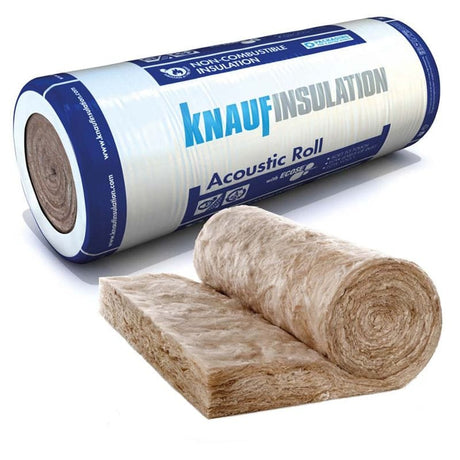
Knauf Acoustic Roll is the glass mineral wool quilt most trades reach for when a stud partition, a ceiling or a timber floor needs to be quieter. It friction fits between studs and joists, fills the cavity that would otherwise carry sound straight through, and does it without adding anything combustible to the build-up.
Insulation UK stocks it in four thicknesses: 25mm, 50mm, 75mm and 100mm. Every thickness is supplied ready-cut into 600mm strips for standard stud and joist centres, and every thickness shares the same core specification: Euroclass A1 reaction to fire, a declared thermal conductivity of 0.035 W/mK, a manufactured density above 10 kg/m³, and Knauf's ECOSE Technology binder with no added formaldehyde or phenol.
This guide sets out the full range, what separates each thickness, how the product maps onto the Building Regulations for sound, and what acoustic quilt can and cannot do once it is in the wall.
The range at a glance
| Thickness | Roll format | Coverage per pack | Thermal resistance | Best fit |
|---|---|---|---|---|
| 25mm | 4 x 600mm strips, 11.1m long | 26.64m² | 0.70 m²K/W | Slim partitions and the minimum absorbent layer named for internal wall type B |
| 50mm | 2 x 600mm strips, 13.5m long | 16.20m² | 1.40 m²K/W | Standard stud partitions and separating walls |
| 75mm | 2 x 600mm strips, 14.5m long | 17.40m² | 2.10 m²K/W | Deeper studs, and walls doing an acoustic and thermal job together |
| 100mm | 2 x 600mm strips, 10.3m long | 12.36m² | 2.85 m²K/W | Intermediate timber floors and ceilings, and the thickness named for internal floor type C |
Coverage runs the opposite way to thickness, which catches people out when they are pricing a job. The 25mm pack covers 26.64m², more than double the 12.36m² you get from a 100mm pack. Read the m² figure, not the number of rolls.
Which thickness do you need?
Two of the four thicknesses map directly onto constructions named in Approved Document E, which makes the choice simpler than it looks. Here is where each one earns its place.

The thin option, and the one with the regulatory hook. 25mm is the minimum absorbent layer thickness named for internal wall type B in Approved Document E, so it is the entry point for a compliant internal partition where the stud depth is tight or the cavity is already busy with services. It also stretches furthest, around 11m of wall run at a 2.4m ceiling height, which makes it the sensible choice when there are a lot of internal walls to get through.
View 25mm Acoustic RollThe default for standard timber and metal stud partitions. In a 70mm to 100mm frame, 50mm fills a useful share of the cavity while staying easy to friction fit and easy to work around services. If you are building bedroom, bathroom and home office walls in a house or a flat and want one thickness to cover the lot, this is usually it. The 1.40 m²K/W comes as a bonus between heated and unheated rooms.
View 50mm Acoustic RollFor deeper frames, and for walls asked to do two jobs. Where the stud depth allows it, more quilt in the cavity means more absorption, and 2.10 m²K/W is enough to make a real difference across a wall between a heated room and a cold garage, utility or store. Coverage holds up well too, at 17.40m² a pack, more than the 100mm gives you.
View 75mm Acoustic RollThe floor and ceiling thickness. Approved Document E's internal floor type C names an absorbent layer of mineral wool at least 100mm thick, at least 10 kg/m³, laid in the joist cavity, which puts this roll exactly on the mark for a compliant intermediate timber floor. It is also the one to reach for between a first floor bedroom and a living room below, or above a room being turned into an office or a music room.
View 100mm Acoustic RollWhy Knauf Acoustic Roll stands out
Acoustic quilt is a competitive category and most products in it look similar on paper. Three things separate this one.
The first is that it is non-combustible. Glass mineral wool carries a Euroclass A1 reaction to fire classification, the highest there is, so putting it in a partition adds acoustic performance without adding fuel. On a domestic partition that matters less; on a flat, an HMO or a commercial fit-out it matters a great deal.
The second is the cut. Every thickness arrives as 600mm-wide strips, sized for friction fitting between studs and joists at 600mm centres, so on a standard frame it goes in without measuring or trimming. Knauf also states the product is designed for friction fitting at 400mm centres.
The third is that Knauf has tested it with all major brands of plasterboard, and states it is suitable for use with a range of Robust Details registered timber separating wall and floor constructions, which reduces the need for on-site acoustic testing. For anyone building to Robust Details rather than pre-completion testing, that is worth checking against the current handbook before specifying.
How acoustic quilt actually works, and what it is not
An empty stud partition is two boards with an air gap between them. Sound passes into the first board, across the cavity and out through the second. Filling that cavity with mineral wool absorbs sound energy inside it and damps the resonance between the two linings, so less noise comes out the other side.
The acoustic performance belongs to the construction, not to the quilt. Knauf's Declaration of Performance for Acoustic Roll declares no value for sound absorption, airflow resistivity or dynamic stiffness, so there is no dB rating that belongs to the roll on its own. A decibel figure only means something when it describes a complete build-up: stud size, lining type and mass, fixings, seals and the insulation together.
That is not a weakness in the product. It is how sound insulation works. It does mean that if a competitor page quotes you a dB figure for a roll of quilt, treat it carefully and ask what construction that number came from.
Where each thickness sits in Approved Document E
This is where the range gets genuinely useful, because two of the four thicknesses line up exactly with constructions named in the guidance.
Approved Document E (Resistance to the passage of sound) applies in England and to excepted energy buildings in Wales. The current version remains the 2003 edition incorporating the 2004, 2010, 2013 and 2015 amendments.
Internal wall type B is a timber or metal framed partition with plasterboard linings both sides and an absorbent layer in the cavity. The guidance calls for an absorbent layer of unfaced mineral wool at least 25mm thick and at least 10 kg/m³ in density, suspended in the cavity, alongside minimum requirements for the linings, the frame depth and the sealing of joints. 25mm Knauf Acoustic Roll meets that thickness at a manufactured density above 10 kg/m³.
Internal floor type C is a timber or metal joist floor with a wood-based board above, a plasterboard ceiling below and an absorbent layer in the cavity. That layer is specified as mineral wool at least 100mm thick and at least 10 kg/m³ in density, laid in the cavity. That is the 100mm roll.
The performance standard those constructions are aiming at, for internal walls and floors within a dwelling, is a minimum of 40 dB Rw airborne sound insulation. Those are laboratory values, and no site testing is required for internal walls and floors within a dwelling, which is a reassuring point if you are a self-builder or a small contractor. Note the exclusions: the requirement does not apply to an internal wall containing a door, to a wall separating an en-suite from its associated bedroom, or to existing walls and floors in a material change of use.
Separating walls and floors between dwellings are a different job and a higher bar: 45 dB DnT,w + Ctr airborne for new build, 62 dB L'nT,w for impact on separating floors, relaxed to 43 dB and 64 dB respectively for a material change of use. Those constructions are tested on site, and the quilt is one component of a specified system rather than the solution on its own.
Outside England, the equivalent guidance is Section 5 of the Technical Handbooks in Scotland, Technical Booklet G in Northern Ireland and Technical Guidance Document E in the Republic of Ireland. For schools, Building Bulletin 93 applies, and for healthcare, Health Technical Memorandum 08-01. Always work to the specification for the building and the jurisdiction rather than to a thickness alone.
All four thicknesses in stock, with trade pricing and pallet quantities on every one.
Shop Knauf Acoustic RollThermal performance: the second job it does
Acoustic Roll is bought for sound, but it is still mineral wool, so it insulates. All four thicknesses share a declared thermal conductivity of 0.035 W/mK, giving thermal resistance of 0.70 m²K/W at 25mm, 1.40 at 50mm, 2.10 at 75mm and 2.85 m²K/W at 100mm.
That is worth having in an internal partition, where it slows heat moving between rooms and helps with zoned or intermittent heating, and it is worth having in an intermediate floor for the same reason. What it is not is a substitute for dedicated thermal insulation in an external wall, a roof or a ground floor, where the U-value target is set by Approved Document L and needs a full build-up calculation. Thermal resistance is a property of the material. A U-value is a property of the whole element, and the two are not interchangeable.
Fire performance
All four thicknesses are classified Euroclass A1, the top reaction to fire classification, meaning the material makes no contribution to a fire. Knauf also states the product contains no ozone-depleting substances or greenhouse gases.
Keep the distinction clear when you are specifying. Reaction to fire (Euroclass A1) describes how the material itself behaves. Fire resistance, measured in minutes, is a property of the completed wall or floor and comes from the lining specification, the fixings and the detailing as much as the insulation. Filling a partition with A1 quilt does not on its own give that partition a fire rating, but it does mean nothing inside the cavity is adding to the fire load.
Installation
Acoustic Roll is a friction fit product, which makes it fast to install if the frame is right and disappointing if it is not.
- Cut the strips slightly wider than the gap so they hold themselves in place. Compressed hard or left slack, the quilt loses contact with the studs and gaps open up.
- Fill the full cavity depth and full stud height. Sound finds gaps in the same way draughts do, and a missed section at the head or sole plate undoes the work of a whole wall.
- Do not leave services, sockets or back boxes back-to-back across a partition. Stagger them, and pack around them.
- Seal the perimeter of the linings. Approved Document E's constructions rely on well sealed joints, and an unsealed junction is a direct sound path.
- The stocked range is cut for 600mm centres. On a 400mm frame, trim the strips to width on site, or call the team and we will look at what else Knauf produces in the range.
One planning point for pricing a job: at a 2.4m stud height, a single pack covers roughly 11m of wall run at 25mm, 6.7m at 50mm, 7.2m at 75mm and 5.1m at 100mm. Those figures are calculated from pack coverage and assume no waste, so allow for cuts.
Sustainability and certification
Knauf glass mineral wool is made with up to 80% recycled content, including glass recovered from windows, bottles and jars, and bound with ECOSE Technology, a plant-based binder with no added formaldehyde or phenol. The product holds a Eurofins Gold Certificate for Indoor Air Comfort and a Declare Red List Free declaration, the fibres are EUCEB certified and meet the Note Q exoneration criteria, and Knauf holds BES 6001 v4.0 Very Good responsible sourcing certification across all three of its plants.
The product is manufactured to BS EN 13162:2012+A1:2015, covered by Declaration of Performance G4209LSCPR and EPD S-P-10428, with a declared thickness tolerance of T1 and a vapour resistivity of 5.00 MNs/g.m. It is odourless, rot proof and non-hygroscopic, will not sustain vermin or support fungi, mould or bacteria, and has a life equivalent to that of the structure.
| Thickness | Knauf code | Packs per pallet | Pallet coverage | Global warming potential, cradle to grave (A1–C4) |
|---|---|---|---|---|
| 25mm | 715838 | 24 | 639.36m² | 0.49 kgCO2e/m² |
| 50mm | 715837 | 24 | 388.80m² | 0.81 kgCO2e/m² |
| 75mm | 715841 | 24 | 417.60m² | 0.86 kgCO2e/m² |
| 100mm | 715843 | 24 | 296.64m² | 1.15 kgCO2e/m² |
Product stage figures (A1–A3) run from 0.36 kgCO2e/m² at 25mm to 0.86 kgCO2e/m² at 100mm. If you are working to an embodied carbon target as well as an acoustic one, that is the number your assessor will want.
What acoustic quilt will fix, and what it will not
Quilt in a cavity deals with airborne sound: voices, television, music, traffic through a partition. It does very little on its own for impact sound, the thump of footsteps or a dropped weight on the floor above, which travels through the structure itself and needs resilient layers, floating floors or isolation details to control.
It also does nothing about flanking. If sound is travelling around your new partition through a continuous floor screed, a shared ceiling void or a lightweight junction with the external wall, insulating the wall cavity will not stop it. Look at the junctions before you look at the insulation.
Where it is worth doing, it is worth doing at first fix. Knauf makes the point that it can cost as little as £30 extra to turn a typical three-bed semi into a genuinely family-ready home by adding acoustic mineral wool to an internal partition, and puts the cost of noise pollution across Europe at £24 billion a year in lost productivity, health costs and impaired learning. On a 10m² partition, a few pounds a square metre at the plasterboarding stage is a fraction of what it costs to open a finished wall back up.
Any drawbacks?
Three, and none of them are dealbreakers if you know about them up front.
There is no declared acoustic figure for the product itself. Knauf's DoP records no performance determined for sound absorption, airflow resistivity and dynamic stiffness, so you cannot specify to a dB number from the roll alone. In practice you specify the construction, and the quilt is one part of it.
It is bulky. Glass mineral wool is light, but the packs take up space on a small site, and there is no compressing them back down once opened. Order to the m² you need rather than to a round number of packs.
The stocked range is cut for 600mm centres. On a 400mm frame you will be trimming strips, which costs time and creates offcuts. Worth factoring into the order quantity.
One specification note: mineral wool quilt is vapour open, with a vapour resistivity of 5.00 MNs/g.m. In build-ups where a vapour control layer is required, that comes from a separate membrane or from the lining specification, not from the quilt.
Our expert verdict
Knauf Acoustic Roll is a straightforward, well documented product doing a job that gets overlooked until the plasterboard is on and the house is occupied. What makes the range easy to specify is how cleanly it maps onto the guidance: 25mm is the minimum absorbent layer named for internal wall type B, 100mm is the thickness named for internal floor type C, and 50mm and 75mm fill the ground between for standard and deeper stud partitions.
Add Euroclass A1 non-combustibility, a genuinely strong sustainability position in ECOSE binder and up to 80% recycled glass, and a 600mm cut that friction fits a standard frame without measuring, and there is not much to argue with. Just keep the expectations honest: it is an airborne sound product, the performance belongs to the build-up, and the junctions matter as much as the cavity.
Shop the full Knauf Acoustic Roll range at Insulation UK in 25mm, 50mm, 75mm and 100mm, with trade pricing and pallet quantities available on every thickness. If you are not sure which thickness your wall or floor build-up needs, call the team on 03003 034 578 and we will talk it through.
Shop Knauf Acoustic Roll