That confusion costs money. Plenty of soil stacks in flats have been wrapped in foam by someone hoping it would quieten them, and it does not, because the material was never designed to. This guide explains what lagging is, how the acoustic type actually works, how to read the performance figures without being misled, and how to tell whether your project needs it.
The Two Jobs Lagging Does
Thermal Lagging
The original meaning. A sleeve or wrap fitted to pipework to slow heat transfer: keeping hot water hot on its way to the tap, protecting pipes in cold roof spaces and unheated voids from freezing, and controlling condensation on cold surfaces.
Products: foam sleeves, mineral wool sections and foil-faced wraps.
The performance measure is thermal conductivity, and thickness is the main lever.
Acoustic Lagging
A different product doing a different job: reducing the noise that radiates out of a pipe or duct into the room around it. Soil stack flow noise, waste discharge, duct breakout, pump and plant noise.
Products: composite barrier and quilt wraps.
The performance measure is sound reduction in decibels, and mass, not thickness, is the main lever.
The two overlap slightly. An acoustic pipe lagging built around a glass mineral wool core will do some incidental thermal and anti-condensation duty, because that is what the core material does. That is a side effect, not a specification, and it should not be the reason you buy it.
Thermal lagging does not solve a noise problem. Standard foam pipe insulation can help with temperature control and will soften some light contact noise, but it lacks the mass needed to resist airborne pipe noise in any meaningful way. A thin foam sleeve weighs almost nothing. A dedicated acoustic lagging carries a barrier layer at around 5 kg per square metre, plus a decoupling layer to make that mass work. Different product, different physics.
How Acoustic Lagging Works
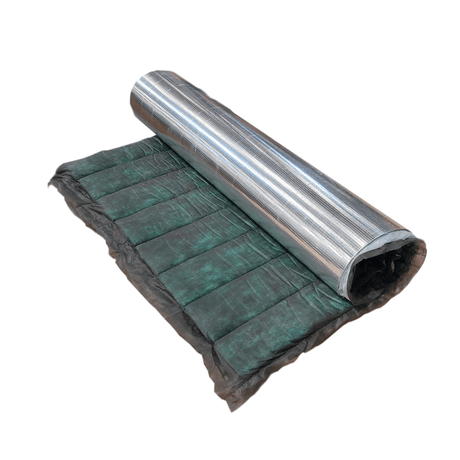
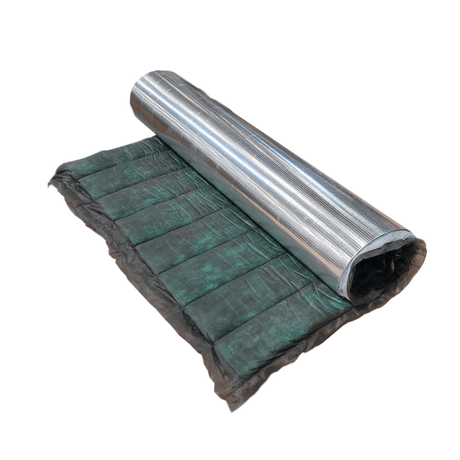
A proper acoustic lagging is a composite, usually three layers, and it works as what acousticians call a mass-spring-mass system. Each layer has a specific job and the product only performs if all three are doing it.
A high-density flexible polymeric sheet, typically 5 kg/m². It blocks airborne sound by sheer weight, following the mass law: roughly speaking, every doubling of mass buys you about another 6 dB. It has to stay limp and unconstrained to work, which is why it is a flexible sheet rather than a rigid board. Pin it down or stiffen it and you lose performance.
A layer of glass mineral wool, commonly 25mm or 50mm at around 24 to 25 kg/m³, usually with a stitched non-woven backing. It does two things. It decouples the barrier from the pipe, so vibration cannot travel straight through the mass layer and short-circuit it. And it absorbs sound energy inside the cavity it creates.
A reinforced foil with a glass scrim backer, providing the durable outer surface, the vapour barrier and the fire facing. It is also the finish, since lagging is normally left exposed in risers, plant rooms and service voids.
Without the quilt, the barrier is just a heavy sheet stuck to a vibrating pipe, and it performs far worse than its mass would suggest. Quilted side against the pipe, foil facing outwards. Fitted the wrong way round, you have removed the decoupler and given away most of what you paid for.
Reading the Decibel Figures Without Being Misled
This is where the category goes wrong, and it is worth slowing down for.
You will see three different numbers on acoustic lagging pages, all quoted in dB, all describing different things. Taking a typical 5 kg/m² barrier with a 25mm glass core, at 1 kHz:
| Figure | What it actually measures | Value |
|---|---|---|
| Barrier alone, Rw | The mass layer on its own, to BS EN ISO 717-1 | 27 dB |
| The product, tested to BS EN 10140-2:2010 | Barrier plus quilt, independently tested | 27.1 dB |
| Guide figure on a steel duct | Barrier plus quilt plus a 0.75mm galvanised duct wall | 43 dB |
That 43 dB is not a false number, but it is not the product's performance. It is the performance of a duct that has been lagged, and a large share of it comes from the steel. Wrap the same product around a 110mm plastic soil pipe, which has a fraction of the mass and stiffness of a galvanised duct, and the result will sit far closer to the tested product figure than the duct figure.
Manufacturers generally say as much themselves in the small print: real performance is a complex subject that must be calculated by an acoustician job by job, taking account of shape, internal size, steel thickness, air or gas movement inside the duct and the surrounding environment, and calculations on ducting tend to produce results at or below the published guidance figures.
Find the figure that was independently tested on the lagging itself, to BS EN 10140-2 or equivalent, and compare like with like. If a retailer only publishes the lagged-duct guide table, you are not looking at the product's performance, and you cannot use it to compare one product against another.
25mm or 50mm Core: Which Thickness
More thickness is not simply more performance, and the difference is not where most people assume.
Comparing like for like on the guide data, the 50mm core is meaningfully better through the 250 Hz to 500 Hz band, worth roughly 6 to 9 dB. Above that it is marginal, a couple of decibels at most. And at 125 Hz it is actually slightly worse than the 25mm, which is a genuine and explainable effect rather than a data error: deepening the cavity moves the mass-spring-mass resonance dip down in frequency, so the dip lands where the thinner build-up was still performing.
What that means in practice:
- Soil stacks in flats, conversions and HMOs. Most soil stack flow noise and most duct breakout sits between 250 Hz and 1 kHz. That is exactly where the thicker core earns its premium, so it is usually the one worth paying for.
- General duct runs, risers and lighter waste pipework. The thinner build-up does the bulk of the work at a lower cost per square metre and takes up less space in a boxing.
- Deep low-frequency rumble from plant or pumps. Neither thickness is the answer on its own. That is a job for damping treatment applied to the duct or plant before lagging, and often for isolating the source, not for wrapping harder.
Where Lagging Goes, and How Much You Need
Typical Applications
- Soil and vent pipes, and waste pipes, particularly in flats, conversions and HMOs
- Rainwater pipes running internally
- HVAC ductwork where breakout noise is a problem
- Plant rooms, risers, service voids and ceiling voids
- Enclosures around pumps and machinery
- Any pipe running through, beside or above a bedroom or other habitable room
Working Out Quantities
Acoustic lagging is sold by the sheet and by area, but you almost certainly know your job in linear metres of pipe. The conversion is straightforward.
Mean wrap circumference is π × (pipe outside diameter + lagging thickness), plus around 50mm for the overlap. Divide the sheet's 2m dimension by that to get the number of strips, then multiply by the 1.2m dimension for linear metres of pipe covered.
From a standard 2m x 1.2m sheet covering 2.4m²:
| Pipe and lagging | Approximate coverage per sheet |
|---|---|
| 110mm soil pipe, 25mm core | Around 4.8 linear metres |
| 110mm soil pipe, 50mm core | Around 3.6 linear metres |
| 50mm waste pipe, 25mm core | Around 7.2 linear metres |
Treat those as a planning guide rather than a cutting list. Real yield drops once you are cutting around bends, branches and access points, so allow a margin.
Five Installation Points That Decide Whether It Works
Acoustic lagging is unusually sensitive to how it goes on. Get any of these wrong and the tested performance stops applying.
Reversing it removes the decoupler and most of the benefit.
Sound takes the easiest path, so a small unlagged area dominates the result out of all proportion to its size. Bends, junctions, branches and access points all need wrapping.
Cut to fit neatly with overlaps on all joins and tape every seam. The technique that matters is stripping the quilt back at the overlap so barrier meets barrier: a foil tape seals the facing but adds no mass across a butt joint, and mass is what is doing the work. A polymeric joint tape carrying the same barrier weight is the correct detail where the specification calls for it. See our acoustic tapes range.
Cable ties or banding pulled tight crush the quilt and short-circuit the decoupling. Snug, not tight.
Lagging deals with radiated noise. It does nothing about structure-borne transmission through rigid clips and brackets. Use flexible pipe clips with rubber isolation bushes, avoid rigid connections between the pipe and the boxing frame, and keep the facing panel clear of the pipe.
So Do You Need It?
Yes, in most cases- Soil stacks passing through or beside separating walls and floors between dwellings. A stack in that position is a flanking path, and an untreated one can sink a pre-completion acoustic test.
- New build flats, conversions and HMOs generally, where Approved Document E sets the framework. Part E1 covers sound between dwellings, Part E2 covers sound within a dwelling, including between a room containing a WC and other rooms, and separating walls and floors in new build flats must achieve a minimum of 45 dB DnT,w + Ctr for airborne sound.
- Stacks and waste runs boxed into or passing through bedrooms.
- Ductwork with a breakout problem, and plant rooms adjoining occupied space.
- Single dwellings where a stack runs through a bedroom wall or above a bedroom ceiling. No regulation obliges you, but it is a cheap fix at first fix and an expensive one afterwards.
- Home offices, studios and any room where background noise matters more than usual.
- Refurbishments where the boxing is already coming off and access is free.
- External stacks, unless noise ingress is a specific complaint. Standard foil facings are an internal finish in any case, and external work needs a UV-stable grade.
- Cold water and heating pipework where the concern is heat loss or frost, which is a thermal lagging job.
- Short waste runs within a single room, with no separating element involved.
Approved Document E does not set a numerical target for pipe noise itself. Standard on-site airborne and impact tests measure the performance of the whole room and do not test the stack in use, so a design or installation error can be missed entirely. Lagging is not "required by Part E" in a direct sense. It is specified because an untreated stack can pull a room's result down, and because occupants complain. BS 8233:2014 is the relevant guidance for internal noise levels, and Robust Details is the alternative compliance route to pre-completion testing.
Four Claims to Treat Carefully
- "Soundproof pipe lagging." Nothing is soundproof. Acoustic lagging reduces radiated noise substantially. It does not address structure-borne transmission through clips and brackets, and it will not rescue a badly designed stack.
- "43 dB reduction." Check what that figure was measured on. If it came from a lagged galvanised duct, it is not what you will get on a plastic soil pipe.
- "Foam lagging will quieten the pipes." It will not, in any meaningful way. Without mass there is nothing to block airborne sound.
- "Class 0 fire rated." Class 0 is a legacy national classification. National reaction to fire tests and classifications under BS 476 were withdrawn fully from Approved Document B on 2 March 2025, and only BS EN 13501 classifications are now accepted in England. Plenty of lagging products, including specialist ones, still carry Class 0 on the datasheet. If your project needs a Euroclass, ask for the BS EN 13501-1 classification for the composite product rather than for one of its layers, and if nobody can produce one, treat that as the answer.
What We Stock
Two build-ups of the same composite, sharing the same barrier and differing only in the depth of the quilt behind it. The sheet figures below are the total build-up, so the 26mm sheet is the thinner core option discussed above and the 53mm is the thicker.
- Barrier
- 5 kg/m²
- Sheet
- 2m x 1.2m
- Coverage
- 2.4m²
- Barrier
- 5 kg/m²
- Sheet
- 2m x 1.2m
- Coverage
- 2.4m²
No single decibel figure is shown against either product, for the reason set out above: the number that matters depends on what the lagging is wrapped around, and a headline dB taken from a galvanised duct tells you nothing useful about a plastic soil pipe. Ask us for the independently tested figure to BS EN 10140-2 and we will send it, along with the guide data for your actual pipe or duct.
Getting the Specification Right
Lagging is a low-cost item that either performs or does not, depending on the product, the orientation, the joints and what the boxing is touching. If you have a stack detail, a specification or an acoustic report, send it over and the team will tell you which build-up suits it, how much you need in linear metres, and which tapes and fixings keep the barrier continuous.