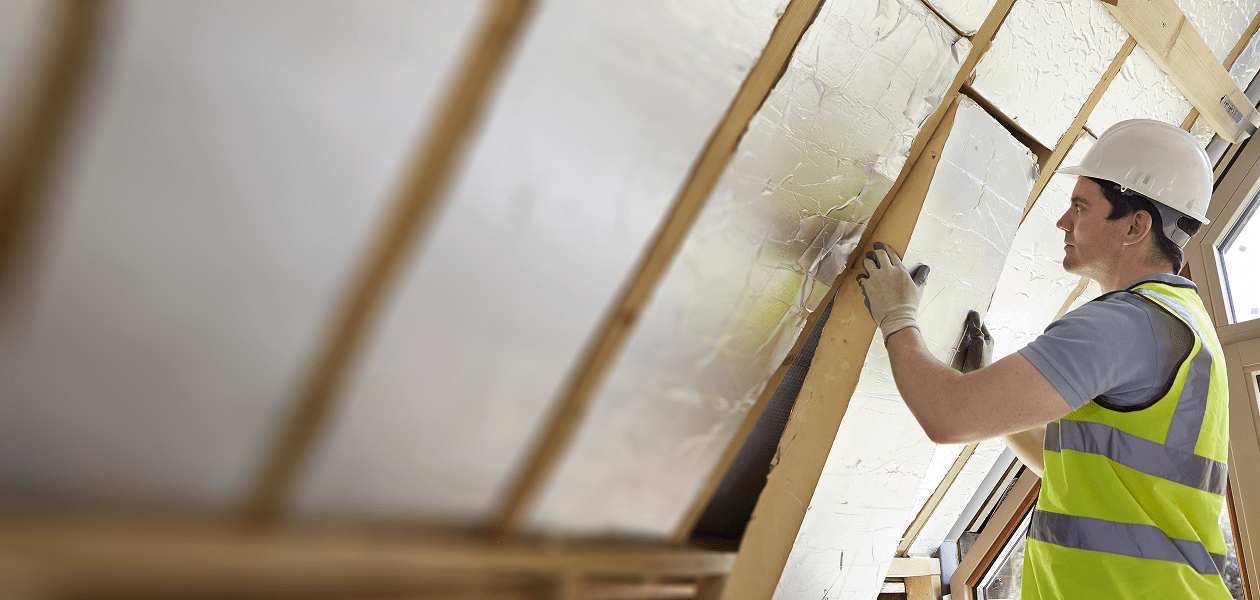
This guide covers what each type actually is, where it belongs, and how to read the performance figures so you are comparing like with like.
How Reflective Insulation Works
Heat moves three ways: conduction through solid material, convection through moving air, and radiation across space.
Conventional insulation targets the first two. It traps still air in a fibre or foam structure so heat has to fight its way through.
Foil targets the third. Aluminium has very low emissivity, meaning it radiates very little heat away from its surface, and reflects most of what arrives. Emissivity figures for the products in this category typically sit between 0.03 and 0.16, against roughly 0.9 for a plasterboard or timber surface.
A reflective surface only does anything if it faces an air gap. Press foil hard against plasterboard and the low emissivity is irrelevant, because radiation is no longer the mechanism moving heat across that junction. Conduction is, and a sheet of foil is a poor conductive barrier.
With one exception covered further down, every product in this guide needs an unventilated cavity next to its reflective face. The cavity is not an installation detail. It is part of the product.
Bubble Foil Insulation
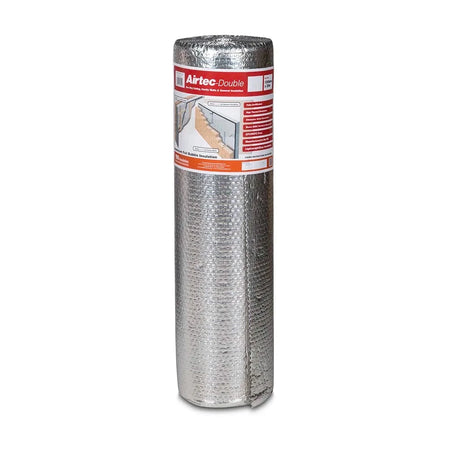
- What it is: a polyethylene air bubble membrane laminated with reflective foil on one or both faces, typically 3mm to 4mm thick. The bubbles trap air, the foil faces create low emissivity surfaces facing adjacent cavities.
- What it does well: it is the cheapest reflective product per square metre, arrives in a manageable roll, cuts with scissors and needs no PPE. Fully taped it also gives you an airtight vapour control layer, which in a draughty outbuilding is often worth more than the thermal figure.
- Where it belongs: garages, sheds, workshops, conservatory roofs, agricultural buildings, campervans and motorhomes, behind radiators, and as a supplementary layer over or under something else. Browse the full range of bubble foil insulation.
- Where it does not: any element you need to sign off against Approved Document L. Core thermal resistance on a bubble product is a fraction of a m²K/W. Manufacturers publish considerably higher installed figures, and those figures are real, but they include the air cavities either side. On its own, in a habitable room, this is not a Part L solution and no reputable supplier should tell you otherwise.
One practical warning: roll widths vary between 1.05m and 1.5m across the market at similar headline prices. Check the coverage in m², not the price of the roll.
Multifoil Insulation
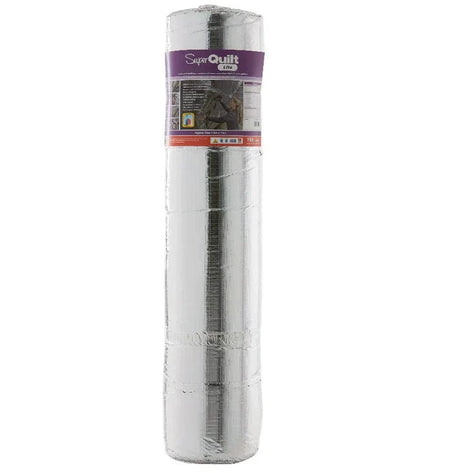
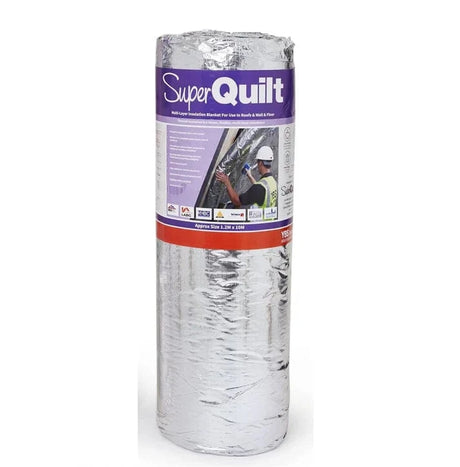
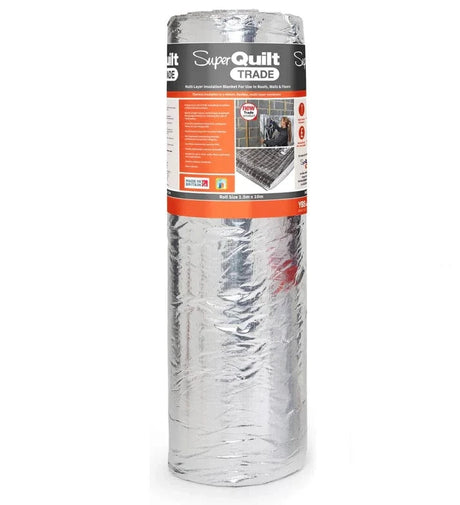
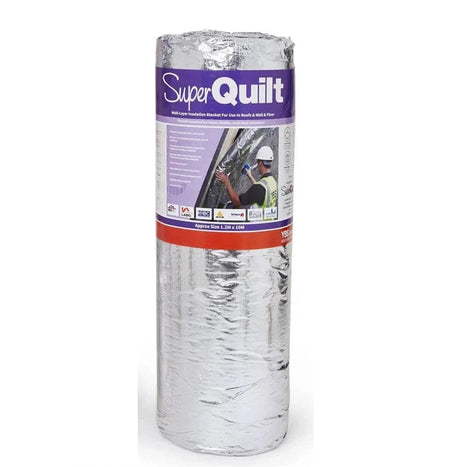
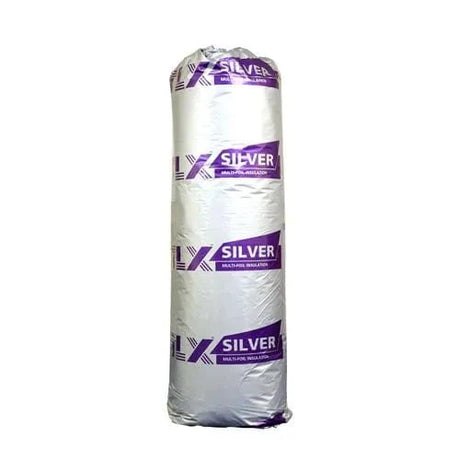
What it is: multiple layers of reflective foil interleaved with wadding, foam or film, welded into a quilt. Thicknesses in the UK market run from roughly 30mm to 40mm, with anywhere from seven to nineteen layers depending on the product. Browse our full multifoil range.
Unlike bubble foil, multifoil works against all three heat transfer mechanisms at once. The outer reflective layers deal with radiation, the fibrous core resists conduction and convection. Most are a vapour control layer in their own right once taped and sealed.
There are two sub-types, and confusing them causes real problems.
Vapour Closed Multifoil
Very high vapour resistance, often a resistance factor in the hundreds of thousands.
Where it goes: under rafters, between and over studs, in floors, on dormer cheeks and dwarf walls.
Fitting a vapour closed quilt on the cold side of a construction traps moisture in the build up. It is the single most damaging thing you can do with one of these products.
Breathable Multifoil
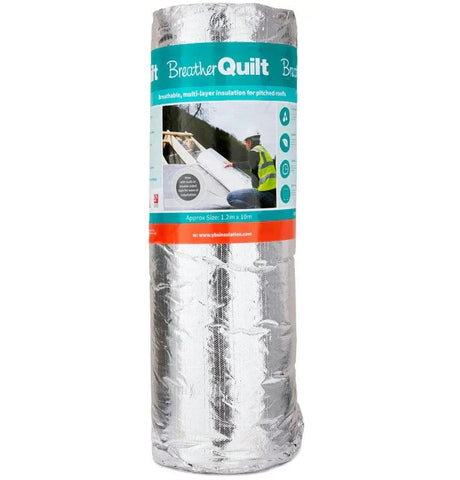
Also called insulating breather membranes. A breather membrane outer layer with perforated reflective layers inside, so moisture can pass from inside to out.
Where it goes: over the rafters, replacing a standard breather membrane and doing two jobs in one pass.
This is why they are popular on re-roofs. You are already lifting the tiles, and you get insulation and membrane for a single labour cost, without losing head height inside.
The better products in this group compress to a few millimetres under tile battens, which means you can drape them over rafters and batten straight on top rather than adding counter battens. Check the certificate before assuming yours does. Some need counter battening, and some specify a minimum rafter depth when draped.
Orientation matters on these. Where a product has a distinct reflective face it will be certified to be installed one way round only.
Foil Backed Insulation
What it is: rigid or semi rigid insulation, usually PIR, phenolic or mineral wool, with a foil facing bonded to one or both faces. See the full foil backed range.
Here is the honest version, and it is worth saying plainly because the category name invites the wrong assumption: the foil is not the insulant. Effectively all of the thermal performance comes from the core. Take the same board with a paper or glass tissue facing and the lambda value barely moves.
The facing earns its place three other ways:
- Vapour control. It acts as a vapour control layer.
- Protection. It protects the core in handling and on site.
- Low emissivity. It provides a low emissivity surface to any adjacent unventilated cavity.
That third point has real value and it is properly recognised. Under BR 443, the conventions document behind UK U-value calculations, where a foil faced product sits next to an unventilated airspace of at least 25mm the airspace itself can be credited with additional thermal resistance in the calculation. That is a genuine gain, it just belongs in the cavity line of the calculation rather than in the board's R-value.
If you are shopping foil backed boards, compare them the way you would compare any rigid board: lambda value, thickness, compressive strength, fire classification. The facing is a specification detail, not the headline.
The R-Value Problem
This is where the category gets people into trouble. Three different numbers are all called R-value in this market, and they can differ by a factor of three for the same product.
| Figure | What it means |
|---|---|
| Core or declared R | The product on its own, tested to a recognised standard. This is the number on the certificate. |
| Installed or system R | The product plus the air cavities it creates in a specified build up. Always higher. |
| Equivalent to Xmm of mineral wool | The system figure translated into a thickness of a different material. A marketing device, not a test result. |
None of these are dishonest in themselves. The problem is quoting the third and calling it the first.
The BBA's conventions for reflective foil insulation are explicit about how this has to be handled in a real calculation, and the rules are stricter than the marketing suggests:
- Compression counts as zero. Where the product is compressed between battens and rafters or studs, its thickness is taken as zero unless the compressed thickness and matching R-value have been robustly determined under representative installed conditions. Compression is not a marginal effect. Published compressed R-values for some quilts drop to under a tenth of the uncompressed figure.
- Sag is assumed. For a product installed above or below rafters, a 30/70 split of the product's opening is assumed to account for sag under gravity. In a wall, a 50/50 split.
- These are requirements, not guidance. The conventions are mandatory for calculations under the BBA and TIMSA U-value competency scheme.
One manufacturer in this market states openly that it quotes worst case R-values and declines to add air gap resistance into its headline figures, on the basis that doing so can mislead. That is the standard the whole category should be held to.
Ask for the certified core R-value and the certificate number. Then ask for the certified U-value build ups, which will state the cavity widths, the rafter depths and, in most cases, the additional rigid insulation required alongside. If a product page gives you a single "up to" number and nothing else, you do not have enough information to specify with.
This also explains why some building control officers push back on multifoil. The certificates are legitimate, but they carry installation conditions that are frequently not met on site. Meet the conditions and the numbers hold. That is the whole argument.
For context, the dispute goes back to the mid 1990s, when multifoil arrived in the UK and manufacturers argued that in situ testing reflected real world performance better than the hot box testing conventional insulation went through. It was settled by Government Circular 06/2009, which established that U-values must be calculated using standardised European Norms or tests forming part of a relevant European Technical Assessment. The category is legitimate and regulation compliant. It just has to be calculated properly.
The Four Things That Decide Whether It Works
Almost every underperforming foil installation fails on one of these.
Unventilated, on the reflective face, typically 25mm minimum and often achieved with battens or counter battens. Check the certificate for the specific figure. Removing the cavity does not reduce performance slightly, it removes the mechanism the product depends on.
Every vapour control and airtightness claim in this category is conditional on sealing laps, joints, perimeters and penetrations. Overlaps are usually specified at 50mm minimum with foil tape along the full joint length. An untaped quilt is not a VCL.
Where a product has a specified face, it is not optional.
Look at the certified U-value build ups for any multifoil aimed at habitable space and you will find additional rigid insulation in almost all of them, commonly 80mm of PIR or more. Foil earns its keep as part of a build up, not instead of one.
What Foil Genuinely Does Better
Set the disputed thermal claims aside and there is a solid case for these products.
- Space. This is the real reason most people buy multifoil. Thirty to forty millimetres doing work that would otherwise eat into head height. In a loft conversion with a tight ridge, that is often the difference between a habitable room and not.
- No fibres, no itch, no PPE. Foil quilts cut with a knife, do not shed irritant fibres and do not need a mask. If you are doing the work yourself over several weekends, that matters more than the spec sheet suggests.
- Recycled content. Recycled content in the leading multifoils runs from around 40% to over 80% depending on the product.
- Combined function. Insulation plus VCL, or insulation plus breather membrane, in a single pass. Fewer trades, fewer layers, fewer opportunities to get the sequencing wrong.
- Dimensional stability. No slumping or settling over time, unlike loft roll in an awkward space.
Claims to Be Sceptical Of
- "R-value up to X." Ask what is included. If it is a system figure, ask for the build up.
- "Reflects 95% of radiant heat." These percentages appear across the market with no consistent test behind them. Emissivity is the measurable property, and it is on the certificate.
- "Meets Part L." No insulation product meets Part L. Constructions do, and only after a calculation.
- "Non-combustible." Foil products are not. Reaction to fire classifications in this category typically sit between Class D and Class F to BS EN 13501-1. Note that combustible insulation is restricted in the external walls of buildings above 11 metres, which rules most of these products out of that application entirely.
- Certificate numbers copied between products. It happens more than it should, particularly between a flagship product and its lighter variant. If the certificate number on two different products is identical, check it.
Which One Do You Need
| Job | Product type |
|---|---|
| Garage, shed, workshop, conservatory roof | Bubble foil |
| Campervan, motorhome, horsebox | Bubble foil |
| Behind a radiator | Bubble foil |
| Under rafters in a loft conversion, working from inside | Vapour closed multifoil, plus rigid board |
| Over rafters on a re-roof, replacing the breather membrane | Breathable multifoil |
| Internal face of a timber frame or masonry wall | Vapour closed multifoil on battens, plus rigid board |
| Under screed or over a suspended floor | Underfloor specific foil, or foil backed board |
| Anywhere you need a certified U-value on its own | Rigid foil backed board |
If you are not sure which side of the vapour closed and breathable line your job falls on, that is the question to ask before you buy anything. Everything else can be worked around. That one cannot.
What We Stock
Grouped by the three categories above rather than by brand, since the category is the decision that matters.
- Roll
- 1.05m x 25m
- Coverage
- 26.25m²
- Thickness
- 40mm
- Layers
- 19
- R-value
- up to 3.00
- Thickness
- 40mm
- Layers
- 19
- R-value
- up to 2.84
- Thickness
- 32mm
- Layers
- 9
- R-value
- up to 2.11
- Thickness
- 30mm
- R-value
- 0.91
- Coverage
- 12m²
- Thickness
- 40mm
- Layers
- 11
- R-value
- 1.62
- Thickness
- 33mm
- R-value
- 0.85
- Coverage
- 12m²
R-values above are as published by each manufacturer and are deliberately shown side by side rather than ranked. They are not directly comparable: some are single certified figures and some are quoted as "up to". Read the section above before treating any of them as a specification, and ask us for the certified U-value build up for the construction you are actually working on.
Get the Right Foil for the Job
Bubble foil, multifoil and foil backed board all in stock for fast UK delivery. If you are not certain which one your build up needs, tell us the construction and we will tell you.