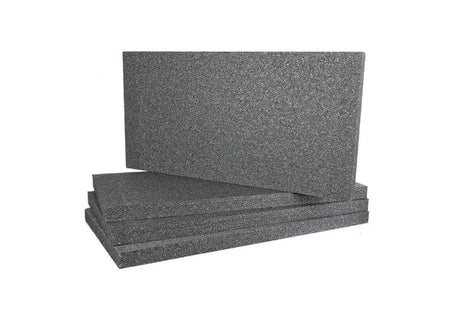
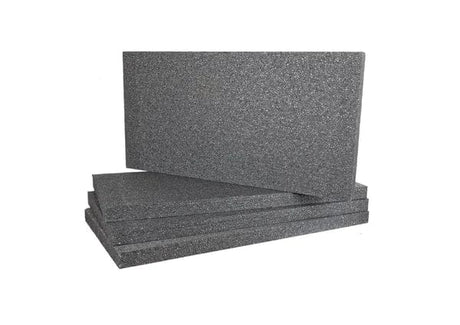
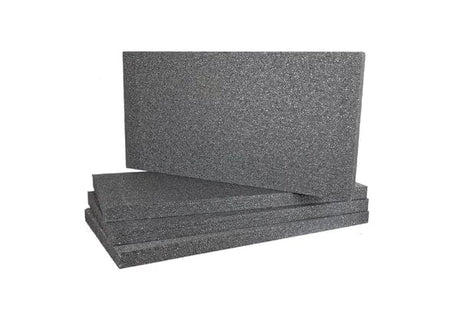
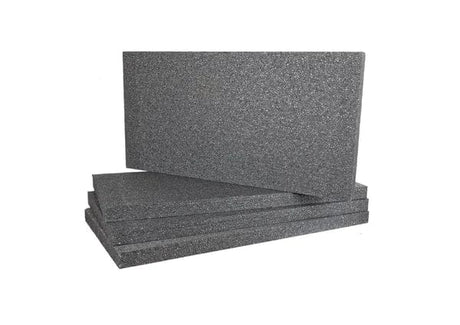
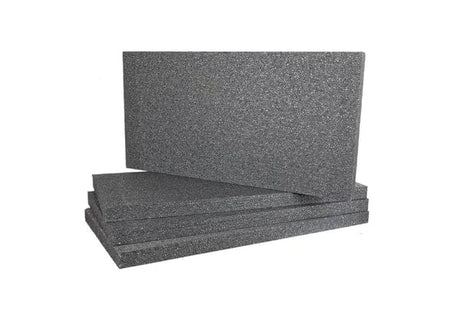
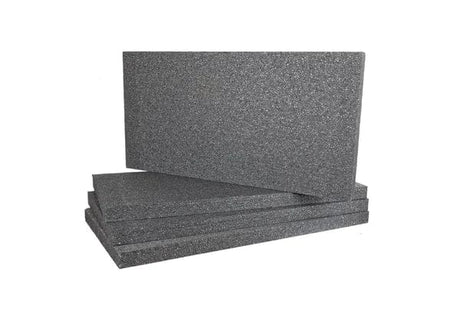
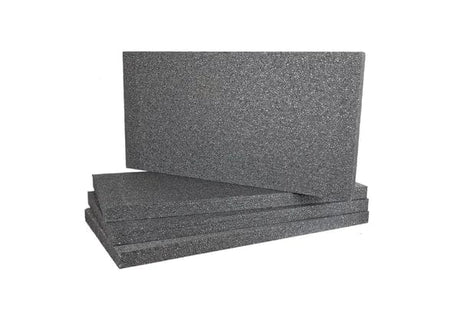
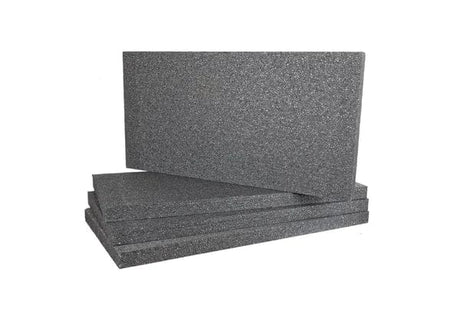
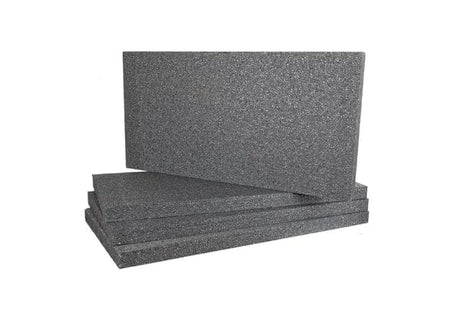
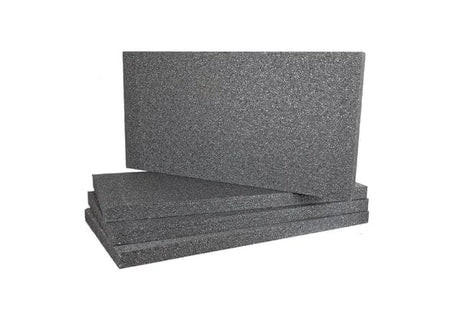
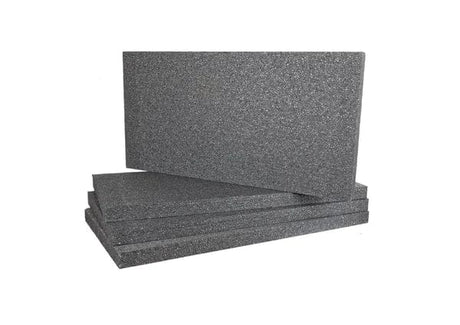
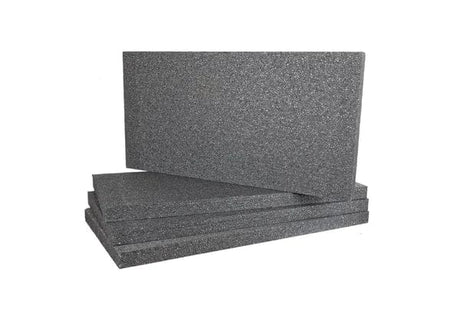
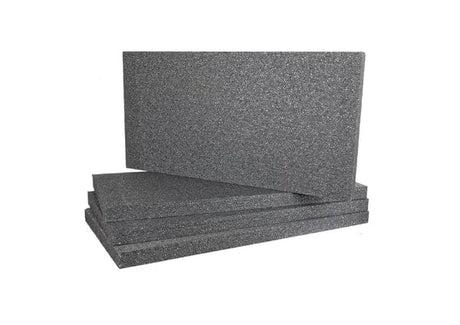
External wall insulation earns its keep on solid-wall homes, and the board doing the work behind the render sets how well the whole system performs. SPI Stylite PlusTherm is a graphite-enhanced expanded polystyrene (EPS) board built for exactly that job: a fixed thermal conductivity of 0.030 W/mK that pulls ahead of standard white EPS, so a thinner board reaches the same thermal resistance.
Insulation UK stocks the range in full, from 20mm through to 150mm, all in the 1200mm x 600mm board. Every thickness shares the same graphite-enhanced core: what changes is the thermal resistance, the pack quantity and the coverage.
This guide sets out the full range, the pack sizes and coverage for each board, how it performs on thermal resistance, fire and sustainability, and how to choose the right thickness for the job.
The EPS external wall insulation range at a glance
Every thickness shares the same graphite-enhanced EPS core: thermal conductivity 0.030 W/mK, compressive strength 70 kPa (PlusTherm 70 grade) and reaction to fire Euroclass E. The figures that change with thickness are thermal resistance, pack quantity and coverage.
| Thickness | R-value* (m²K/W) | Boards per pack | Coverage per pack (m²) |
|---|---|---|---|
| 20mm | 0.65 | 60 | 43.20 |
| 30mm | 1.00 | 40 | 28.80 |
| 40mm | 1.30 | 30 | 21.60 |
| 50mm | 1.65 | 24 | 17.28 |
| 60mm | 2.00 | 20 | 14.40 |
| 70mm | 2.30 | 17 | 12.24 |
| 75mm | 2.50 | 16 | 11.52 |
| 80mm | 2.65 | 15 | 10.80 |
| 90mm | 3.00 | 13 | 9.36 |
| 100mm | 3.30 | 12 | 8.64 |
| 120mm | 4.00 | 10 | 7.20 |
| 150mm | 5.00 | 8 | 5.76 |
*R-values are calculated from the declared thermal conductivity of 0.030 W/mK and rounded down to the nearest 0.05 m²K/W. Per-thickness R-values and board weight are not declared on the current datasheet: confirm the figures, along with the reaction-to-fire class, on the Stylite EWI datasheet or Declaration of Performance before specifying.
What makes graphite EPS different
The difference comes down to the graphite. Standard white EPS sits around 0.038 W/mK; the graphite-enhanced core here brings that down to 0.030 W/mK. In practice a thinner board hits the thermal resistance a thicker white board would need, which keeps reveal depths and system build-up under control on a retrofit, where every extra millimetre of board depth shows up around windows and doors.
- Graphite-enhanced EPS at 0.030 W/mK, a step up on standard white EPS.
- Lightweight and easy to cut on site, with no specialist tools needed.
- Strong value per m²K/W against many rigid board alternatives.
- BRE Green Guide A+ rating, 100% recyclable, with a GWP of zero and no HFCs, CFCs or HCFCs.
- No reduction in thermal performance over the life of the board.
Thermal performance
Thermal conductivity is fixed at 0.030 W/mK across the range, so thermal resistance climbs steadily with thickness: from 0.65 m²K/W on the 20mm board up to 5.00 m²K/W on the 150mm. The thicker boards do the heavy lifting on solid-wall homes chasing a low U-value, while the slimmer boards suit topping up or detailing work.
Because the insulation goes on the outside face of the wall, the masonry stays within the warm side of the build-up. That keeps wall temperatures up and reduces the risk of surface condensation forming inside, which is one of the main reasons external wall insulation is chosen over internal systems on solid-wall properties. The U-value achieved always depends on the full wall construction, not the board alone, so check the figure across the complete build-up.
Reaction to fire is not fire resistance
This is the distinction worth getting right. The boards are a fire-retardant grade EPS with a reaction to fire of Euroclass E to BS EN 13501-1. Reaction to fire describes how the board itself behaves when exposed to flame; it is not the same as fire resistance, which is a property of the finished wall build-up, measured in minutes, rather than of any single board.
EPS is a combustible material, so it must sit within a tested render system and be specified in line with the project fire strategy and Building Regulations. The board is suitable for wall applications up to 18m per the manufacturer; on taller buildings and certain building types, restrictions on combustible materials in external walls apply under Approved Document B, so always confirm compliance with the system provider and the project specification.
Where can you use it?
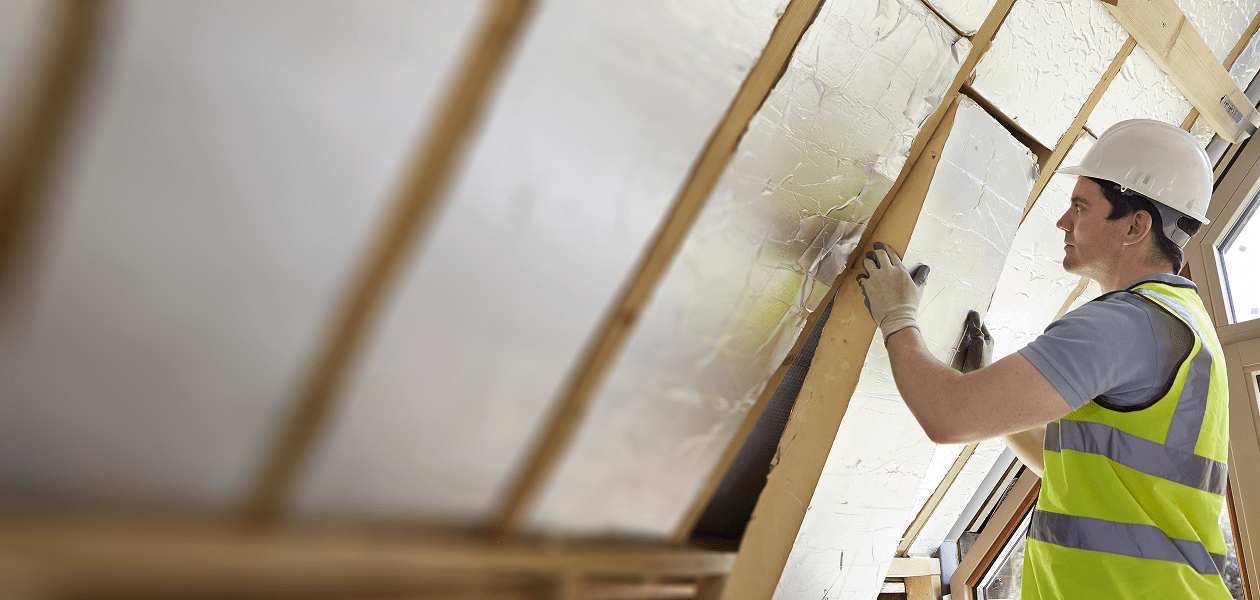
The boards are designed for use within external wall insulation systems, and work with both adhesive and mechanically fixed methods. They can be applied to solid brickwork, timber frame and steel frame construction, then finished with a rendered system to give a durable, weathertight outer face.
The typical home for this board is solid-wall retrofit, where there is no cavity to fill and the insulation has to go on the outside, along with new build specified for a rendered EWI finish. It is not an internal lining board or a standalone structural sheet: it is one component within a full external wall insulation system.
Board thickness and what it changes
Every board shares the same graphite-enhanced core, so the difference between thicknesses is depth, thermal resistance and how the board sits in the build-up, rather than the material itself. The slim boards add modest resistance where depth is tight; the mid-range boards are the common retrofit choice; the thicker boards are there when a low target U-value is the priority.
Pick the thickness the U-value target and specification call for rather than assuming the thickest board is always the better buy: on a retrofit, reveal depth around windows and doors, and the overall system build-up, both put a practical ceiling on how far you go.
Fixing and finishing
The boards are cut and handled easily on site: scored with a sharp knife along a straightedge and snapped, or cut with a fine saw, with no specialist tools required. They are then bonded and mechanically fixed to the substrate using the correct insulation anchors and adhesives for the wall, in line with the system provider's guidance.
Finishing is done as part of the render system: basecoat, reinforcing mesh and the chosen render, built up to the system specification. Two points worth flagging on site: any PVC cables running behind the boards must be protected within a suitable conduit to prevent plasticiser migration, and boards should be stored flat on a firm, level base, protected from sunlight and UV exposure until they go up.
Standards and sustainability
The range is manufactured to BS EN 13163:2012+A2:2016, the harmonised European standard for factory-made EPS thermal insulation products, under ISO 9001 and ISO 14001 certified management systems. Its reaction to fire is Euroclass E to BS EN 13501-1, and it carries a BRE Green Guide A+ rating. Confirm the reaction-to-fire class and the declared figures against the current Stylite EWI datasheet and Declaration of Performance before specifying.
On sustainability, the boards are 100% recyclable, manufactured with a GWP of zero and free of HFCs, CFCs and HCFCs. Because thermal performance holds steady over time, the benefit designed in on day one is the benefit delivered years down the line.
Which thickness should you choose?
Slim boards: 20mm to 40mm
R-values of 0.65 to 1.30 m²K/W. Best for topping up an existing insulation layer, working around tight window and door reveals, and detailing where a full-depth board will not fit. Starts with the 20mm board.
Mid-range: 50mm to 90mm
R-values of 1.65 to 3.00 m²K/W. The common retrofit choice on solid-wall homes, balancing a meaningful U-value improvement against reveal depth and budget. The 90mm board sits at the top of this band.
Thicker boards: 100mm to 150mm
R-values of 3.30 to 5.00 m²K/W. For low target U-values, new build and deep-retrofit specifications where maximum thermal resistance is the priority, up to the 150mm board.
Any drawbacks?
The main thing to keep in mind is that EPS is combustible, with a Euroclass E reaction to fire, so it has to sit within a tested render system and comply with the project fire strategy and Building Regulations, with height and building-type restrictions to check on taller buildings. Where the specification calls for a non-combustible insulant, mineral wool (Euroclass A1) is the route to take instead, at the cost of more weight and, thickness for thickness, less thermal efficiency.
Beyond fire, the boards are one part of a system rather than a finished solution: correct fixings, adhesive, basecoat, mesh and render are all needed to achieve the specified performance and durability. And because the achieved U-value depends on the full wall build-up, confirm it across the whole construction rather than reading it off the board R-value alone.
Our expert verdict
SPI Stylite PlusTherm is a straightforward, well-priced graphite EPS for rendered external wall insulation: a 0.030 W/mK core that keeps build-up depth sensible, and a full thickness range from 20mm to 150mm to match almost any target U-value.
Pick the thickness for the job: the slim boards for topping up and tight detailing, the 50mm to 90mm band as the everyday retrofit choice, and the 100mm to 150mm boards where a low U-value is the priority. For solid-wall retrofit and new build where a combustible insulant fits the fire strategy, it is a sound, cost-effective board that does its job for the life of the wall. Where the specification calls for non-combustible, step across to mineral wool.
Confirm the thickness against your U-value target and the full system specification, and this is a strong, sensible core for a rendered EWI system.
Shop the EPS External Wall Insulation range today, or speak to the Insulation UK team on 03003 034 578 if you need help matching the right thickness to your U-value target and system.