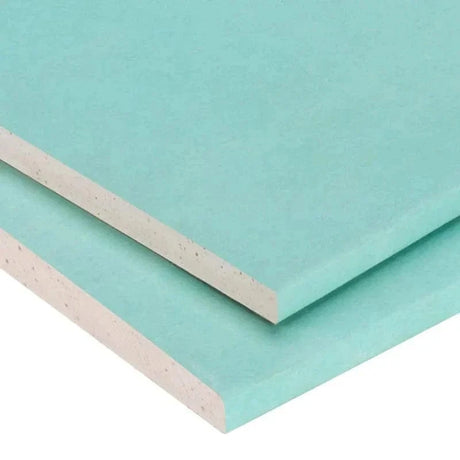
In a kitchen, bathroom or utility room, standard plasterboard is working against the conditions. Steam, splashing and day-to-day humidity are exactly what plain gypsum board does not cope with: it takes up moisture, softens, and can go on to harbour mould behind the finish. Moisture-resistant plasterboard is the board made for those rooms, with a water-repellent core that stands up to humidity and occasional wetting where standard board would fail.
It is a Type H board to BS EN 520. The gypsum core is treated with water-repellent additives and the paper liners are treated too, so the board absorbs far less water than standard board. Across UK manufacturers it is conventionally faced in green, which is how it is told apart on site. It is fixed and finished much like standard board, then decorated, tiled or skimmed.
Insulation UK stocks the moisture-resistant range in 12.5mm and 15mm tapered edge boards, both in the 2.4m x 1.2m sheet. The thickness you choose follows the job: 12.5mm as the everyday board, 15mm where more rigidity or robustness is wanted.
The moisture-resistant plasterboard range at a glance
Both boards share the same water-repellent Type H core and the same 2.4m x 1.2m sheet. What changes is the thickness, and with it the rigidity and how the board sits in a build-up.
Tapered edge
| Thickness | Sheet size | Coverage per board | Best fit |
|---|---|---|---|
| 12.5mm | 2.4m x 1.2m | 2.88m² | The everyday moisture-resistant board for walls and ceilings in humid rooms. |
| 15mm | 2.4m x 1.2m | 2.88m² | The heavier board for more rigidity and where 15mm is specified. |
*Coverage is per board. Board weight and the exact moisture-resistance class (Type H) are not listed on the current product pages: confirm both, along with the reaction-to-fire class, on the product datasheet or Declaration of Performance before specifying.
What makes moisture-resistant plasterboard different
Standard plasterboard readily takes up water: the gypsum core weakens, swells and can crumble, and mould can follow behind tiles or decoration. Moisture-resistant board is built to resist that. Its gypsum core carries water-repellent additives, typically silicones, and the paper liners are treated to shed surface water, so the board absorbs far less moisture than standard board and holds up in humid and occasionally wet conditions.
That resistance is what BS EN 520 measures through its Type H classification, graded by how much water the board absorbs: H1 at 5% or less, H2 at 10% or less, and H3 at 25% or less by weight. UK boards for wet areas are commonly H1, the highest grade, but the exact class belongs to the specific board, so check it on the datasheet or Declaration of Performance.
Water-resistant is not waterproof
This is the distinction that matters most, and the one most likely to cause a callback if it is missed. Moisture-resistant board is water-resistant, not waterproof. It is designed to cope with humidity, steam and the occasional splash, not with standing water or continuous wetting.
In a shower enclosure, a wet room, or anywhere in direct and repeated contact with water, moisture-resistant board on its own is not enough. Those areas need a proper waterproofing approach: a tanking system over the board, or a dedicated tile backer or cement board substrate designed for wet zones, installed to the tiling and waterproofing guidance for the job. Good ventilation and correctly sealed joints and penetrations matter too. Used within its limits, moisture-resistant board is the right board for humid rooms; pushed past them, it still needs help.
Where can you use it?
Moisture-resistant board suits internal rooms where humidity and occasional moisture are part of daily use: kitchens, bathrooms, en-suites, cloakrooms, utility and laundry rooms, and the ceilings and wall linings in those spaces. It is used across homes and commercial buildings such as washrooms and changing areas.
It is not an external board, a structural sheet or a standalone wet-area substrate. Where the wall or ceiling stays dry, standard board is the more economical choice; where it faces direct water, a tile backer or cement board takes over. Moisture-resistant board covers the large middle ground between the two.
Board thickness and what it changes
Both thicknesses share the same water-repellent core, so the difference is depth, weight and rigidity rather than moisture performance. 12.5mm is the everyday moisture-resistant board, the thickness most humid-room walls and ceilings are lined with. 15mm is heavier and more rigid, chosen where a more robust lining is wanted, over wider stud or joist spacings, or where a 15mm board is specified.
Both take the same finishes and fix the same way, so pick the thickness the job or specification calls for rather than assuming the thicker board is always the better buy.
Fixing and finishing
Moisture-resistant board is cut and fixed like standard board: scored along a straightedge with a sharp knife, snapped, and cut through the back, then screwed to timber or metal framing or bonded to masonry. The water-repellent paper is a little tougher to cut but handles much the same.
Finishing is where the moisture-resistant face needs a moment's thought. Because the surface is treated to repel water, a skim coat needs the correct primer or pre-treatment to bond properly, so follow the plaster and primer guidance rather than skimming straight onto the board. The tapered edge suits taping and jointing for a flush, decoratable finish. Seal the joints and perimeter properly, keep the boards flat, dry and off the ground before fixing, and treat cut edges and fixings in line with the finishing guidance for humid areas.
Standards and sustainability
Moisture-resistant plasterboard is a Type H board manufactured to BS EN 520, the harmonised European standard for gypsum plasterboards, and is CE or UKCA marked against it. Its moisture-resistance class (H1, H2 or H3) and its reaction-to-fire class, generally A2-s1,d0 for gypsum boards under BS EN 13501-1, are set on the board's datasheet and Declaration of Performance, so confirm both against your project before specifying.
Gypsum remains one of the more recyclable construction materials, and clean plasterboard offcuts can be recycled through dedicated waste streams rather than sent to landfill.
Which board should you choose?
12.5mm: the everyday board
12.5mm is the thickness most humid-room walls and ceilings are lined with. Its tapered edge suits a taped and jointed finish, and it is the standard choice for kitchens, bathrooms, utility rooms and the ceilings above them. Stocked as a 12.5mm tapered edge 2.4m x 1.2m board.
15mm: the heavier board
15mm carries more mass and more rigidity, for a more robust lining, wider stud or joist spacings, or where a 15mm board is specified. It shares the same water-repellent core as the 12.5mm, so the difference is in the board's strength and feel rather than its moisture performance. Stocked as a 15mm tapered edge 2.4m x 1.2m board.
Any drawbacks?
The main thing to keep in mind is the water-resistant, not waterproof, line. Moisture-resistant board handles humidity and splashes, but it is not a wet-room substrate on its own: showers, wet rooms and direct water contact need tanking and often a tile backer or cement board. It is also not a fire-rated or acoustic board, so where those performances are needed, the fire-resistant or acoustic ranges are the right tools, sometimes alongside a moisture-resistant board.
Beyond that, it costs a little more than standard board, so it is worth using where the moisture is rather than throughout, and the treated face needs the correct primer before skimming. The 15mm board is also heavier than the 12.5mm, so plan handling on ceilings and overhead work.
Our expert verdict
Moisture-resistant plasterboard is the board for the damp end of the house: a Type H board with a water-repellent core that copes with the humidity, steam and splashing that would soften and spoil standard board.
Pick the thickness for the job: 12.5mm as the everyday board for humid-room walls and ceilings, and 15mm where more rigidity or a specified thickness is called for. Use it where the moisture is, keep standard board for the dry rooms, and step up to tanking with a tile backer or cement board wherever water is in direct, repeated contact with the wall.
For kitchens, bathrooms, utility rooms and the humid spaces in between, moisture-resistant plasterboard belongs at the top of the list, with the standard, fire-resistant and acoustic ranges there for the jobs that need them.
Shop the Moisture Resistant Plasterboard range today, or speak to the Insulation UK team on 03003 034 578 if you need help choosing the right thickness or board for your kitchen, bathroom or utility room.