Floor insulation carries a problem the other elements do not. Every millimetre you add either deepens the dig and the spoil you have to cart away, or lifts the finished floor towards the doors, thresholds and the bottom of the stairs. So on a floor, the thinnest board that hits the target wins. That is the whole pitch of Kingspan Kooltherm K103.
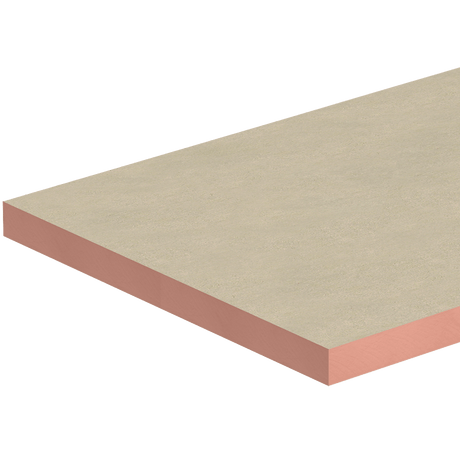
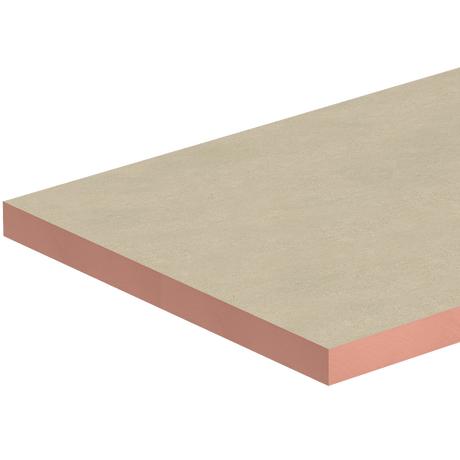
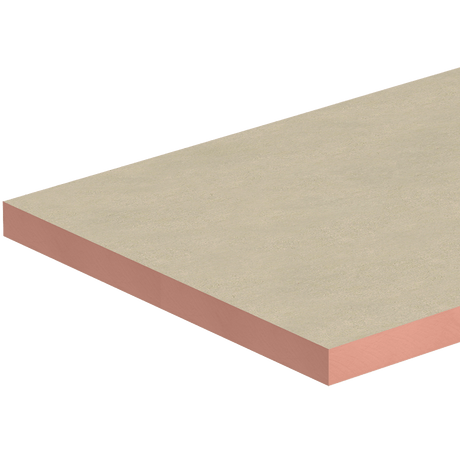
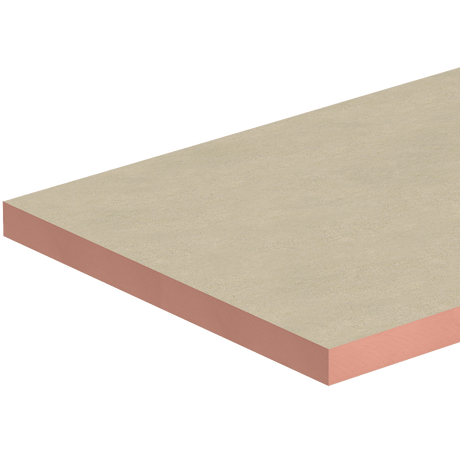
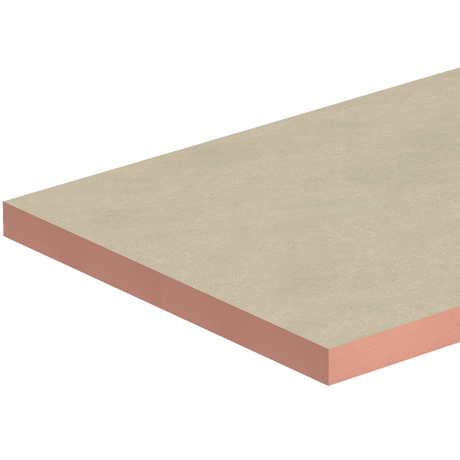
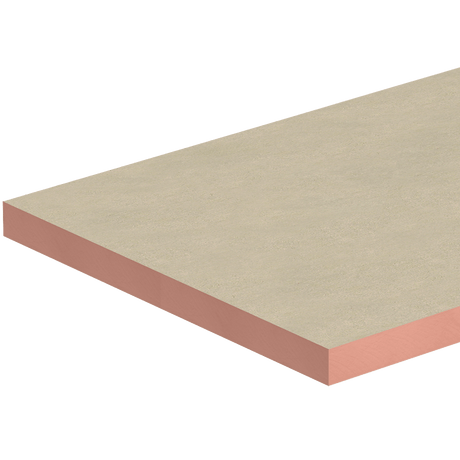
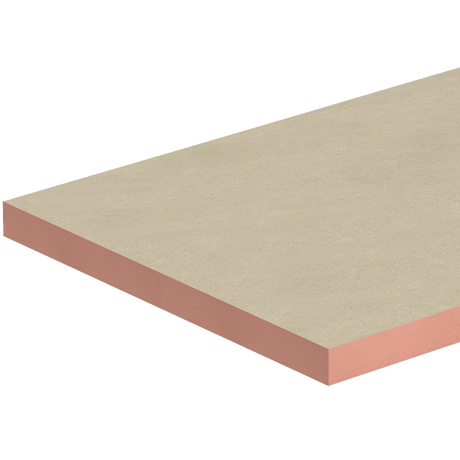
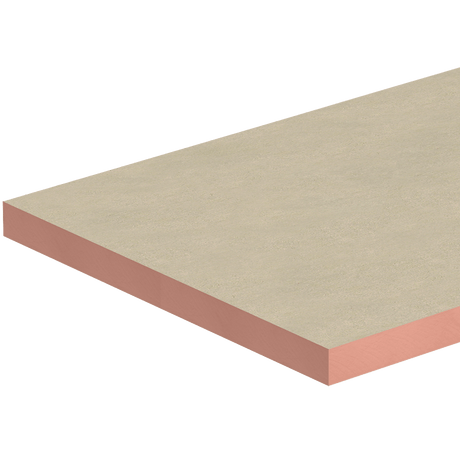
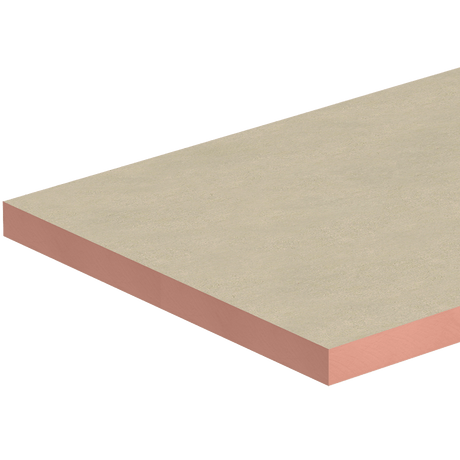
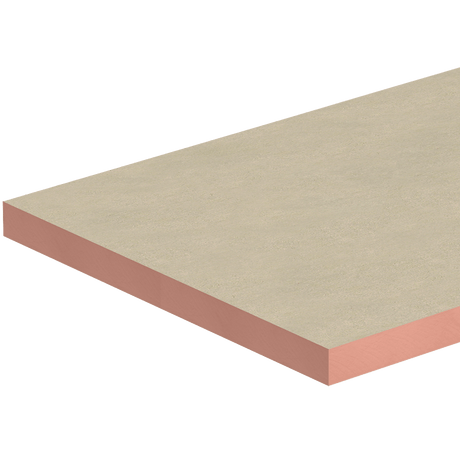
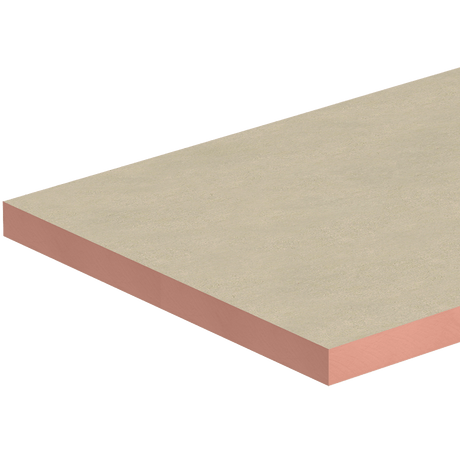
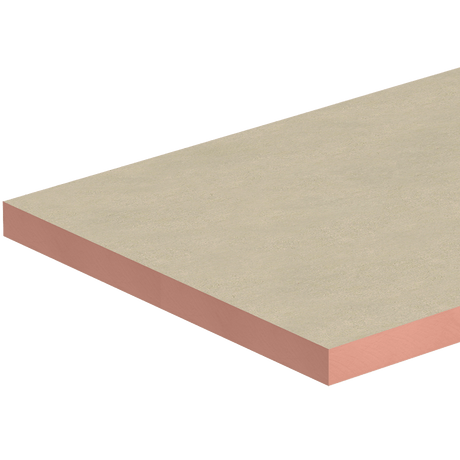
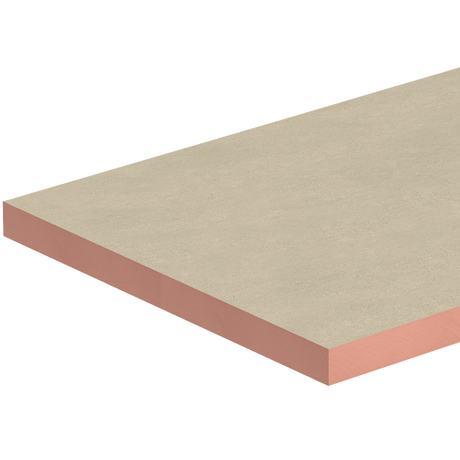
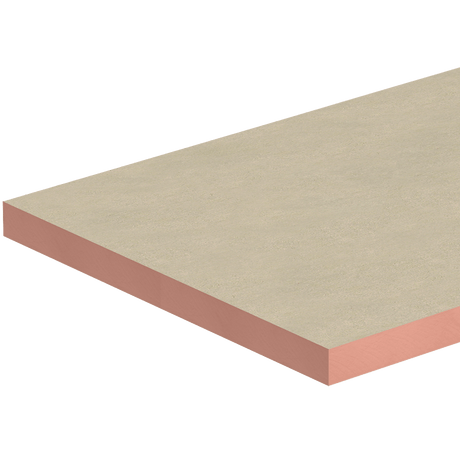
K103 is a premium-performance rigid thermoset phenolic floorboard, faced on both sides with a glass tissue based facing, on the standard 2400mm x 1200mm board with a square edge. Its phenolic core gives it a thermal conductivity of 0.019 W/mK, lower than a typical polyisocyanurate (PIR) board, which means it reaches a given thermal resistance in less thickness.
The range runs from 25mm to 150mm, and because the lambda stays at 0.019 W/mK across every thickness, the R-value rises in step with depth, from 1.30 m²K/W at 25mm to 7.85 m²K/W at 150mm. Insulation UK stocks it two ways, as single sheets and as full packs, so you can take a handful of boards for a small job or a full pack for a whole floor.
For solid concrete and suspended timber floors, in new builds and refurbishments, and alongside underfloor heating, this is one of the highest-performing floor boards you can specify.
The Kingspan Kooltherm K103 range at a glance
Every board is 2400mm x 1200mm (2.88m² per sheet), shares the 0.019 W/mK phenolic core, and carries the same R-value at a given thickness whichever way you buy it. What changes between the two formats is simply how many boards you take at once.
Single sheets
Single sheets suit smaller jobs, top-ups and one-off thicknesses where you need only a few boards rather than a full pack.
| Thickness | Board size | Coverage per sheet | R-value |
|---|---|---|---|
| 25mm | 2400mm x 1200mm | 2.88m² | 1.30 m²K/W |
| 50mm | 2400mm x 1200mm | 2.88m² | 2.60 m²K/W |
| 75mm | 2400mm x 1200mm | 2.88m² | 3.90 m²K/W |
| 100mm | 2400mm x 1200mm | 2.88m² | 5.25 m²K/W |
Full packs
Full packs cover the wider set of thicknesses and are the format to take when you are insulating a whole floor.
| Thickness | Sheets per pack | Pack coverage | R-value |
|---|---|---|---|
| 25mm | 12 sheets | 34.56m² | 1.30 m²K/W |
| 40mm | 8 sheets | 23.04m² | 2.10 m²K/W |
| 50mm | 6 sheets | 17.28m² | 2.60 m²K/W |
| 60mm | 5 sheets | 14.40m² | 3.15 m²K/W |
| 70mm | 4 sheets | 11.52m² | 3.65 m²K/W |
| 75mm | 4 sheets | 11.52m² | 3.90 m²K/W |
| 90mm | 3 sheets | 8.64m² | 4.70 m²K/W |
| 100mm | 3 sheets | 8.64m² | 5.25 m²K/W |
| 150mm | 2 sheets | 5.76m² | 7.85 m²K/W |
If you are insulating a whole floor, buying by the pack is usually the smarter move. The packs are bundled and priced as a unit, so a single line on the order covers the area rather than building it up sheet by sheet, and you take a consistent batch from one delivery rather than risking a part order running short part way through. The pack coverage figures make the maths simple: divide your floor area, plus a contingency allowance, by the pack coverage to land on the number of packs. Full packs are also the easiest way to clear the free delivery threshold (orders over £500 ex VAT) and to set up project pricing with the team on larger jobs. Single sheets stay the better call for top-ups, repairs and small areas, where a full pack would only leave you with boards spare.
Why Kingspan Kooltherm K103 stands out
The value in K103 is thinness. At 0.019 W/mK, phenolic is one of the lowest-conductivity rigid insulants available, so it reaches a target floor U-value in less depth than a PIR or mineral wool board would need to.
On a floor, that thinness pays off in concrete ways: less dig and less spoil to remove under a slab, a shallower overall build-up, and finished floor levels that stay clear of doors, thresholds and the foot of the stairs. The boards are faced both sides with a glass tissue facing for a durable bond, and the phenolic core is fibre-free, so they handle more cleanly than fibrous alternatives.
For trade buyers, a thinner board can mean fewer knock-on costs elsewhere in the build. For self-builders and renovators, it often means hitting the regulations without raising the floor and reworking the doors and skirtings around it.
Thermal performance
Every thickness shares a declared thermal conductivity of 0.019 W/mK, quoted to BS EN 13166. The R-values climb steadily with depth, from 1.30 m²K/W at 25mm to 7.85 m²K/W at 150mm, with the full set in the tables above.
One point is specific to floors and worth being straight about. Unlike a wall or a roof, a ground floor's U-value cannot be read from the build-up alone. It depends on the ratio of the floor's exposed perimeter to its area: the same board gives a better U-value on a large, compact floor than on a small or long, narrow one. So size the board against a proper floor U-value calculation for your actual plan, rather than the R-value on its own.
Installation and site practicality
In most floor build-ups K103 is loose-laid rather than fixed down. Below a slab or screed, the boards are laid break-bonded with joints lightly butted over a damp-proof membrane, with a perimeter upstand strip (at least 25mm) around the edge to limit cold bridging at the floor-to-wall junction. Where two layers are needed, the joints are offset so they do not line up. Before the screed goes on, the boards are overlaid with a polythene sheet that doubles as a vapour control layer and keeps wet screed out of the joints.
In a suspended timber floor, the boards are cut to fit snugly between the joists and carried on battens, clips or nails so they finish flush, with any gaps filled by expanding urethane sealant. Cut with a fine-toothed saw, or score with a sharp knife and snap over a straight edge. The boards work with underfloor heating systems, and should be protected from foot and wheeled traffic during the build. Install in line with the BBA certificate and Kingspan's guidance for the floor type.
Fire performance
K103 carries a Euroclass C-s2,d0 reaction-to-fire classification to EN 13501-1, a step up from the Euroclass F typical of an unfaced PIR board. In a floor, the insulation normally sits below a concrete slab, a screed or timber boarding, so it is enclosed within the construction rather than left exposed.
As always, the project's fire strategy and the relevant building regulations govern. Kingspan's classification also carries specific test conditions for the substrate it is fixed to, so those should be checked against the build-up.
Strength, moisture and durability
Floors carry load, so compressive strength matters. K103 has a compressive strength of 120 kPa, tested to BS EN 826, which supports normal domestic and many commercial floor loads when designed as part of the build-up. Where floor loads are unusually high, Kingspan points specifiers towards its higher-strength GreenGuard XPS instead.
The board resists the passage of water vapour, with a water vapour resistivity greater than 370 MNs/gm, although it still has to sit over a damp-proof membrane and is not for direct contact with subsoil. The fibre-free phenolic core resists mould and microbial growth, offers no food value to vermin, and, correctly installed, can have an indefinite life.
Certification and sustainability
K103 is covered by BBA Certificate 16/5299 across the 25mm to 150mm range, and is manufactured to BS EN 13166, the product standard for factory-made phenolic foam. Manufacture sits under a broad set of management systems: ISO 9001 for quality, ISO 14001 for environmental, ISO 37301 for compliance, ISO 45001 for health and safety, and ISO 50001 for energy.
The board is certified to BES 6001 'Good' for responsible sourcing, and an Environmental Product Declaration is available. That depth of documentation makes it straightforward to specify and to put in front of building control.
Which thickness should you choose?
Thinner boards: 25mm to 50mm
The 25mm, 40mm and 50mm boards (R-values of 1.30 to 2.60 m²K/W) are for top-ups, upgrading an existing floor where depth is limited, or as one layer of a two-layer build-up. They give the least resistance on their own, but they are the boards to reach for when every millimetre of floor height counts.
Mid-range: 60mm to 90mm
The 60mm, 70mm, 75mm and 90mm boards (3.15 to 4.70 m²K/W) are the everyday choice for many new-build and refurbishment floors, balancing a useful jump in resistance against a build-up that stays manageable. The 75mm board, at 3.90 m²K/W, is a common specification point.
High performance: 100mm and 150mm
The 100mm and 150mm boards are for demanding low U-value targets where the build-up has the depth to take them. The 150mm board reaches 7.85 m²K/W, the highest single-board resistance in the range, and is the one to specify on low-energy and new-build floors chasing the tightest U-values.
Is Kooltherm K103 only for floors?
In short, yes. K103 is Kingspan's floorboard, designed and certified for solid concrete and suspended timber floor insulation, in new builds and refurbishments alike. It is not a wall or roof board. The wider Kooltherm range has dedicated products for those jobs, such as insulated plasterboard for internal walls and rafter-level boards for roofs, so for walls and roofs the right Kooltherm board is a different one.
It should also always sit over a damp-proof membrane, and never in direct contact with subsoil. Get the membrane, the perimeter upstand and the joint detailing right and the board does the rest.
Any drawbacks?
The main one is cost. Premium phenolic sits above PIR and mineral wool on price, and what you are paying for is the thinness and the low lambda. That trade is worth it where floor depth or finished levels are tight, and less compelling where there is room to spare and a cheaper, thicker board would do the same job.
Beyond price, the points to plan around are straightforward: the Euroclass C-s2,d0 board is enclosed within the floor build-up rather than left exposed, and the fire strategy still applies; it has to be installed over a DPM; it should be protected from traffic during the build; and, like any phenolic, cutting it makes dust, so set up for that on site. Store the boards flat, dry and off the ground before they go in.
Our expert verdict
Kingspan Kooltherm K103 is the floor board to reach for when thinness is the priority. The 0.019 W/mK phenolic core hits a target U-value in less depth than PIR or mineral wool, which on a floor saves dig, build-up and finished height, and the 120 kPa compressive strength, vapour resistance and BBA certification back it up for real floor build-ups.
The thickness follows the target and the depth available: the 25mm to 50mm boards for top-ups and tight build-ups, the 60mm to 90mm boards for everyday new-build and refurbishment floors, and the 100mm and 150mm boards for demanding low U-value targets. Buy single sheets for small jobs and top-ups, and full packs for whole floors and the simpler delivery and pricing that come with them.
For solid and suspended floors where performance and a slim build-up both matter, the Kingspan Kooltherm K103 range belongs at the top of your shortlist.
Shop the Kingspan Kooltherm K103 Floorboard range today, in single sheets or full packs, or speak to the Insulation UK team on 03003 034 578 if you need help choosing the right thickness for your floor.