When builders talk about Celotex in ranges, the letters are doing real work. TB is for thermal bridging, GA is for general applications, and XR stands for extra resistance. The XR4000 boards are the thick end of the Celotex PIR family: the boards you reach for when space is not the constraint and the job is to hit a demanding thermal target in a single layer.
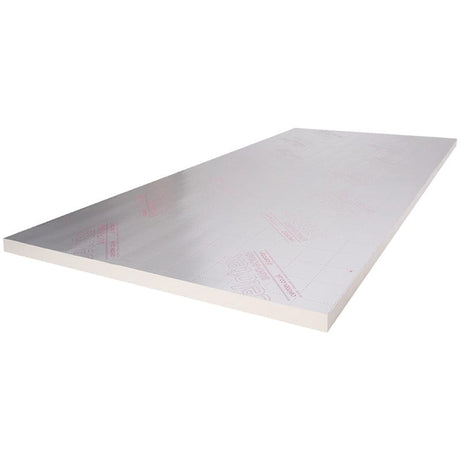
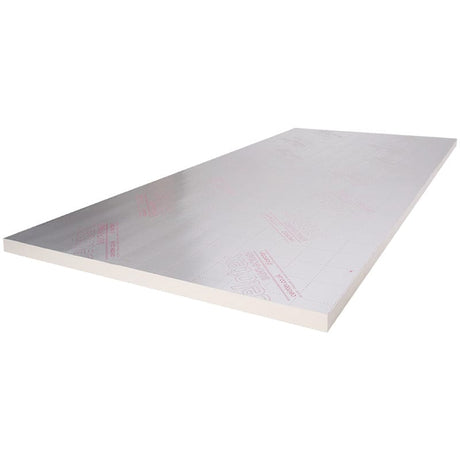
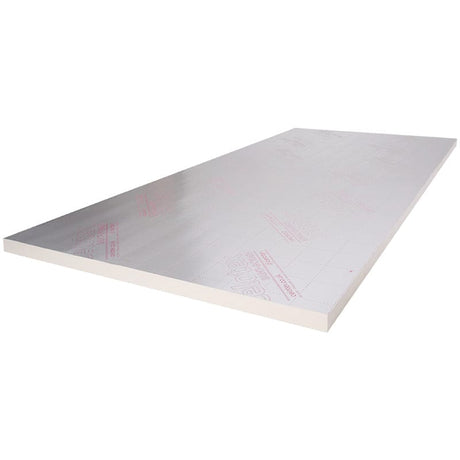
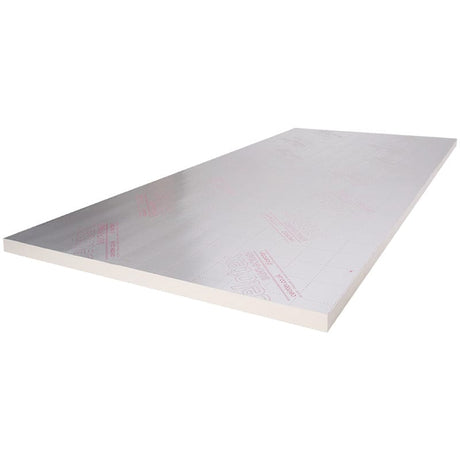
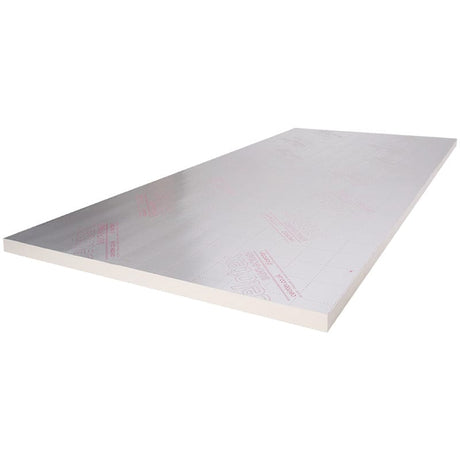
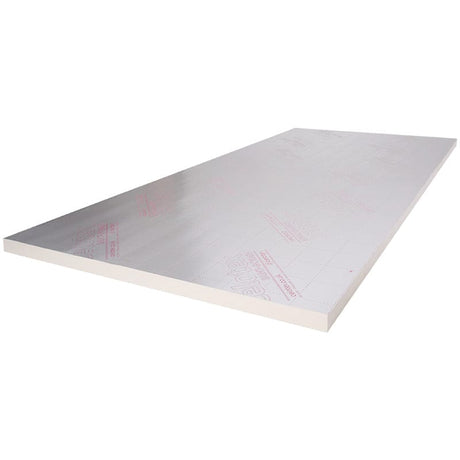
Celotex XR4000 is a rigid polyisocyanurate (PIR) insulation board with a low-emissivity foil facing on both sides and a square edge, on the standard 2400mm x 1200mm board. It uses the same 0.022 W/mK core as the rest of the Celotex PIR range. What changes across XR4000 is the thickness, and with it the thermal resistance.
The range covered here spans six thicknesses from 110mm to 200mm. The number in the code is the thickness: XR4110 is 110mm, XR4200 is 200mm. Because every board shares the same 0.022 W/mK lambda, the R-value climbs in step with depth, from 5.00 m²K/W at 110mm to 9.05 m²K/W at 200mm. You pick the board that meets your target in as few layers as possible.
For floors, flat and pitched roofs, and walls where there is room to build in a thick, high-resistance board, this is the part of the Celotex range made for exactly that job.
The Celotex XR4000 range at a glance
Insulation UK lists the Celotex XR4000 range across these thicknesses, all 2400mm x 1200mm and 2.88m² per board. Thermal resistance climbs steadily with thickness, while pallet quantities fall as the boards get deeper, which is worth knowing when you are planning deliveries of the larger sizes.
| Product | Board size | Coverage per board | R-value | Best fit |
|---|---|---|---|---|
| 110mm Celotex XR4110 | 2400mm x 1200mm | 2.88m² | 5.00 m²K/W | The entry to the extra-resistance range, for strong single-board performance. |
| 120mm Celotex XR4120 | 2400mm x 1200mm | 2.88m² | 5.45 m²K/W | A step up for more demanding floor and roof targets. |
| 130mm Celotex XR4130 | 2400mm x 1200mm | 2.88m² | 5.90 m²K/W | Higher resistance for low-energy floor and roof build-ups. |
| 140mm Celotex XR4140 | 2400mm x 1200mm | 2.88m² | 6.35 m²K/W | Strong resistance where a thicker single board suits the build-up. |
| 150mm Celotex XR4150 | 2400mm x 1200mm | 2.88m² | 6.80 m²K/W | High resistance for demanding new-build floors and roofs. |
| 200mm Celotex XR4200 | 2400mm x 1200mm | 2.88m² | 9.05 m²K/W | The highest resistance in the range, for the most demanding U-value targets. |
Why Celotex XR4000 stands out
The point of XR4000 is resistance in a single board. With a 0.022 W/mK core, these boards reach R-values from 5.00 to 9.05 m²K/W without stacking multiple layers, which keeps the build-up simpler and cuts the number of joints across a large floor or roof.
The low-emissivity foil facing adds a further benefit. Where it faces a sealed cavity air space, the foil improves the achievable U-value beyond the board's own thermal resistance. It is the same closed-cell PIR used across the Celotex range, so even at 150mm or 200mm the boards stay light and rigid for their size, which keeps handling and cutting on site manageable.
For trade buyers, fewer layers means a faster, cleaner install over large areas. For self-builders, it means hitting a tough thermal target without an elaborate, multi-layer build-up.
Thermal performance
Every board in the range carries a declared thermal conductivity of 0.022 W/mK, measured to BS EN 13165, which is high-performance PIR. A low lambda means more thermal resistance per millimetre, so a single XR board can do work that would otherwise need a thicker or layered build-up.
The R-values rise in clear steps with thickness: 5.00 m²K/W at 110mm, 5.45 m²K/W at 120mm, 5.90 m²K/W at 130mm, 6.35 m²K/W at 140mm, 6.80 m²K/W at 150mm and 9.05 m²K/W at 200mm.
It is worth being clear about one thing. These figures are the thermal resistance of the board itself. The finished U-value of a floor, roof or wall depends on the whole construction: the structure, any air gaps, other layers, the finishes and the quality of the fit. The foil facing's contribution, in particular, only applies where it faces a sealed cavity air space. Size the board against the target build-up rather than the board figure alone.
Installation and site practicality
For their thickness, the boards are light and rigid, which keeps transport, handling and fitting straightforward. They have a square edge, so they butt together rather than interlocking, which makes tight, gap-free jointing the thing to get right across large areas.
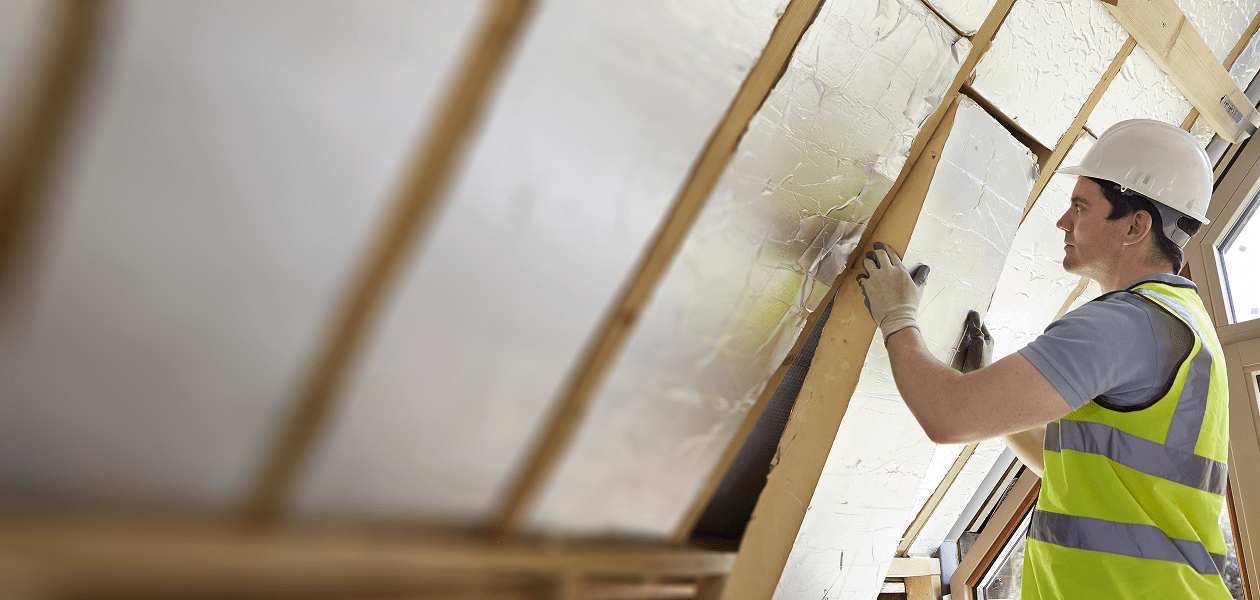
PIR cuts with a sharp knife or a fine-toothed saw, and the printed grid lines on the facing help you keep cuts straight. Cutting thick PIR is a messy job, so protect the area first. On a solid wall the boards are usually bonded with adhesive and can be further secured with mechanical fixings, with the surface cleared of old plaster or paper beforehand; on a timber frame they are cut between or fixed over the battens. For exact-fit boards and less waste on site, Insulation UK's bespoke cutting service can supply them pre-cut. Whatever the method, install in line with the BBA certificate and the latest Celotex guidance for the build-up.
Fire performance
This is an important point to understand, because XR4000 is a bare PIR board rather than a faced or laminated one. It carries a Euroclass F reaction-to-fire classification to BS EN 13501-1, and at this class no smoke rating is provided. In practice that means the board is designed to be installed behind a lining or covering rather than left exposed: in a wall, for example, it is finished with plasterboard, not painted directly.
There is also a height limit to respect. Celotex states that XR4000 should not be used in the external walls of buildings over 11 metres in height, in line with the rules that only non-combustible insulation or insulation of limited combustibility should be used at that height. On taller buildings, the project fire strategy decides what can be used.
Sustainability and certification confidence
Celotex XR4000 is backed by the documentation specifiers and building control look for. It is BBA approved (certificate 25/7318) for floors, dry lining and pitched roof applications, when installed, used and maintained as set out in the certificate, and it is UKCA marked to BS EN 13165, the product standard for factory-made rigid PIR.
On the environmental side, the board holds a BRE Green Guide rating of A under BRE Global certificate ENP413, which can support a BREEAM assessment. Manufacture is covered by ISO 9001:2015 for quality management and ISO 14001:2015 for environmental management, and the closed-cell PIR is produced CFC and HCFC free with zero ozone depletion potential.
That breadth of paperwork makes the board straightforward to put in front of an architect, energy assessor or building control officer.
Which thickness should you choose?
110mm Celotex XR4110
The 110mm board opens the extra-resistance range with an R-value of 5.00 m²K/W. It picks up where the 100mm GA4100 leaves off, giving stronger single-board performance for floors and roofs without moving to a layered build-up. At 4.54 kg/m² it is the lightest board in the range and comes 20 to a pallet.
120mm Celotex XR4120
The 120mm board lifts the R-value to 5.45 m²K/W. It is the choice when 110mm is close but a more demanding floor or roof target needs a little more out of a single layer, while keeping pallet quantities the same at 20 boards.
130mm Celotex XR4130
The 130mm board brings an R-value of 5.90 m²K/W. It suits low-energy floor and roof build-ups where the resistance has to climb but the depth is available to take it.
140mm Celotex XR4140
The 140mm board reaches an R-value of 6.35 m²K/W, strong single-board resistance for build-ups designed around a thicker insulation layer. It comes 16 to a pallet.
150mm Celotex XR4150
The 150mm board reaches an R-value of 6.80 m²K/W, high resistance for demanding new-build floors and roofs. It is the thickest of the closely spaced 110mm to 150mm steps before the range jumps to the 200mm board.
200mm Celotex XR4200
The 200mm board is the highest-resistance option in the range, with an R-value of 9.05 m²K/W. It is the one to specify for the most demanding U-value targets where the build-up has the depth to take it. At 8.06 kg/m² and 12 to a pallet, it is the board to plan handling and deliveries around.
Where can you use Celotex XR4000?
Celotex positions XR4000 for roof, wall and floor applications, and the BBA certification specifically covers floors, dry lining and pitched roofs. In practice that means ground floors (beam and block, concrete slab and suspended timber), pitched roofs (between and under the rafters), and internal wall lining. It is also used in flat roof and external wall build-ups, which sit outside that headline BBA scope, so confirm those uses against the certificate and the project specification.
Two points are worth flagging clearly. First, the foil facing improves thermal performance in a sealed cavity air space, but it is not a vapour control layer. Where the build-up needs vapour control, or a floor needs a damp-proof membrane, that has to be provided separately as part of the design. Second, XR4000 is not a full-fill cavity board; for masonry cavity walls a dedicated cavity board such as Recticel Eurowall+ is the right specification.
Any drawbacks?
The main thing to plan around is that XR4000 is bare PIR. The Euroclass F classification means it has to be installed behind a lining or covering and finished separately: it is not left exposed and not painted directly. The 11-metre height restriction and the wider fire strategy apply on taller buildings.
The boards are thick by design, so on floors and roofs the extra depth has to be built into the construction, and the 200mm board in particular needs planning for handling and storage. The foil facing is not a vapour control layer or a damp-proof membrane, so those remain separate parts of the design. As an internal, dry-use board, it should be stored flat, dry and protected before it goes in.
Our expert verdict
Celotex XR4000 is the part of the Celotex PIR range built for resistance rather than slimness. The 0.022 W/mK core delivers R-values from 5.00 to 9.05 m²K/W in a single board, the low-emissivity foil facing adds performance in a sealed cavity, and the BBA certification and A Green Guide rating give it the paperwork to back the specification.
The thickness you choose follows the target. Through the closely spaced 110mm to 150mm steps you can dial in the resistance a floor or roof needs, from 5.00 to 6.80 m²K/W. When the target is more demanding and the depth is there, the 200mm board takes resistance to 9.05 m²K/W in one layer.
For floors, roofs and internally lined walls where a high single-board thermal resistance is the priority, the Celotex XR4000 range belongs on your shortlist.
Shop the Celotex XR4000 PIR Insulation Board range today, or speak to the Insulation UK team on 03003 034 578 if you need help choosing the right thickness for your project.