Insulated plasterboard exists to answer one awkward question: how do you add real thermal performance to a wall or ceiling that has none, without building a separate insulation layer and then boarding over the top of it? Celotex PL4000 answers it by doing both jobs in a single board.
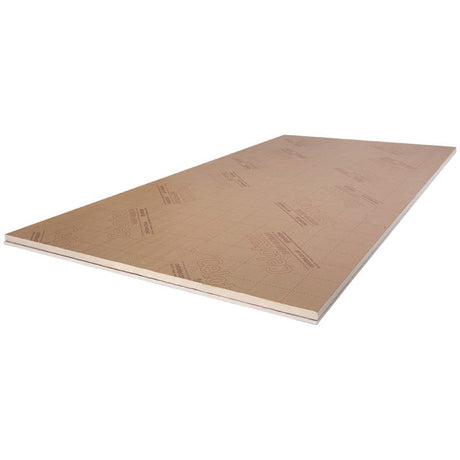
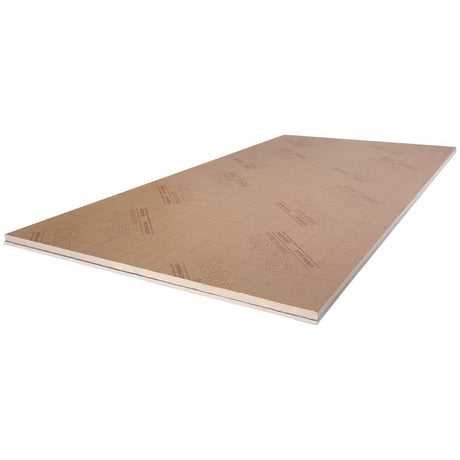
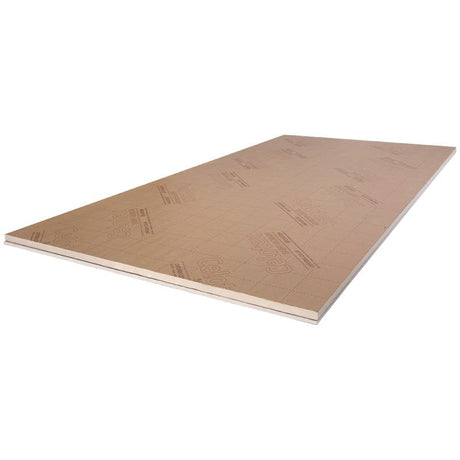
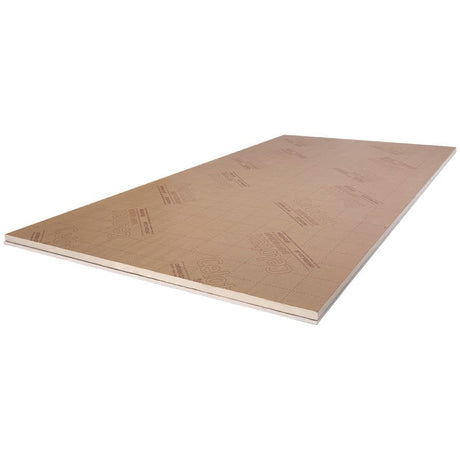
It is a rigid polyisocyanurate (PIR) insulation board with a paper facing, factory-bonded to a 12.5mm tapered edge plasterboard. Fix one board to the wall or ceiling and you have insulated and dry lined the surface in one pass, rather than running an insulation layer and a separate plasterboard layer as two trades.
The range covered here runs across four thicknesses (37.5mm, 52.5mm, 62.5mm and 72.5mm overall), all on the same 2400mm x 1200mm board with the same 0.022 W/mK PIR core. The number in the product code is the depth of insulation: PL4025 carries 25mm of PIR, PL4060 carries 60mm. You pick the thickness that hits your target without giving up more internal space than the room can spare. Add a Euroclass B-s1,d0 reaction-to-fire classification and BBA certification, and you have a board that covers performance, fire and paperwork in one product.
For anyone lining a cold solid wall from the inside, dry lining underneath the rafters, or upgrading a room's thermal performance where there is no cavity to fill, this is exactly the kind of board that deserves a proper look.
The Celotex PL4000 range at a glance
Insulation UK lists the Celotex PL4000 range across four thicknesses, all 2400mm x 1200mm and 2.88m² per board. Thermal resistance steps up with the depth of the PIR core, while pallet quantities drop as the boards get thicker and heavier, which matters when you are working out how much can come on one delivery.
| Product | Board size | Coverage per board | R-value | Best fit |
|---|---|---|---|---|
| 37.5mm Celotex PL4025 | 2400mm x 1200mm | 2.88m² | 1.20 m²K/W | Slim lining where internal space is tight, such as window and door reveals. |
| 52.5mm Celotex PL4040 | 2400mm x 1200mm | 2.88m² | 1.85 m²K/W | A step up in resistance while keeping the build-up slim. |
| 62.5mm Celotex PL4050 | 2400mm x 1200mm | 2.88m² | 2.30 m²K/W | Stronger internal wall lining where more depth is acceptable. |
| 72.5mm Celotex PL4060 | 2400mm x 1200mm | 2.88m² | 2.75 m²K/W | The highest resistance of the four, where the room can give up the depth. |
Why Celotex PL4000 stands out
The value here is not just the lambda figure. Plenty of insulation materials sit at a similar thermal conductivity. What sets PL4000 apart is that it is two products in one: a high-performance PIR core for the thermal resistance, and a 12.5mm tapered edge plasterboard face that is ready to tape, joint and finish.
That two-in-one format is the practical win. Insulating and dry lining a wall normally means fixing an insulation layer and then boarding over it. PL4000 collapses that into a single fixing operation, which keeps the build-up tight to the wall and removes a step from the programme.
For trade buyers, that means a quicker, more repeatable job. For self-builders and homeowners, it means you are not buying a bare insulation board and working out how to line it afterwards: you are buying a finished internal lining that insulates at the same time. The PIR core is also fibre-free, so it handles cleanly compared with a fibrous insulation behind a separate board.
Thermal performance
The PIR component of every board in the range carries a declared thermal conductivity of 0.022 W/mK, measured to BS EN 13165, which puts it firmly in high-performance PIR territory. A low lambda means you reach a given thermal resistance in a thinner board, and that thinness is the whole point when you are insulating a room from the inside.
The R-values step up clearly with depth, and these figures already include the plasterboard: 1.20 m²K/W at 37.5mm, 1.85 m²K/W at 52.5mm, 2.30 m²K/W at 62.5mm and 2.75 m²K/W at 72.5mm.
It is worth being straight about one thing. These figures are the thermal resistance of the board itself. The finished U-value of the wall or roof depends on the whole construction: the masonry or stud behind the lining, any residual cavity, the existing finishes and the quality of the fix. Choose the thickness against your target build-up rather than the board figure alone.
Installation and site practicality
This is where the two-in-one format earns its keep. One fixing operation insulates and dry lines the surface, so there is less to handle and fewer stages to coordinate than running insulation and plasterboard separately.
The boards are rigid, which makes them straightforward to handle, transport and offer up to the wall. The tapered edges let the joints be taped, filled and finished, or skimmed, for a flush surface ready to decorate. Thermal laminates like this are usually fixed either by bonding to the substrate with adhesive (the dot and dab method) or by mechanical fixing to battens or a stud frame, so the right method depends on the wall you are lining.
Because the detailing around the perimeter, openings and service penetrations affects both thermal and moisture performance, the boards should be installed in line with the BBA certificate and the latest Celotex installation guidance for the build-up in question. Get the fixing and sealing right and the board performs close to its rated figure.
Fire performance
This is a point worth understanding properly, because it is where the laminate differs from a bare PIR board. On its own, rigid PIR is a combustible material. Bonding it to plasterboard changes the reaction-to-fire picture: the finished Celotex PL4000 laminate carries a Euroclass B-s1,d0 classification to BS EN 13501-1. That is a strong rating, with s1 indicating very limited smoke and d0 indicating no flaming droplets, reflecting the protection the plasterboard face provides.
There is an important limit to respect. Celotex states that PL4000 should not be used in the external walls of buildings over 18 metres in height in England and Wales, or over 11 metres in Scotland, in line with the rules that only non-combustible insulation or insulation of limited combustibility may be used at those heights. On taller buildings, the project fire strategy decides what can be used, not the board's classification alone.
Sustainability and certification confidence
Celotex PL4000 is backed by the documentation specifiers and building control look for. It is BBA approved (certificate 16/5357) for plasterboard thermal laminate applications when installed, used and maintained as set out in the certificate, and it is UKCA marked to BS EN 13950, the product standard for plasterboard with insulating material.
On the environmental side, the board holds a BRE Green Guide rating of A+ under BRE Global certificate ENP413, which can support a BREEAM assessment. Manufacture is covered by ISO 9001:2015 for quality management and ISO 14001:2015 for environmental management.
That breadth of paperwork matters because insulated plasterboard is not a category where vague confidence is enough. It makes the product straightforward to put in front of an architect, energy assessor or building control officer.
Which thickness should you choose?
37.5mm Celotex PL4025
The 37.5mm board carries 25mm of PIR for an R-value of 1.20 m²K/W, the slimmest option in the range. It loses the least internal floor area, which is why it tends to come into its own at window and door reveals, or anywhere a room simply cannot give up much depth. It is the entry point to the range, the lightest board at 9.99 kg/m², and it comes 52 to a pallet.
52.5mm Celotex PL4040
The 52.5mm board steps the PIR up to 40mm and the R-value to 1.85 m²K/W while keeping the lining tight to the wall. It is the choice when 37.5mm does not give quite enough resistance but you still want to limit the depth you build into the room.
62.5mm Celotex PL4050
The 62.5mm board brings 50mm of PIR and an R-value of 2.30 m²K/W. It is a stronger internal lining for cold solid walls where the room can accept a little more depth in exchange for the extra performance, and it sits as the higher of the two middle options.
72.5mm Celotex PL4060
The 72.5mm board is the highest-performing of the four, with 60mm of PIR and an R-value of 2.75 m²K/W. It is the one to specify when thermal resistance is the priority and the space is there to take it. At 11.31 kg/m² it is also the heaviest board in this group, so plan handling on site.
Where can you use Celotex PL4000?
Celotex positions PL4000 for roof and internal wall lining, and the applications follow from that. In practice it is used on external walls lined internally, dry lining a cold solid wall from the inside; on pitched roofs, fixed underneath the rafters; and on flat roofs, fixed underneath the joists. It is a board for internal, dry applications.
It is not a cavity wall board, not a floor board, and not for below-ground use or anywhere exposed to the weather. For those jobs a dedicated board is the correct specification. There is one build-up point worth flagging clearly: managing condensation risk and vapour movement is part of designing any internally insulated wall or roof, and that needs checking against the project specification and the relevant guidance rather than being assumed from the board alone.
Any drawbacks?
The main thing to keep in mind is that PL4000 is a specification-led product. The thickness should follow the target performance and the space available, not be picked casually, so settle the build-up before you order.
Lining a wall internally always costs some floor area, and more of it as the board gets thicker, so reveals around windows, doors, sockets and radiators all need planning. The PIR core is combustible, so while the finished laminate rates Euroclass B-s1,d0, the height restriction (18 metres in England and Wales, 11 metres in Scotland) and the wider fire strategy still have to be respected. As with any internal insulation, getting the vapour and condensation strategy right for the build-up is part of the job. The boards are also for internal dry use, so store them flat, dry and protected before they go in.
Our expert verdict
Celotex PL4000 is one of the more straightforward ways to add thermal performance to a wall or roof that has none, because it does two jobs in one board: a 0.022 W/mK PIR core for the resistance, and a 12.5mm tapered edge plasterboard face that is ready to finish. The Euroclass B-s1,d0 rating, BBA certification and A+ Green Guide rating give it the paperwork to stand up to scrutiny.
The thickness you choose comes down to the space you can spare against the performance you need. If you want the slimmest lining, the 37.5mm board loses the least room. For a balance of performance and depth, the 52.5mm and 62.5mm boards sit in the middle. If thermal resistance is the priority and the depth is available, the 72.5mm board is the strongest of the four.
For internal wall lining and roof dry lining where performance, a clean finish and specification confidence all matter, the Celotex PL4000 range belongs on your shortlist.
Shop the Celotex PL4000 PIR Insulated Plasterboard range today, or speak to the Insulation UK team on 03003 034 578 if you need help choosing the right thickness for your project.