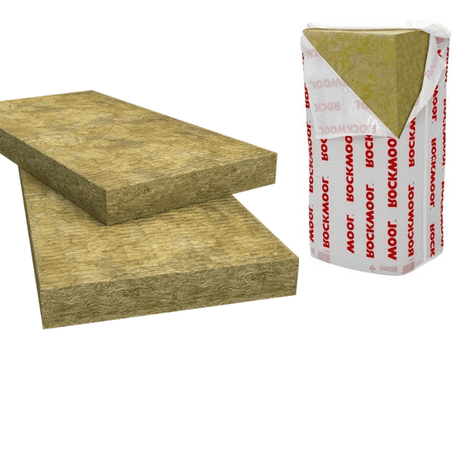
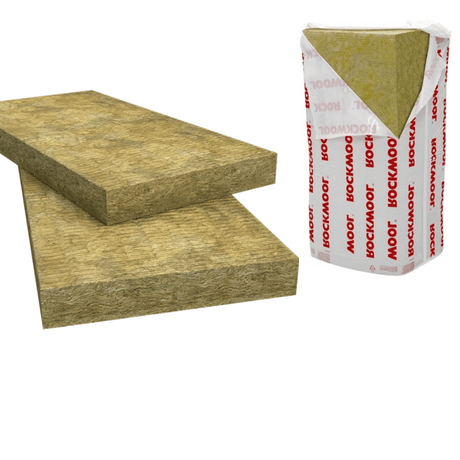
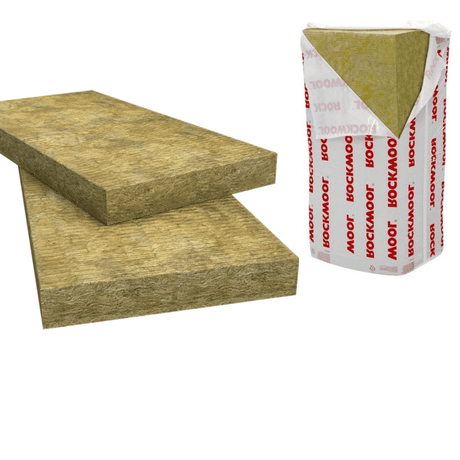
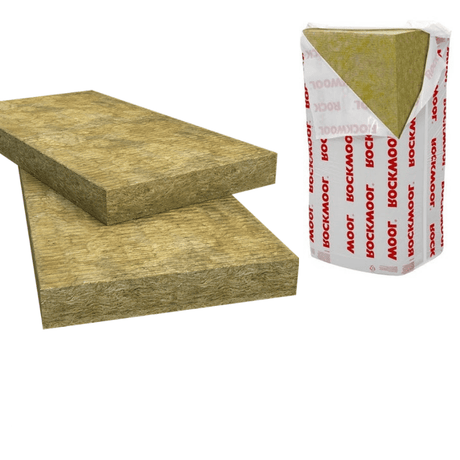
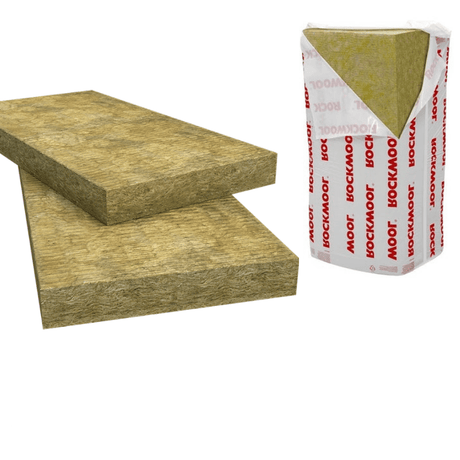
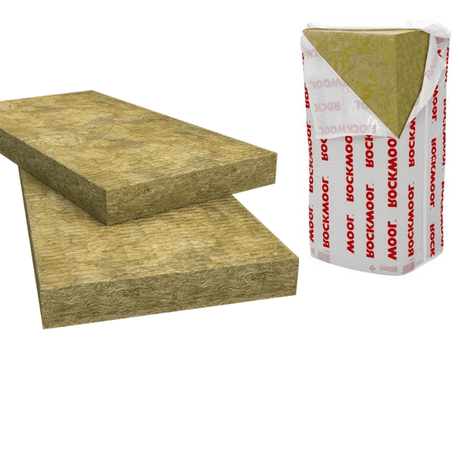
Most insulation is bought for its U-value. Rockwool RWA45 is bought for what it does to sound, fire and heat at the same time. It is the slab most trades reach for when a partition, separating wall, floor or ceiling needs to be quieter, safer and warmer, all from a single product.
RWA45 is a semi-rigid stone wool slab, made from natural volcanic rock at a nominal density of 45 kg/m³ (the "45" in the name), on a 1200mm x 600mm slab. Stone wool is sound absorbing by nature and non-combustible, so the same slab handles acoustic, fire and thermal duties across walls, floors, ceilings and roofs.
Insulation UK stocks it from 25mm to 100mm, supplied in packs of slabs, with more slabs per pack on the thinner sizes and fewer on the thicker. The thickness is usually chosen to fill the stud or joist depth rather than to hit a number, though thermal resistance does rise with depth.
For stud partitions, separating and party walls, floors between joists and ceilings, in homes and in commercial work like offices, schools and hospitals, RWA45 is the trade default.
The Rockwool RWA45 range at a glance
Every slab is 1200mm x 600mm and shares the same 45 kg/m³ stone wool core, an A1 non-combustible fire classification and a 0.035 W/mK thermal conductivity. What changes with thickness is the depth of cavity it fills, the thermal resistance, and how many slabs come in a pack.
| Thickness | Slabs per pack | Coverage per pack | R-value* | Best fit |
|---|---|---|---|---|
| 25mm | 16 slabs | 11.52m² | 0.70 m²K/W | Thin acoustic and fire layer for ceilings, flanking details and slim cavities. |
| 30mm | 12 slabs | 8.64m² | 0.85 m²K/W | A slim fill for stud partitions where a thinner slab suits. |
| 40mm | 12 slabs | 8.64m² | 1.10 m²K/W | Partition and separating-wall fill, and acoustic upgrades to existing walls. |
| 50mm | 9 slabs | 6.48m² | 1.40 m²K/W | The workhorse: fills 50mm studs and common 70mm-stud party-wall systems. |
| 60mm | 8 slabs | 5.76m² | 1.70 m²K/W | A common stud-cavity fill, including the cavity of twin-frame party walls. |
| 75mm | 6 slabs | 4.32m² | 2.10 m²K/W | Deeper studs and fuller stud fills, with stronger absorption. |
| 100mm | 4 slabs | 2.88m² | 2.85 m²K/W | The deepest fill, for joist voids and higher-performance build-ups. |
*R-values are calculated from the declared thermal conductivity of 0.035 W/mK, rounded down to the nearest 0.05. Rockwool does not publish a per-thickness R-value table for RWA45, so treat these as a guide and confirm against a project calculation.
Why Rockwool RWA45 stands out
Most insulation does one job well. RWA45 earns its place because it does three at once. The stone wool fibres are non-directional and densely packed, which traps sound and dampens vibration, so it is a genuine acoustic material rather than a thermal board that happens to deaden a little noise.
It is classified A1, the top of the reaction-to-fire scale, which means it is non-combustible and does not add to a fire, with a melting point above 1000°C. And it still brings a useful thermal contribution at 0.035 W/mK. The slabs are semi-rigid, so they hold their shape and friction-fit between studs and joists without slumping over time.
For trade buyers, that is one product covering the acoustic, fire and thermal lines on the same job, from a brand that needs little introduction on site.
Acoustic performance
This is RWA45's main event. Building regulations set the bar: Approved Document E requires a minimum of 40 Rw dB sound insulation between a bedroom or WC and another room in dwellings in England and Wales, rising to 43 Rw dB in Scotland. Stone wool's open, non-directional fibre structure absorbs airborne sound inside a partition or floor cavity, which is why it is specified across dwellings, offices, schools and hospitals.
The figures that matter are system results, not the slab on its own. As an example from Rockwool's own data, a 70mm metal stud partition at 600mm centres, filled with 50mm RWA45 and lined with two layers of 12.5mm plasterboard each side, achieves a weighted sound reduction of Rw 50dB, rising to Rw 55dB with heavier plasterboard. The slab is one part of that build-up: the studs, the plasterboard layers, the mass and the sealing all contribute, and separating-wall systems usually require pre-completion sound testing to prove compliance.
Fire performance
RWA45 is classified Euroclass A1 to BS EN 13501-1, the highest reaction-to-fire class, meaning it is non-combustible and does not contribute to fire growth or smoke. The stone wool melts only above 1000°C. That makes it a natural fit where fire performance and acoustics are both on the specification, such as separating walls and protected partitions.
One honest distinction is worth drawing. Reaction to fire describes how the material itself behaves in a fire. It is not the same as the fire resistance of the whole wall or floor, which is a system property measured in minutes and depends on the full build-up. RWA45 contributes to both, but the rated fire resistance belongs to the tested construction, not the slab alone.
Thermal performance
Alongside the acoustic and fire performance, RWA45 brings a thermal contribution, with a declared thermal conductivity of 0.035 W/mK. Because Rockwool does not publish a per-thickness R-value table for RWA45, the figures in the table above are calculated from that lambda and should be treated as a guide.
They are modest next to a rigid PIR or phenolic board, which is exactly as expected: RWA45 is an acoustic and fire slab first, with thermal performance as a genuine bonus rather than its headline. As with any insulation, the finished U-value depends on the whole build-up, not the slab in isolation.
Installation and site practicality
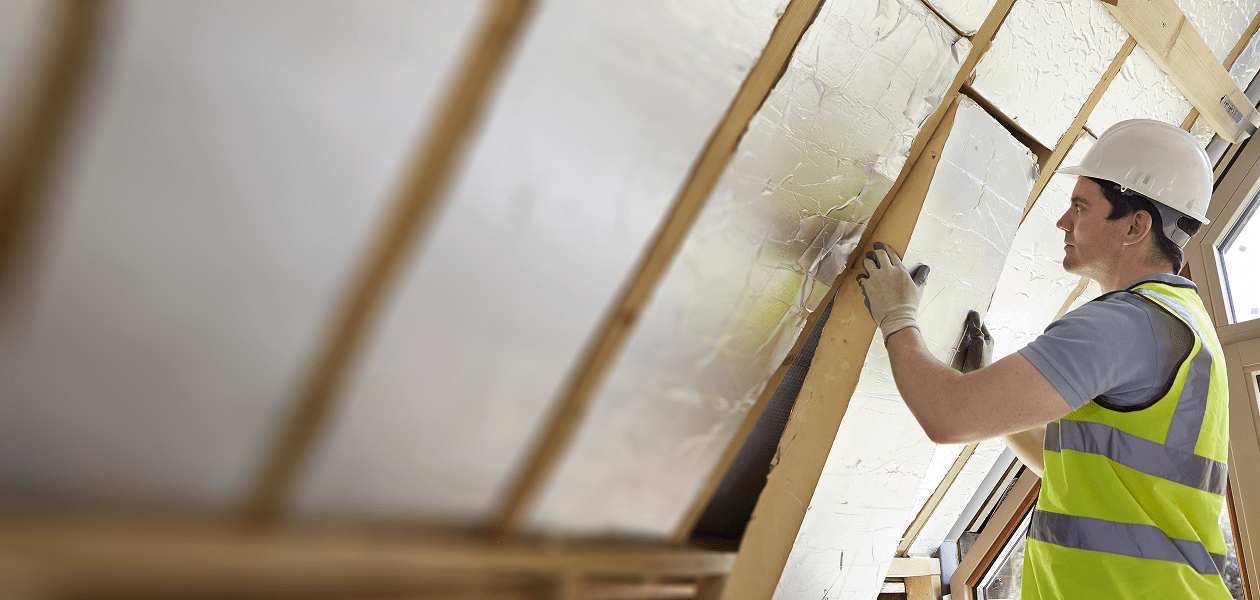
RWA45 is friction-fitted rather than fixed down. The semi-rigid slabs are cut slightly oversize and pushed between studs or joists, typically at 400mm or 600mm centres, so they grip in place without slumping, butted tightly with no gaps between them.
Cut the slabs with a serrated or utility knife: they are easy to work, but stone wool sheds fibres, so wear gloves and goggles, and use a dust mask if you are cutting in an unventilated space. No specialist PPE is otherwise required. Store the slabs under cover and clear of the ground, and keep them out of prolonged sun and rain before they go in.
Which thickness should you choose?
Thin slabs: 25mm and 30mm
The 25mm and 30mm slabs are the thin options, for ceilings, flanking details and slim partition cavities where there is little depth to fill. They are the highest-coverage packs in the range, at 11.52m² and 8.64m², so they suit larger areas of thinner build-up.
Workhorse slabs: 40mm, 50mm and 60mm
The 40mm, 50mm and 60mm slabs are the everyday choice for stud partitions, separating walls and acoustic upgrades to existing walls. The 50mm is the one most jobs reach for, filling 50mm studs and the common 70mm-stud party-wall systems, while the 60mm suits deeper stud cavities and the cavity of twin-frame party walls.
Deep slabs: 75mm and 100mm
The 75mm and 100mm slabs are for deeper studs and joist voids, fuller stud fills and build-ups where the extra acoustic and thermal performance is worth the depth. They come in the smaller packs, at 4.32m² and 2.88m².
Where can you use Rockwool RWA45?
RWA45 is a general building slab for internal, dry applications. It is used in timber and steel stud partition walls, separating and party walls, between floor joists, in ceilings and in roof build-ups, across homes and commercial buildings such as offices, schools and hospitals.
It is a friction-fit slab that needs a frame or cavity to sit in, so it is not a standalone rigid board for something like a screeded floor or an external face. Stone wool is water-repellent and vapour-open, which helps the construction breathe and reduces the risk of condensation, but the slabs should still be kept dry and stored correctly before installation.
Any drawbacks?
The main thing to keep in mind is what RWA45 is for. It is an acoustic, fire and thermal infill, not a high-performance thermal board. Its thermal resistance per millimetre is modest next to rigid PIR or phenolic, so where the priority is a demanding U-value in a tight space, a rigid board is the better tool for that part of the job.
Being friction-fitted, it needs a stud frame or joist void to sit in rather than working as a standalone layer. And, like all stone wool, it sheds fibres when cut, so gloves, goggles and a dust mask in poorly ventilated spaces are sensible. Keep it dry and stored off the ground before it goes in.
Our expert verdict
Rockwool RWA45 is the slab to reach for when a build needs to be quieter, safer and warmer from a single product. The dense, non-directional stone wool absorbs sound, the A1 classification means it is genuinely non-combustible, and the 0.035 W/mK core adds a useful thermal layer on top.
The thickness follows the cavity: the 25mm and 30mm slabs for thin details, the 40mm to 60mm slabs for everyday partitions and separating walls, and the 75mm and 100mm slabs for deeper studs and joist voids. The thinner sizes also come in the bigger packs, which helps when you are covering a large area.
For acoustic partitions, separating walls, floors and ceilings where fire performance matters too, RWA45 belongs at the top of your shortlist.
Shop the Rockwool RWA45 Slab range today, or speak to the Insulation UK team on 03003 034 578 if you need help choosing the right thickness for your partition, floor or ceiling.