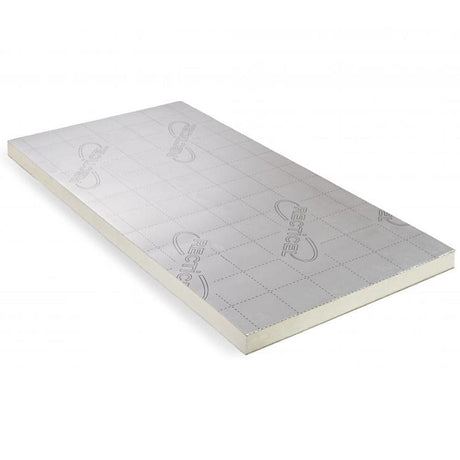
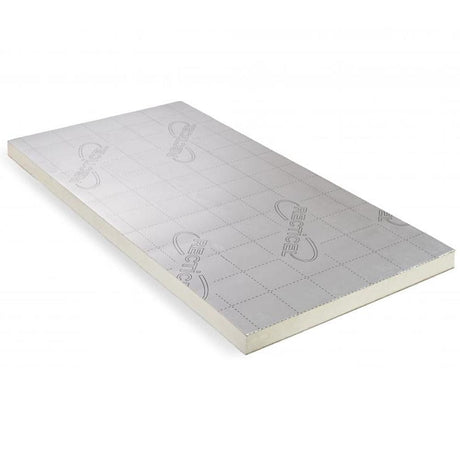
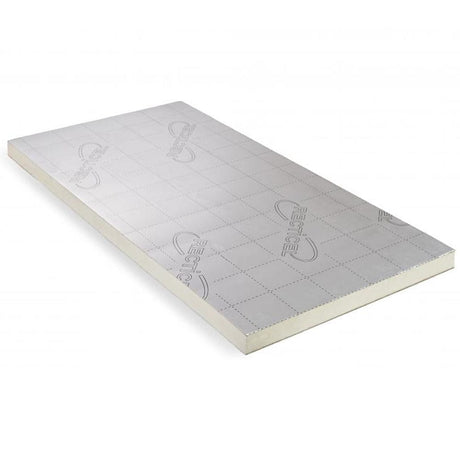
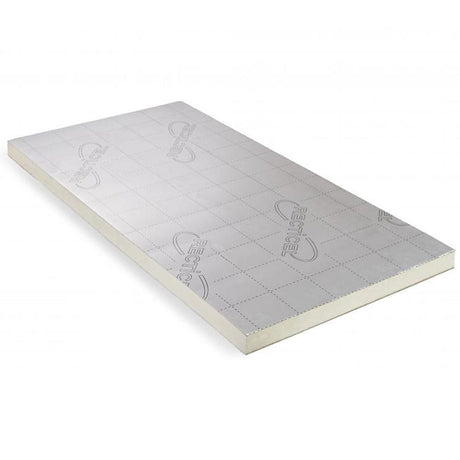
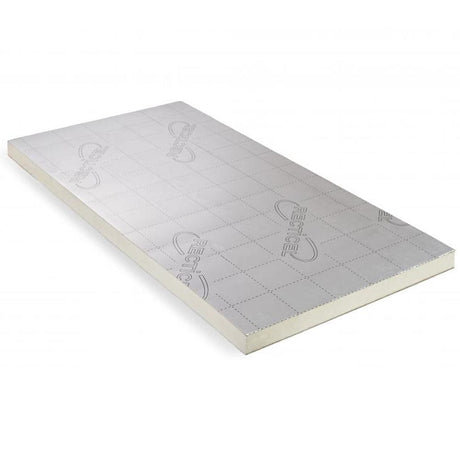
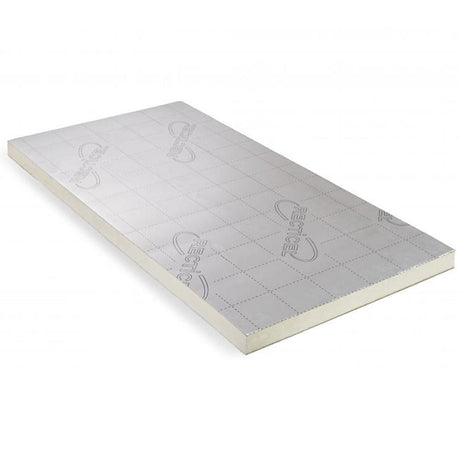
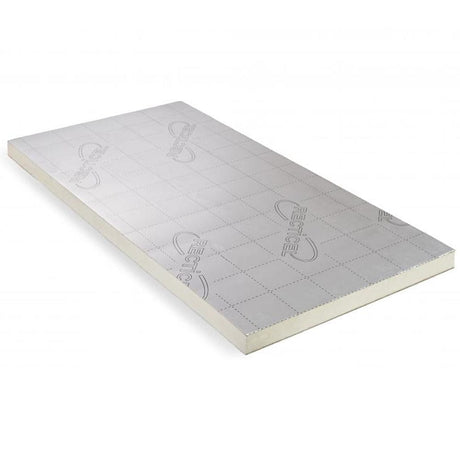
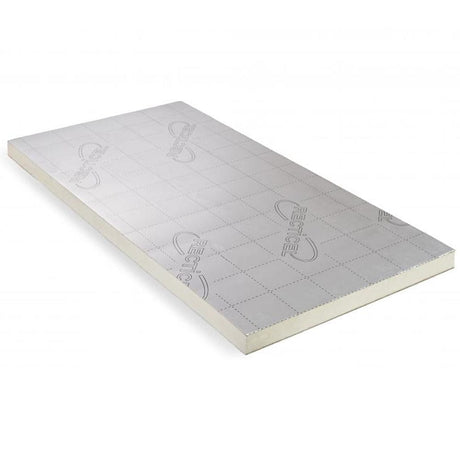
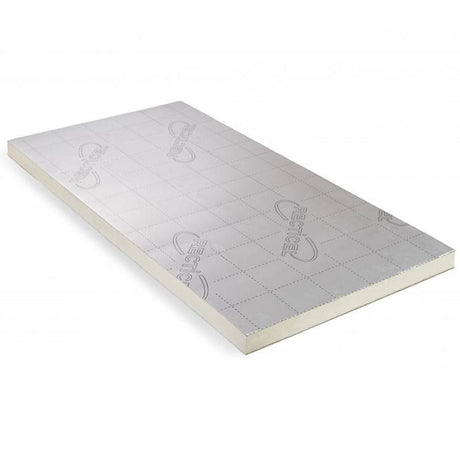
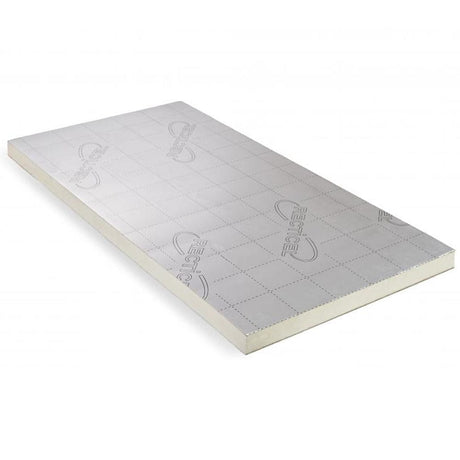
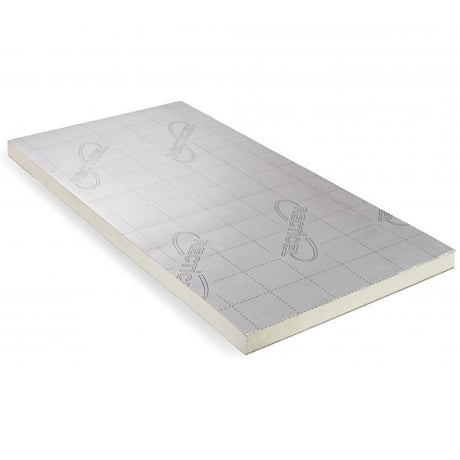
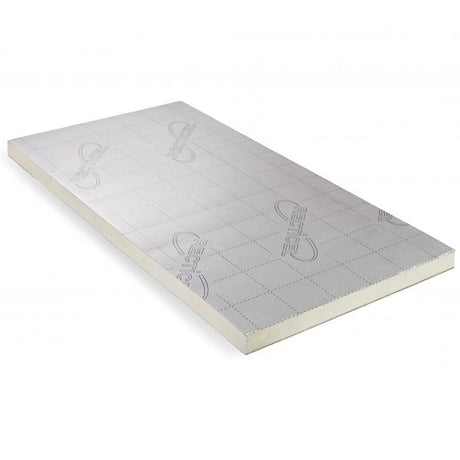
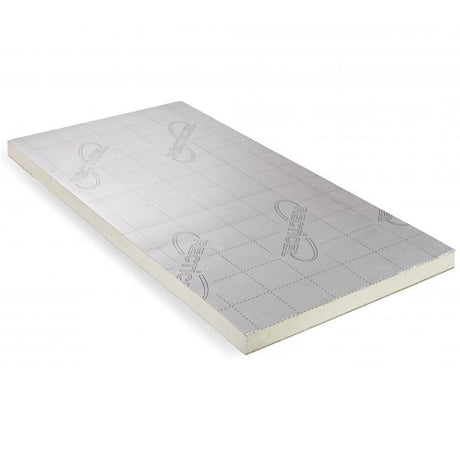
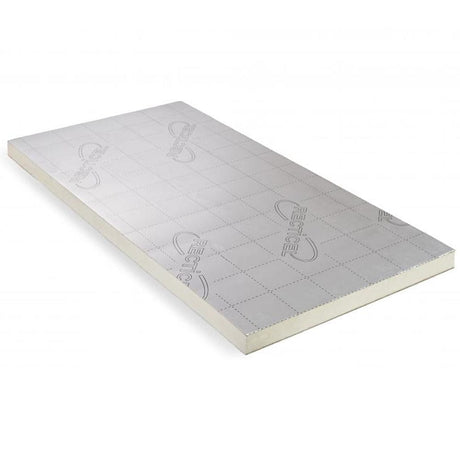
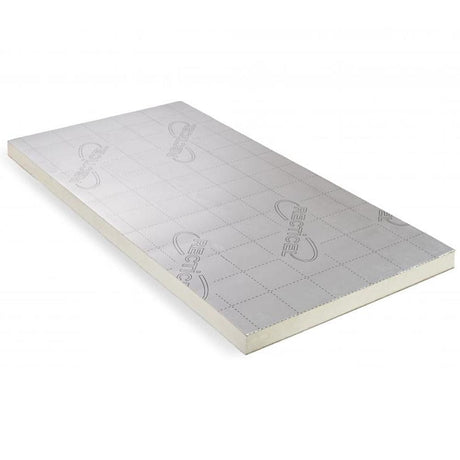
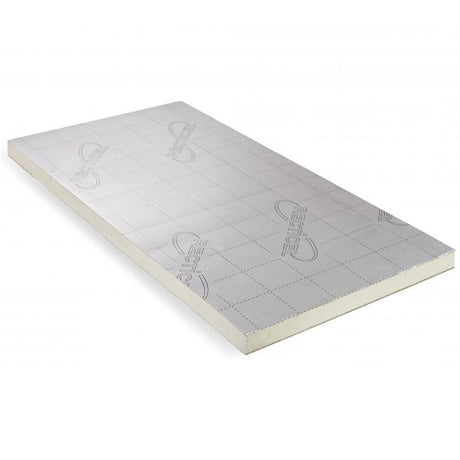
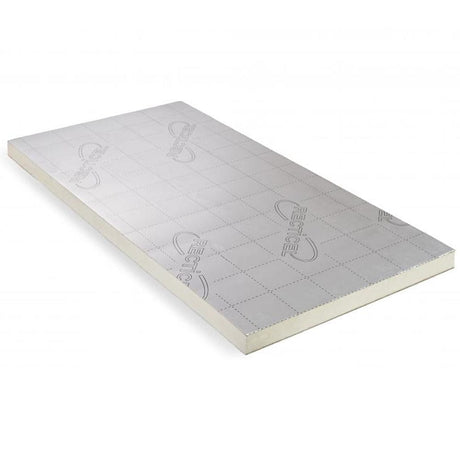
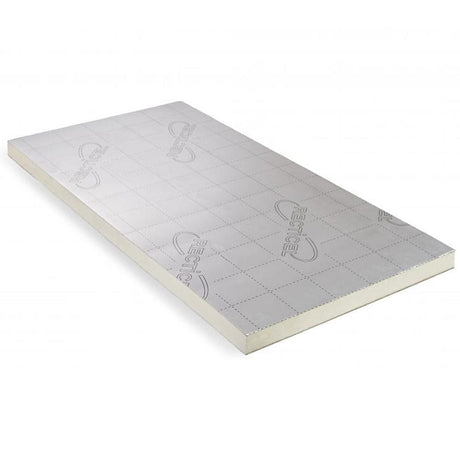
PIR is the board you reach for when you need strong thermal performance in the least possible thickness. Recticel Eurothane GP is a general-purpose PIR board built to handle the three jobs most projects throw at it: pitched roofs, framed walls and floors. Rather than one size you size up and hope for the best, it runs as a full thickness ladder, so you pick the depth that hits your target instead of layering up a board meant for something else.
Every thickness shares the same rigid PIR core, a gas-tight multilayer foil facing on both sides and a printed grid for straight cutting. The declared lambda value is fixed at 0.022 W/mK across the whole range, so thermal resistance climbs in step with thickness, from 1.10 m²K/W at 25mm up to 7.25 m²K/W at 160mm. Boards measure 2.4m x 1.2m, giving 2.88m² of cover each, with straight edges that butt together cleanly.
Insulation UK stocks the range in eighteen thicknesses, from 20mm to 160mm. Whether you are speccing a pitched roof, lining a framed wall or building up a floor, this is the part of the Recticel range worth understanding before you order.
The Recticel Eurothane GP range at a glance
Insulation UK stocks the range in eighteen thicknesses, all the same 2.4m x 1.2m board. Board size and coverage stay constant across the range, while thermal resistance climbs steadily as thickness increases. The R-values below are taken from the current Recticel Eurothane GP datasheet.
| Board | Board size | Coverage per board | R-value | Best fit |
|---|---|---|---|---|
| 20mm Eurothane GP | 2.4m x 1.2m | 2.88m² | 0.90 m²K/W* | Thin linings and upgrade layers where depth is very tight. |
| 25mm Eurothane GP | 2.4m x 1.2m | 2.88m² | 1.10 m²K/W | Slim linings and topping up where build-up depth is limited. |
| 30mm Eurothane GP | 2.4m x 1.2m | 2.88m² | 1.35 m²K/W | Internal wall linings and slim floor or roof build-ups. |
| 40mm Eurothane GP | 2.4m x 1.2m | 2.88m² | 1.80 m²K/W | Framed walls and floors where space is limited. |
| 50mm Eurothane GP | 2.4m x 1.2m | 2.88m² | 2.25 m²K/W | Framed walls, floors and roof build-ups. |
| 60mm Eurothane GP | 2.4m x 1.2m | 2.88m² | 2.70 m²K/W | Floors, framed walls and pitched roofs. |
| 70mm Eurothane GP | 2.4m x 1.2m | 2.88m² | 3.15 m²K/W | Pitched roofs, floors and framed walls. |
| 75mm Eurothane GP | 2.4m x 1.2m | 2.88m² | 3.40 m²K/W | A frequently specified depth for pitched roofs and floors. |
| 80mm Eurothane GP | 2.4m x 1.2m | 2.88m² | 3.60 m²K/W | Pitched roofs, floors and framed walls. |
| 90mm Eurothane GP | 2.4m x 1.2m | 2.88m² | 4.05 m²K/W | Roofs and floors where higher resistance is needed. |
| 100mm Eurothane GP | 2.4m x 1.2m | 2.88m² | 4.50 m²K/W | A commonly bought depth for pitched roofs and floors. |
| 110mm Eurothane GP | 2.4m x 1.2m | 2.88m² | 5.00 m²K/W | Roofs and floors targeting lower U-values. |
| 120mm Eurothane GP | 2.4m x 1.2m | 2.88m² | 5.45 m²K/W | Roofs and floors where fewer board layers are preferred. |
| 125mm Eurothane GP | 2.4m x 1.2m | 2.88m² | 5.65 m²K/W* | Where a set build-up depth between 120mm and 130mm is required. |
| 130mm Eurothane GP | 2.4m x 1.2m | 2.88m² | 5.90 m²K/W | Higher-resistance roof and floor build-ups. |
| 140mm Eurothane GP | 2.4m x 1.2m | 2.88m² | 6.35 m²K/W | Roofs and floors approaching the top of the range. |
| 150mm Eurothane GP | 2.4m x 1.2m | 2.88m² | 6.80 m²K/W | High single-board resistance for roofs and floors. |
| 160mm Eurothane GP | 2.4m x 1.2m | 2.88m² | 7.25 m²K/W | The thickest board, highest resistance in a single layer. |
*R-values for the 20mm and 125mm boards are calculated from the 0.022 W/mK declared lambda, as these thicknesses sit outside the certified 25mm to 160mm datasheet range.
Why Recticel Eurothane GP stands out
The value here is not just the lambda figure, though at 0.022 W/mK it is among the best you will find in a general-purpose board. What sets Eurothane GP apart is that one product covers the three elements most projects need insulating: pitched roofs, framed walls and floors. You are not switching product types as you move around a build, you are changing the thickness to suit each element.
The board is faced both sides with a gas-tight multilayer foil, which adds a low-emissivity surface and doubles as a vapour control layer once the joints are sealed. A printed grid on both faces makes straight cutting quick, which matters when you are sizing boards to rafters, studs or joists on site. The result is a board that is fast to fit and forgiving to work with, without giving up thermal performance.
For trade buyers, that translates into one familiar product across multiple jobs. For self-builders and serious DIYers, it means a board that is straightforward to cut, handle and fit without specialist kit.
Thermal performance and building regulations
Every thickness in the range carries a declared thermal conductivity of 0.022 W/mK. The R-values step up clearly with depth, from 1.10 m²K/W at 25mm to 7.25 m²K/W at 160mm, so the thicker the board, the more thermal resistance it adds to the build-up.
Because PIR conducts heat so slowly, it reaches a given U-value in noticeably less thickness than mineral wool or polystyrene, which is why it is the go-to where space is tight. The exact thickness you need depends on the element you are insulating and the U-value target set by your specification or building control under Part L. Eurothane GP covers roofs, walls and floors, so the same product can be specced across a project at different depths to suit each element.
It is worth being straight about one thing. A board's R-value is not the whole story: the U-value of the finished element depends on the full build-up, the other materials in it and how cleanly it is installed. Use the R-value to compare thicknesses, and confirm the target U-value for your specific element before you order.
Installation and site practicality
Eurothane GP is lightweight and easy to handle, and the printed grid lets you cut straight lines without marking out. On framed walls the boards are fixed to battens with an air gap behind, rather than bonded straight to the masonry, and finished with plasterboard. In floors they sit above or below the slab, or under screed, used with a damp-proof membrane, and the board is compatible with underfloor heating.
Cutting PIR is a messy job, so cover the floor and keep a sharp knife or insulation saw to hand. If you would rather skip the offcuts and the dust, the bespoke cutting service can supply boards cut to your sizes. The boards should be stored dry, off the ground and out of direct sunlight before they go in.
Fire safety and sustainability
Eurothane GP carries a reaction-to-fire classification of Euroclass F to EN 13501-1, and a Class 1 rating for surface spread of flame to BS 476 Part 7. Like all PIR, it is a combustible product, so it must be installed behind a suitable lining such as plasterboard in line with the relevant Building Regulations. That is a specification point to settle early rather than a fault, but it is worth being clear about.
On the environmental side, the board is manufactured using a blowing agent with zero ozone depletion potential and low global warming potential. It holds PEFC 100% chain-of-custody certification on its timber-derived content and a VOC A+ rating for low emissions, so the sustainability credentials hold up to scrutiny rather than being a line on the packaging.
Which thickness should you choose?
The right depth comes down to the element you are insulating, the U-value you need to hit and how much room you have in the build-up. As a rule of thumb: thinner boards suit linings and upgrade layers where space is short, the mid-range covers most framed walls and floors, and the thicker boards earn their place in roofs and floors chasing lower U-values with fewer layers. If you are unsure, the Insulation UK team can help you size it.
20mm Recticel Eurothane GP
The 20mm board is the slimmest in the range, for thin linings and upgrade layers where build-up depth is very limited. It sits below Recticel's published 25mm to 160mm range, so its 0.90 m²K/W R-value is calculated from the 0.022 W/mK lambda rather than separately certified.
25mm Recticel Eurothane GP
The 25mm board gives an R-value of 1.10 m²K/W, suited to slim linings and topping up an existing layer where depth is at a premium.
30mm Recticel Eurothane GP
The 30mm board (1.35 m²K/W) is a common pick for internal wall linings and slim floor or roof build-ups.
40mm Recticel Eurothane GP
The 40mm board (1.80 m²K/W) works for framed walls and floors where space is limited.
50mm Recticel Eurothane GP
The 50mm board (2.25 m²K/W) is a mid-range option for framed walls, floors and roof build-ups.
60mm Recticel Eurothane GP
The 60mm board (2.70 m²K/W) is used across floors, framed walls and pitched roofs.
70mm Recticel Eurothane GP
The 70mm board (3.15 m²K/W) suits pitched roofs, floors and framed walls.
75mm Recticel Eurothane GP
The 75mm board (3.40 m²K/W) is a frequently specified depth for pitched roofs and floors.
80mm Recticel Eurothane GP
The 80mm board (3.60 m²K/W) covers pitched roofs, floors and framed walls.
90mm Recticel Eurothane GP
The 90mm board (4.05 m²K/W) is for roofs and floors where higher thermal resistance is needed.
100mm Recticel Eurothane GP
The 100mm board (4.50 m²K/W) is one of the most commonly bought depths, for pitched roofs and floors.
110mm Recticel Eurothane GP
The 110mm board (5.00 m²K/W) suits roofs and floors targeting lower U-values.
120mm Recticel Eurothane GP
The 120mm board (5.45 m²K/W) is for roofs and floors where fewer board layers are preferred.
125mm Recticel Eurothane GP
The 125mm board sits between the 120mm and 130mm boards for a set build-up depth. Its 5.65 m²K/W R-value is calculated from the 0.022 W/mK lambda, as this thickness is not listed on the current datasheet.
130mm Recticel Eurothane GP
The 130mm board (5.90 m²K/W) is for higher-resistance roof and floor build-ups.
140mm Recticel Eurothane GP
The 140mm board (6.35 m²K/W) approaches the top of the range for demanding U-value targets.
150mm Recticel Eurothane GP
The 150mm board (6.80 m²K/W) gives high single-board resistance for roofs and floors.
160mm Recticel Eurothane GP
The 160mm board (7.25 m²K/W) is the thickest in the range, giving the highest resistance in a single layer.
Can you use Eurothane GP for cavity walls?
This comes up often, and the honest answer is that Eurothane GP is built for pitched roofs, framed walls and floors, not full-fill masonry cavities. It has straight edges rather than the tongue-and-groove profile a cavity board uses to keep continuity across joints, and it is not designed to bridge a masonry cavity. Using it there means cutting boards to fit and managing the residual cavity yourself, which is not what the board is set up to do.
For cavity work, the correct specification is a cavity-specific board. Eurowall+ full fill is designed for full fill masonry cavities, and Eurowall partial fill for partial fill build-ups, both with tongue-and-groove edges that keep the insulation layer continuous. If your job is a cavity wall, start there rather than with the general-purpose board.
Quality and specification confidence
Eurothane GP is backed by the documentation specifiers and building control look for. It holds BBA Agrément Certificate 24/7254, is CCPI assessed, and is manufactured to product standard EN 13165:2012 + A2:2016 under ISO 9001:2015 quality management and ISO 14001:2015 environmental management. A current datasheet and Declaration of Performance are available for the range.
That breadth of paperwork matters because insulation is not a category where vague confidence is enough. It makes the board straightforward to put in front of an architect, energy assessor or building control officer. Always check the latest Recticel datasheet, Declaration of Performance and BBA certificate for the exact thickness before specification.
Any drawbacks?
The main thing to keep in mind is the fire classification. Eurothane GP is a combustible product with a Euroclass F rating, so it always needs a suitable lining over it to meet Building Regulations. That is standard for PIR, but it is a planning point to settle before you order. It is also moisture resistant rather than waterproof, so it should be kept dry on site and is not the board for below-ground or permanently wet conditions.
Two thicknesses are worth a second look. The 20mm and 125mm boards are stocked but fall outside the thicknesses listed on the current Recticel datasheet, so their R-values are calculated from the 0.022 W/mK lambda rather than separately certified, and are worth confirming with Recticel before relying on them in a specification. And as covered above, this is a roof, wall and floor board, not a cavity board, so check you are buying the right product for the element before you commit.
Our expert verdict
Recticel Eurothane GP is one of the most dependable choices in the general-purpose PIR category because it gets the fundamentals right. The fixed 0.022 W/mK conductivity gives strong thermal performance in a thin board, the foil facing and printed grid make it quick to fit, and the eighteen-thickness ladder means there is a depth for almost any roof, wall or floor target.
The real strength is that range. For most framed walls and floors the mid-range thicknesses do the job, while roofs and demanding U-value targets are covered by the thicker boards up to 160mm at 7.25 m²K/W. Match the depth to your element and your target U-value, check the datasheet figure for that thickness, and Eurothane GP does the job without fuss.
For any roof, framed wall or floor project where thermal performance and a clean install both matter, the Recticel Eurothane GP range belongs on your shortlist.
Shop the Recticel Eurothane GP range today, or speak to the Insulation UK team on 03003 034 578 if you need help choosing the right thickness for your project.