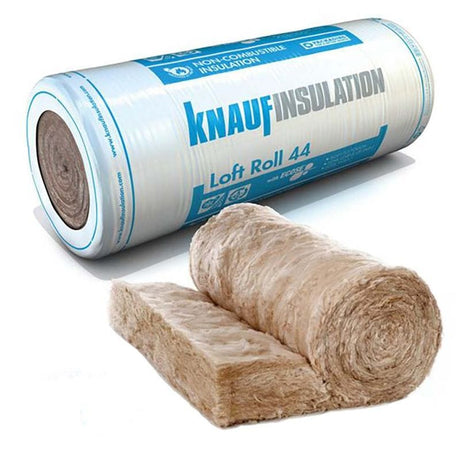
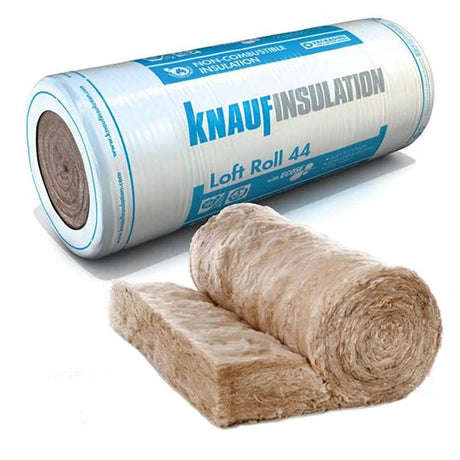
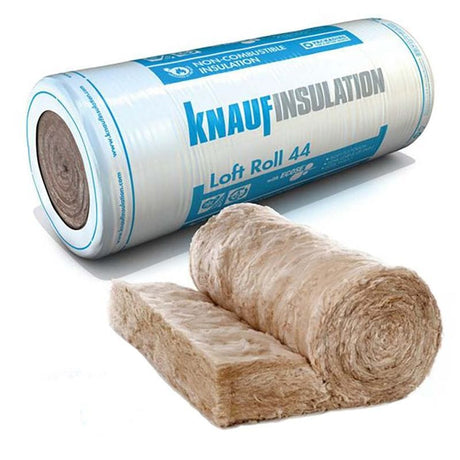
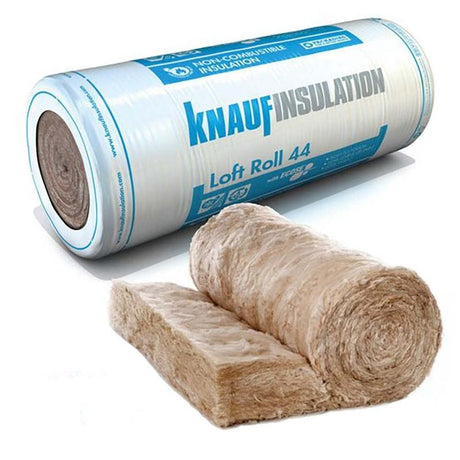
Loft insulation is the cheapest, highest-return thermal upgrade most homes will ever get. The catch is that a loft roll only does its job properly when the layering is right, the joists are filled flush and the gaps are kept to a minimum. That is the whole idea behind Knauf Loft Roll 44 Combi-cut.
It is a glass mineral wool roll designed for insulating cold pitched roofs at ceiling level, and it is one of the most widely used loft insulation products in the country. Rather than being a single board you size up once, the range is built as a layering system. Four thicknesses (100mm, 150mm, 170mm and 200mm) all share the same 0.044 W/mK thermal conductivity, so you choose the combination that hits your target depth rather than wrestling one roll into a job it was not meant for.
The combi-cut format is the part that earns its name on site. Each roll is partially perforated at 2 x 570mm and 3 x 380mm across its 1.14m width, so it tears cleanly to suit joists at 400mm or 600mm centres, or rolls out uncut as a full-width cross-laid layer. Add a Euroclass A1 non-combustible fire classification and ECOSE Technology, Knauf's bio-based binder, and you have a product that performs on thermal numbers, fire and sustainability at the same time.
For anyone topping up an existing loft, insulating a new build to specification or fitting out a garage or extension roof, this is exactly the kind of range that deserves a proper look.
The Knauf Loft Roll 44 Combi-cut range at a glance
Insulation UK stocks the range in four thicknesses, all 1.14m wide in combi-cut format. Thermal resistance climbs steadily as thickness increases, and coverage per roll drops accordingly, which matters when you are working out how many rolls a loft needs.
| Product | Roll size | Coverage per roll | R-value | Best fit |
|---|---|---|---|---|
| 100mm Knauf Loft Roll 44 Combi-cut | 12.18m x 1.14m | 13.89m² | 2.25 m²K/W | The base layer, laid flush between ceiling joists. |
| 150mm Knauf Loft Roll 44 Combi-cut | 8.05m x 1.14m | 9.18m² | 3.40 m²K/W | A cross-laid overlay; two layers over a 100mm base reach a strong 400mm. |
| 170mm Knauf Loft Roll 44 Combi-cut | 7.03m x 1.14m | 8.01m² | 3.85 m²K/W | The simplest route to the 270mm minimum in a two-layer install. |
| 200mm Knauf Loft Roll 44 Combi-cut | 6.00m x 1.14m | 6.84m² | 4.50 m²K/W | A top overlay for maximum depth and the lowest U-values. |
Why Knauf Loft Roll 44 Combi-cut stands out
The value here is not just the lambda figure. Plenty of loft rolls sit at a similar thermal conductivity. What sets Loft Roll 44 apart is how well it is set up for the way lofts are actually insulated: a base layer between the joists, then one or two cross-laid layers over the top.
The combi-cut perforations are central to that. Standard joist centres of 400mm and 600mm are catered for without dragging a knife down the whole roll, so the base layer fills flush and the cross-laid layers run out fast and clean. Fewer cuts means fewer gaps, and fewer gaps means the insulation performs closer to its rated figure once it is down.
For trade buyers, that translates into a quicker, more repeatable install. For homeowners and self-builders, it means you are buying a loft roll that has been designed around the job, not a generic blanket cut to length.
Thermal performance and building regulations
Every thickness in the range carries a declared thermal conductivity of 0.044 W/mK, which is the standard you would expect from a quality glass mineral wool loft roll. The R-values step up clearly with depth: 2.25 m²K/W at 100mm, 3.40 m²K/W at 150mm, 3.85 m²K/W at 170mm and 4.50 m²K/W at 200mm.
Depth is what drives compliance. Building regulations require a minimum total insulation depth of 270mm in England and Wales, and 350mm in Scotland. New build properties typically run deeper still, with 400mm to 500mm common. That is why the layering matters: a 100mm base plus a 170mm cross-laid layer lands you on exactly 270mm with a U-value of 0.16 W/m²K. Build it deeper and the U-value keeps falling, reaching 0.11 W/m²K at 400mm, 0.10 W/m²K at 440mm and 0.09 W/m²K at 500mm.
It is worth being straight about one thing. These figures relate to the insulation build-up. The final performance of the ceiling also depends on workmanship, ventilation, the condition of the loft and how cleanly the layers are laid. Get the install right and the numbers look after themselves.
Installation and site practicality
This is where Loft Roll 44 does a lot of its talking. The combi-cut perforations let you split the roll to joist width by hand, and the full 1.14m width rolls out across the joists for the cross-laid layer with very little trimming. Less cutting on a dusty loft job is always welcome.
The material itself is easy to live with. It is lightweight, low-itch and comfortable to handle, which the reviews back up: customers consistently note it is less irritating to work with than many alternatives and that it rolls out and recovers to full thickness without fuss. It is also rot proof, odourless and non-hygroscopic, so it will not attract rodents or support mould, fungi or bacteria, and it is built to last the lifetime of the building rather than slumping over the years.
Fire safety and sustainability
Knauf Loft Roll 44 carries a Euroclass A1 reaction-to-fire classification. That is the highest rating on the scale, meaning the product is classified as non-combustible and does not contribute to a fire. In a loft, where you want the simplest possible fire story above your ceilings, that is a genuine reassurance and a point worth raising with building control where relevant.
On the environmental side, the range is manufactured with ECOSE Technology, a bio-based binder with no added formaldehyde or phenol. It contains up to 80% recycled glass content, is CFC and HCFC free and has zero ozone depletion potential. It carries a BRE Green Guide A+ rating, a BES 6001 'Very Good' responsible sourcing rating and a DECLARE Red List Free label, so the sustainability credentials hold up to scrutiny rather than being a line on the packaging.
Which thickness should you choose?
100mm Knauf Loft Roll 44 Combi-cut
The 100mm roll is the base layer almost every loft starts with. It is laid between the ceiling joists to fill them flush, at either 400mm or 600mm centres, before the cross-laid layers go over the top. On its own it does not meet building regulations, so think of it as step one. Pair it with a 170mm layer to hit the 270mm minimum, or build higher with 200mm layers to maximise performance. At 13.89m² per roll it also offers the most coverage in the range.
150mm Knauf Loft Roll 44 Combi-cut
The 150mm roll is a strong cross-laid overlay. Laid at right angles over a 100mm base, a single layer brings the total to 250mm, just under the minimum, while two 150mm layers over the base reach 400mm, which is a solid specification for most domestic lofts and gives a U-value of 0.11 W/m²K. Cross-laying perpendicular to the base layer also helps break up thermal bridging across the joists.
170mm Knauf Loft Roll 44 Combi-cut
The 170mm roll is the one most people actually need. Lay 100mm between the joists, roll 170mm across the top at right angles, and you have exactly 270mm with a U-value of 0.16 W/m²K. That is the building regulation minimum for England and Wales met in a simple, cost-effective two-layer install. For Scotland's 350mm requirement, a second 170mm layer takes you to 440mm and a U-value of 0.10 W/m²K.
200mm Knauf Loft Roll 44 Combi-cut
The 200mm roll is the highest-performing single roll in the range, with an R-value of 4.50 m²K/W. It is the overlay to reach for when depth and the lowest U-values are the priority. A 100mm base with two 200mm cross-laid layers reaches 500mm and a U-value of 0.09 W/m²K, which is well into high-specification territory for a domestic loft.
Can you use Knauf Loft Roll 44 Combi-cut anywhere other than the loft?
This comes up often, and the honest answer is that Loft Roll 44 is built for one job. Knauf's datasheet is specific: the product is designed for the thermal insulation of cold pitched roofs at ceiling level, laid between the joists and then across them. It is an unfaced glass mineral wool quilt with no vapour control layer, so it is not the right choice for cavity walls, warm-roof (rafter-level) build-ups or anything below ground. For those jobs, a dedicated board or a faced product is the correct specification.
There is one widely accepted extension. Because it is a generic glass mineral wool quilt, the same roll is often laid between suspended timber floor joists, where there is room for a decent depth, to add thermal resistance to a ground floor. That use sits outside Knauf's headline application, so it is worth confirming suitability and following Knauf's guidance before relying on it.
It is also worth knowing that glass mineral wool is naturally sound absorbing. The same open fibrous structure that traps heat helps dampen airborne noise, so a well-filled loft floor offers a modest secondary benefit in softening sound transfer between the loft and the rooms below. This comes as a bonus rather than a rated acoustic performance: Loft Roll 44 is a thermal product first, so where sound control is the real priority a purpose-made acoustic roll is the better specification.
Quality and specification confidence
Loft Roll 44 is backed by the documentation specifiers and building control look for. It is manufactured to BS EN 13162:2012+A1:2015 and carries a CCPI Verification Mark (certificate number 000600173/0627), so the published performance is independently verified. The fibres are EUCEB certified against the exoneration criteria for carcinogenicity, and manufacture is covered by ISO 9001, ISO 14001, ISO 45001 and ISO 50001. A current Environmental Product Declaration is also available.
That breadth of paperwork matters because loft insulation is not a category where vague confidence is enough. It makes the product straightforward to put in front of an architect, energy assessor or building control officer.
Any drawbacks?
The main thing to keep in mind is that no single roll in this range meets building regulations on its own. Loft Roll 44 is a layering system, so the 100mm base always needs cross-laid layers over the top, and the thickness you choose depends on the total depth you are targeting. That is a planning point rather than a fault, but it is the question to settle before you order.
It is also worth checking your loft itself. Insulating to 270mm or beyond means losing usable head height for storage unless you raise the loft boarding, and any downlights, wiring or recessed fittings need to be handled correctly. The roll is designed for internal dry applications, so it should be stored covered, off the ground and protected from the weather before it goes in.
Our expert verdict
Knauf Loft Roll 44 Combi-cut is one of the most dependable choices in the loft roll category because it gets the fundamentals right. The 0.044 W/mK conductivity gives a solid thermal base, the Euroclass A1 rating keeps the fire story simple, the ECOSE and recycled-glass credentials stand up, and the combi-cut format genuinely speeds up the install.
The real strength is the four-thickness layering system. The 100mm roll is the base layer nearly every loft needs. If you want the most practical all-rounder, the 170mm is the standout: a 100mm base plus a 170mm overlay meets the 270mm minimum in just two layers. For higher specifications, two 150mm or two 200mm layers over a 100mm base take you to 400mm and 500mm respectively, with U-values down to 0.09 W/m²K.
For any loft project where thermal performance, fire safety and a clean install all matter, the Knauf Loft Roll 44 Combi-cut range belongs on your shortlist.
Shop the Knauf Loft Roll 44 Combi-cut range today, or speak to the Insulation UK team on 03003 034 578 if you need help choosing the right combination for your loft.