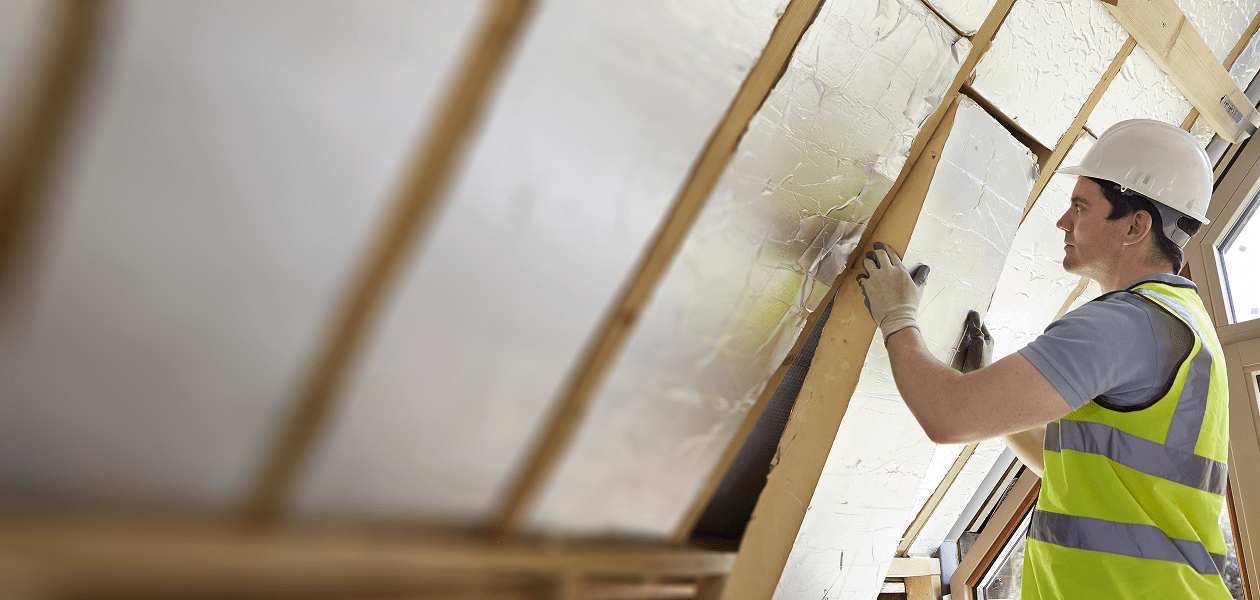
ODE STARflex Acoustic Partition Roll HP quietens a stud partition, floor void or timber-framed wall without redrawing the build-up. It's a glass mineral wool roll made specifically for sound absorption, not thermal performance, and it does one job well.
Insulation UK stocks it in four thicknesses, from a slimline 25mm up to a full 100mm. Every roll is 1200mm wide and factory pre-cut into two 600mm widths, so it friction-fits straight between standard stud centres with minimal cutting on site.
Previously sold as LUNAflex. ODE has consolidated this product under its STARflex glass mineral wool brand. If you've specified or ordered ODE LUNAflex Acoustic Partition Roll HP before, STARflex APR HP is the same product under the current name. ODE's own Declaration of Performance covers both names against the same product type, and the roll dimensions, coverage and performance figures are unchanged.
The range at a glance
Coverage per roll drops sharply as thickness increases, so quantities and pack numbers can look very different across the range for the same square metreage. Always calculate by area needed rather than roll count.
| Thickness | Roll dimensions | Coverage per roll | Density | Product code |
|---|---|---|---|---|
| 25mm | 1.2m x 20m | 24m² | 24 kg/m³ | STO6580 |
| 50mm | 1.2m x 10m | 12m² | 18 kg/m³ | STO6581 |
| 75mm | 1.2m x 8m | 9.6m² | 15 kg/m³ | STO6583 |
| 100mm | 1.2m x 6.5m | 7.8m² | 12 kg/m³ | STO6584 |
Density falls as thickness rises, from 24 kg/m³ at 25mm down to 12 kg/m³ at 100mm. The thicker rolls build their acoustic layer through depth of material rather than a denser section, which keeps them light to handle and easy to friction-fit at full thickness.
Why STARflex APR HP stands out
An acoustic partition roll is a simple product on paper: mineral wool cut to fit a stud cavity. What separates a well-specified one from a forgettable one is in the detail, and ODE has covered the basics properly.
- Euroclass A1 non-combustible. The range carries the highest reaction to fire classification available, A1 to BS EN 13501-1.
- Sound absorption coefficient 0.8 to 1.0. ODE quotes a high absorption range for the material itself, which is what matters for the layer doing the actual absorbing inside a cavity.
- Published partition test data. ODE quotes 40.1dB and 45.1dB for two specific partition build-ups, set out in full below. Plenty of acoustic rolls are sold on a coefficient alone.
- BREEAM A+ rated. Rated A+ under the BRE Green Guide, useful where a specification needs to show sustainable material choices.
- Over 80% recycled glass content. Made predominantly from recycled glass rather than virgin raw material.
- Pre-cut to 600mm. Every 1200mm roll arrives split into two 600mm widths, fitting standard stud centres without extra cutting.
Acoustic performance
ODE quotes a sound absorption coefficient of 0.8 to 1.0 for STARflex APR HP. That figure describes how effectively the material absorbs sound energy, not how much noise a finished wall blocks: that's the Sound Reduction Index, a property of the whole build-up (studs, boards, sealant and roll together), not the roll on its own.
Usefully, ODE also publishes figures for two complete partition build-ups, which gives a far better sense of what the material does in a real wall.
| Wall build-up | Finished wall thickness | Sound absorption value |
|---|---|---|
| 50mm profile, 50mm STARflex APR, 12.5mm plasterboard both sides | 75mm | 40.1dB |
| 100mm profile, 100mm STARflex APR, 15mm plasterboard both sides | 130mm | 45.1dB |
Both figures are ODE's own published values for those exact build-ups. Change the profile, the board thickness or the board layup and the result changes with it, so treat them as a guide rather than a substitute for the project's acoustic specification. A deeper layer of absorptive material generally gives more headroom to work with inside a stud cavity, which is one reason the range runs from 25mm through to 100mm rather than stopping at a single thickness.
STARflex APR HP doesn't carry a published UK thermal conductivity (lambda) value. It isn't given on ODE's website, its Declaration of Performance or its product datasheet. Specify it for acoustic performance, not as a thermal upgrade. Where thermal performance is also needed in the same build-up, pair it with a dedicated thermal insulation product rather than expecting this range to do both jobs.
Fire performance
Every thickness in the range achieves Euroclass A1 non-combustible to BS EN 13501-1, the highest reaction to fire classification a building material can hold. That's a strong result for a partition insulation product and worth factoring in on any project where fire strategy is under scrutiny, from party walls to commercial fit-outs. As with any reaction to fire classification, this describes the material itself; overall fire resistance in minutes is a property of the complete wall or floor system, not the insulation alone, so always check that against the full specification.
Standards and certification
- Euroclass A1 reaction to fire to BS EN 13501-1.
- CE marked and TSE certified to BS EN 13162, the standard for factory made mineral wool thermal insulation products for buildings.
- EUCEB registered, confirming the mineral wool fibres meet European bio-solubility requirements.
- Environmental Product Declaration registered with The International EPD System.
- Manufactured under ISO 9001, ISO 14001, ISO 45001, ISO 50001 and ISO 27001 management systems.
Which thickness do you need?
- 25mm, the shallow retrofit option. Suited to shallow cavities, stud upgrades or adding sound absorption without eating into room space, such as retrofitting acoustic performance into an existing partition. Roll length is longest at this thickness (20m), so it also delivers the highest coverage per roll across the whole range at 24m².
- 50mm, the frequently specified middle ground. A sensible default inside standard partition wall build-ups, and the thickness ODE publishes its 40.1dB partition figure against, so it's an easy one to point a specification at.
- 75mm, for deeper cavities. Suits deeper stud and joist cavities where more absorptive depth is available and worth using, commonly seen in separating walls between rooms with a higher noise-control requirement.
- 100mm, the deepest roll in the range. Aimed at the largest cavities, such as separating floors and full-depth partition voids, and the thickness behind ODE's strongest published figure at 45.1dB in a 130mm wall. Roll length is shortest here (6.5m, 7.8m² per roll), so factor extra rolls into larger-area quantities.
Not sure which thickness suits your cavity depth? Our team can talk it through.
Call 03003 034 578Installation
STARflex APR HP is designed for timber and metal-framed partition and separating walls, and for floor and ceiling voids where a similar cavity exists. Installation follows the same pattern across all four thicknesses.
- Friction-fit the pre-cut widths. Each 1200mm roll is factory pre-cut into two 600mm widths, so it fits standard stud centres without needing to be cut down first, keeping on-site waste low and speeding up the first fix.
- Loose-lay into the void. Work the roll gently into place rather than compressing it. Compressing mineral wool reduces its absorptive capacity.
- Fill the full depth of the cavity. Gaps at the edges or a partially filled void give sound an easy path through.
- Finish with the specified lining to complete the wall, floor or ceiling build-up.
An acoustic partition roll on its own reduces noise passing through the cavity it fills. It won't solve flanking noise travelling around a partition through floors, ceilings or gaps at the perimeter. For a genuinely quiet result, pair it with the specified acoustic plasterboard, acoustic sealant at all perimeter junctions, and resilient bar or isolation clips where called for.
Storage and handling
STARflex APR HP is supplied on ODE's Hyperpack palletised system, which compresses the packs for transport and storage. Pallet quantities are 24 packs for 25mm, 32 for 50mm, 24 for 75mm and 32 for 100mm. ODE states the packaging allows outdoor storage and handling by transpallet, which is worth knowing on a site with limited covered space.
Sustainability
Two figures do the work here: STARflex APR HP is manufactured from over 80% recycled glass, and the range holds a BREEAM A+ rating under the BRE Green Guide. ODE also holds an Environmental Product Declaration registered with The International EPD System for its STARflex glass wool.
ODE states that its glass mineral wool does not degrade, decompose or become mouldy over time, supporting the case for a product that shouldn't need replacing partway through a building's life.
STARflex APR HP vs STARflex Loft Roll Ultra 42
STARflex is ODE's glass mineral wool brand and covers more than one product, so it's easy to pick up the wrong one if you're only skimming a listing. STARflex Acoustic Partition Roll HP is pre-cut into 600mm widths and built for sound absorption in partition walls, floors and ceilings. STARflex Loft Roll Ultra 42 is a different product entirely: a thermal roll pre-cut into 570mm widths, designed for cold loft spaces at ceiling level.
| Attribute | APR HP | Loft Roll Ultra 42 |
|---|---|---|
| Job | Sound absorption in partition walls, floors and ceilings | Thermal insulation in cold pitched roofs |
| Thicknesses stocked | 25, 50, 75, 100mm | 100, 150, 200mm |
| Pre-cut width | 600mm, from a 1.2m roll | 570mm, from a 1.2m roll |
| Fire rating | Euroclass A1 | Euroclass A1 |
| Declared lambda | Not published, acoustic spec | 0.042 W/mK |
Confirm you're looking at the acoustic partition roll (600mm pre-cut, coverage as set out in the range table above) rather than the loft roll, especially when comparing coverage figures across suppliers. Browse the full ODE insulation range to see both side by side.
Any drawbacks?
- No published UK lambda value. This is an acoustic product, not a thermal one, so it shouldn't be specified anywhere a declared U-value or R-value contribution is required.
- Coverage per roll drops sharply as thickness increases, from 24m² at 25mm down to 7.8m² at 100mm, so quantities and pack numbers can look very different across the range for the same square metreage.
- Partition data covers two build-ups only. ODE publishes figures for a 75mm and a 130mm wall. If your build-up differs, you're back to working from the absorption coefficient and the wider system specification.
- Doesn't solve flanking noise on its own. Budget for acoustic sealant, the specified plasterboard and, where called for, resilient bar or isolation clips alongside it.
Our expert verdict
Across all four thicknesses, STARflex APR HP is a well-specified acoustic partition roll: Euroclass A1 fire rated, a sound absorption coefficient of 0.8 to 1.0, published partition figures of 40.1dB and 45.1dB, made from over 80% recycled glass, and pre-cut for a fast, low-waste fit. It won't do a thermal job, and it isn't a standalone fix for every noise problem in a building, but as the acoustic layer inside a partition, floor or ceiling void, it does what it's meant to across a thickness range wide enough to suit most stud depths.
Not sure which thickness suits your partition? Call 03003 034 578 and our team will help you specify it.
Shop ODE STARflex Insulation