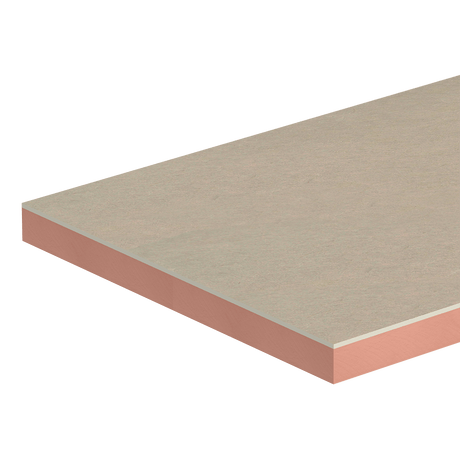
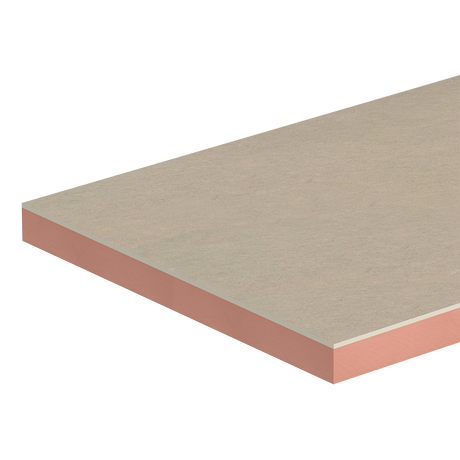
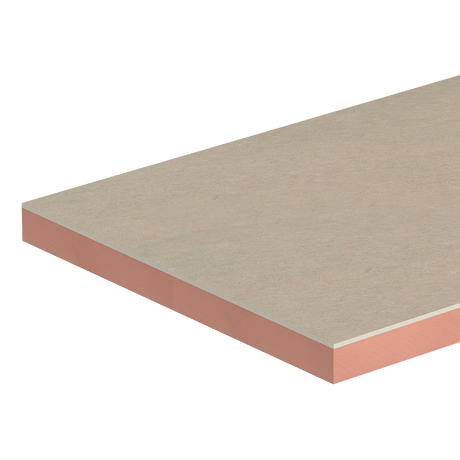
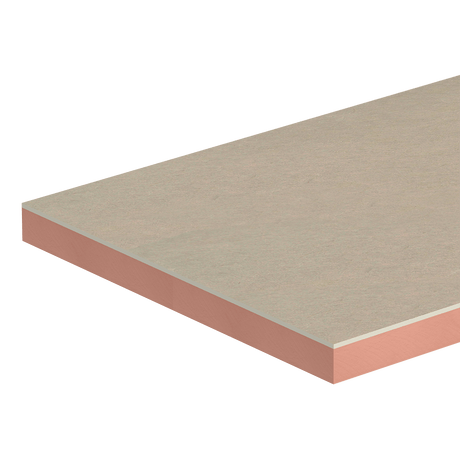
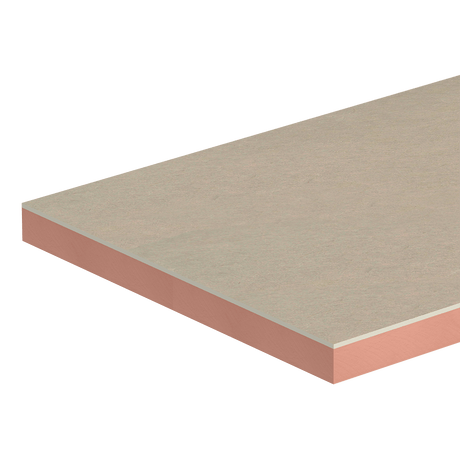
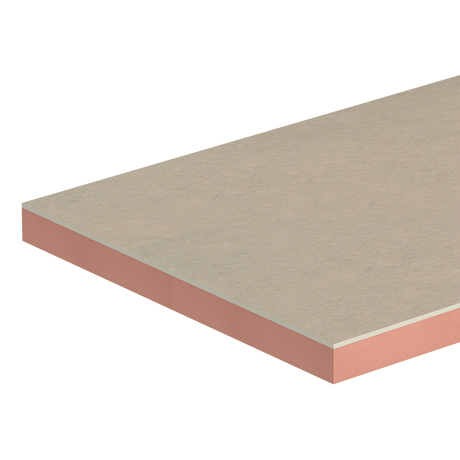
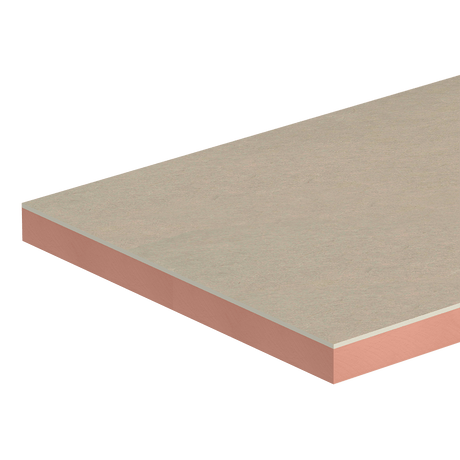
Kingspan Kooltherm® K118 Insulated Plasterboard combines a phenolic insulation core with a 12.5mm tapered-edge plasterboard face in one factory-bonded board, built for internal wall insulation on solid or cavity masonry. It's a different chemistry to a standard PIR laminate, and that difference is what gives it its performance.
Insulation UK stocks it across six thicknesses, all sharing the same 0.019 W/mK lambda, with more phenolic core behind the plasterboard as you move up the range. Here's what it actually is, board by board.
Kooltherm K118 replaced Kingspan's older K17 and K18 ranges. If you've seen either name still doing the rounds on an older spec, it's the same product family under current branding.
What Is Kingspan Kooltherm® K118, Exactly?
K118 is built around a fibre-free rigid thermoset phenolic insulation core, factory-bonded to a 12.5mm tapered-edge gypsum plasterboard on the room-facing side. Kingspan's PIR products sit in the separate Therma range; Kooltherm is phenolic chemistry, and that's what gives K118 a lower lambda than a same-thickness PIR laminate. The reverse face carries a low-emissivity composite foil that acts as an integral vapour control layer, and the tapered edge lets joints be filled and skim-finished in the normal way. Every board is manufactured in the UK, at Kingspan's Pembridge site in Herefordshire.
The Core Numbers: Lambda, Fire Class And BBA
K118's declared thermal conductivity is 0.019 W/mK, constant across every thickness in the range. It's worth flagging because an older datasheet quoted 0.018 W/mK, and that superseded figure is still doing the rounds on a lot of retailer pages. If you've seen 0.018 quoted elsewhere, it's out of date.
| Property | Figure |
|---|---|
| Thermal conductivity (lambda) | 0.019 W/mK, constant across all thicknesses |
| Fire classification (whole board) | Euroclass B-s1,d0 to BS EN 13501-1:2018 |
| Fire classification (plasterboard facing) | Euroclass A2-s1,d0 |
| Compressive strength | Typically >100 kPa at 10% compression (BS EN 826) |
| Vapour control | Integral, via the low-emissivity composite foil on the reverse face |
| BBA certificate | 16/5299, Product Sheet 8, Issue 2 (25 July 2024) |
One distinction worth being clear on: B-s1,d0 and A2-s1,d0 describe how the board reacts to fire, not how long a complete wall build-up will resist it. Reaction-to-fire is a product-level classification; fire resistance is a whole-system outcome that depends on the wall it's built into.
Not sure which thickness suits your wall? Our team can talk it through.
Call 03003 034 578The Range At A Glance
Every K118 board measures 2400mm x 1200mm whatever the thickness, so coverage per board is a constant 2.88m² across the range. The only thing that changes is the phenolic core, which sits behind a fixed 12.5mm layer of plasterboard, so a thicker board simply means a thicker core doing more work.
| Board thickness | Insulation core | Coverage per board | Thermal resistance |
|---|---|---|---|
| 37.5mm | 25mm | 2.88m² | 1.30 m²K/W |
| 42.5mm | 30mm | 2.88m² | 1.55 m²K/W |
| 52.5mm | 40mm | 2.88m² | 2.10 m²K/W |
| 62.5mm | 50mm | 2.88m² | 2.60 m²K/W |
| 72.5mm | 60mm | 2.88m² | 3.15 m²K/W |
| 82.5mm | 70mm | 2.88m² | 3.65 m²K/W |
Thermal resistance calculated to BS EN 13166 (core thickness ÷ 0.019 W/mK, rounded down to the nearest 0.05 m²K/W). 52.5mm and 72.5mm figures are confirmed directly against Kingspan's current datasheet.
- 37.5mm and 42.5mm suit projects where wall thickness or door reveals are tightly constrained and every millimetre of build-up counts.
- 52.5mm and 62.5mm cover most standard internal wall insulation upgrades on solid or cavity masonry.
- 72.5mm and 82.5mm come into play where the target U-value is more ambitious, or the wall is already a poor performer and needs a bigger step-change in one layer.
U-Values Are A Wall Decision, Not A Board Spec
None of the figures above are a U-value, and no board on its own has one. The U-value of an insulated wall depends on the whole build-up: the masonry type and thickness, the fixing method, and any secondary fixings through the insulation layer. Kingspan publishes U-value tables for common wall constructions, but the right figure for your project needs a proper calculation against the actual wall, along with a condensation risk assessment to BS 5250.
Specifying K118 as part of a grant-funded retrofit scheme, such as ECO4, GBIS or Warm Homes: Local Grant? That work needs to follow PAS 2035:2023, which requires a moisture risk assessment for internal wall insulation before installation. It isn't a legal requirement on private able-to-pay jobs, but it's increasingly expected as good practice there too.
Where K118 Is Used
K118 is designed for internal wall insulation, most commonly as a retrofit upgrade to existing solid or cavity masonry walls, and also specified in new build dry lining. It should be installed in line with Kingspan's current guidance and the project specification.
- Seal every joint, penetration and perimeter. The integral VCL only performs as intended when these details are sealed correctly.
- Add a second line of defence where needed. Two coats of Gyproc Drywall Sealer can be applied where extra vapour resistance is required.
- Don't use it to isolate dampness. K118 isn't designed for continuously humid conditions or as a damp-proofing measure.
- Check your adhesive. Some solvent-based adhesives, particularly those containing MEK, aren't compatible with the board.
If you're working to Part L thermal upgrade requirements, note that this applies in England. Scotland, Wales and Northern Ireland each work to their own building standards, so check the equivalent requirement for the nation you're building in.
Any Drawbacks?
- Premium pricing. Phenolic performance costs more than volume PIR laminates of a similar thickness. Worth it where lambda or fire class is decisive; a needless spend if it isn't.
- Detailing matters more than usual. The integral VCL is only as good as your jointing, so this isn't a board to rush the finishing on.
- Not every thickness is stocked as standard. Sizes outside the 37.5mm to 82.5mm range shown above are made to order and carry longer lead times, so check before you commit to a project programme.
Our Verdict
K118 earns its premium position through genuine phenolic performance: a constant 0.019 W/mK lambda across the range, a BBA-certified system, and a UK-manufactured board with an integral VCL that removes a separate install step when detailed correctly. It's a straightforward, well-documented spec once you've got the lambda, fire class and phenolic-not-PIR distinction pinned down.
Certification & Standards At A Glance
- BBA Certificate 16/5299, Product Sheet 8, Issue 2 (25 July 2024)
- Product standard: EN 13166
- Management systems: ISO 9001:2015, ISO 14001:2015, ISO 45001:2018, ISO 50001:2018
- Responsible sourcing: BES 6001 "Excellent" at the Pembridge manufacturing site
- Blowing agent: zero ODP, low GWP
- Service life: indefinite when correctly installed
Always check the latest Kingspan technical datasheet, Declaration of Performance and BBA certificate before specification or installation.
Every thickness of Kingspan Kooltherm® K118 is in stock and ready to go, with free UK delivery available. Call 03003 034 578 or browse the full range online.
Shop Kooltherm K118