
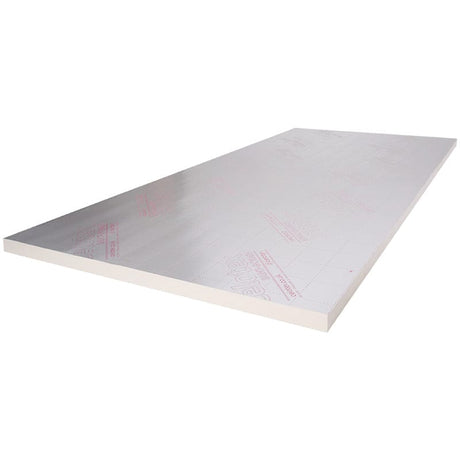
Celotex
20mm Celotex TB4020 PIR Insulation Board 2.4m x 1.2m
£20.22 Inc VAT £16.85 Ex VATUnit price /UnavailableIn stock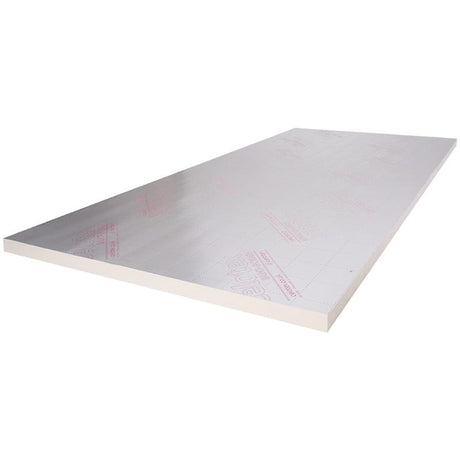
Celotex
25mm Celotex TB4025 PIR Insulation Board 2.4m x 1.2m
£17.70 Inc VAT £14.75 Ex VATUnit price /UnavailableIn stock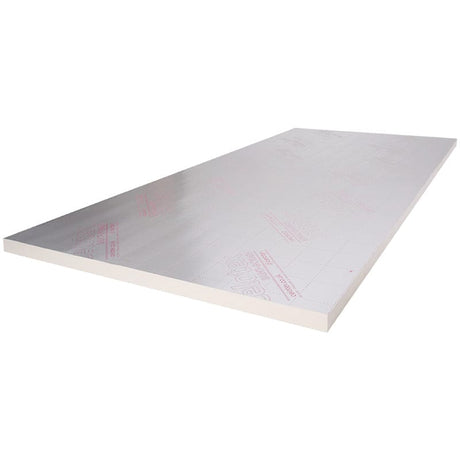
Celotex
30mm Celotex TB4030 PIR Insulation Board 2.4m x 1.2m
£20.84 Inc VAT £17.37 Ex VATUnit price /UnavailableIn stock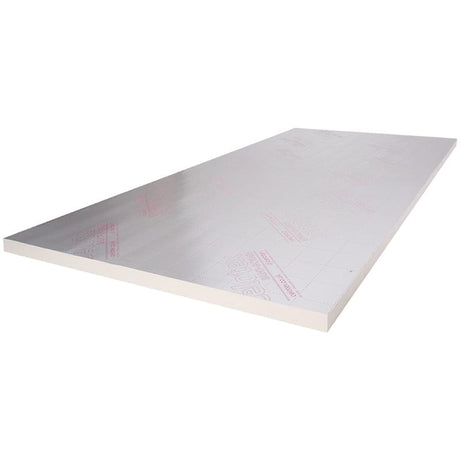
Celotex
40mm Celotex TB4040 PIR Insulation Board 2.4m x 1.2m
£25.00 Inc VAT £20.83 Ex VATUnit price /UnavailableIn stock


Celotex TB4000: Cold Corners, Damp Reveals, and What Causes Them
Insulation layers rarely run uninterrupted. They stop at an opening, they thin out where a lintel crosses, they get pushed aside by a steel or a joist end, they finish short at a floor perimeter. Every one of those interruptions is a thermal bridge: a route where heat moves out faster than it does through the surrounding fabric.
Two things follow. The element loses more heat than the calculation suggests it should. And the internal surface at that point sits colder than the wall around it, which is why reveals go black in the corners and perimeters grow mould while the middle of the wall stays dry.
Neither is fixed by adding more insulation to the main layer. The fix is continuity: carrying insulation across the break so there is no fast route left. That is what a thin board is for, and it is why Celotex TB4000 exists as a range in its own right rather than as the bottom end of a thicker one. TB stands for Thermal Bridging.
Celotex TB4000 is a rigid polyisocyanurate (PIR) insulation board with low-emissivity aluminium foil on both faces, at 2400mm x 1200mm. We stock four thicknesses from 20mm to 40mm. It has a declared thermal conductivity of 0.022 W/mK, a compressive strength of 120 kPa, and holds BBA Certificate 25/7318 for pitched roof, dry lining and floor insulation.
Six Details Where a Thin Board Earns Its Place
Window and door reveals. The commonest job on the range. A 20mm or 25mm board lines the reveal without eating into the opening or fouling the frame.
Lintels. Steel and concrete lintels conduct readily and sit right where the wall insulation stops. Over-lining the soffit and face carries the layer past them.
Floor and ceiling perimeters. Where a floor slab or an intermediate floor meets an external wall, the insulation layer is interrupted by the structure. A perimeter upstand closes it, including on screeded floors with underfloor heating, where the edge detail is where the heat goes if it is left open.
Over-lining structure. Steel columns, timber posts and joist ends that project into the insulation zone can be faced off so the layer runs continuous across them.
Topping up an existing layer. A build-up that falls short of its target resistance, with only 25mm or 30mm of depth left to give, is a classic TB4000 job.
Behind service voids and boxings. Where a duct, a soil pipe or a boxed run pushes the lining out and leaves a thin spot behind it.
What none of these are is a cavity. TB4000 is not a partial fill cavity wall board and never has been, whatever a retailer listing says about installing it between wall ties. For masonry cavity walls the boards designed for the job are CW4000 and Thermaclass Cavity Wall 21; browse the cavity wall insulation range for what we stock.
What Thickness of Celotex TB4000 Do I Need?
With this range the depth available almost always decides the board, not the other way round. Work from what the detail can physically take, then check what that thickness delivers.
| Product code | Thickness | Thermal resistance (RD) | Coverage per board |
|---|---|---|---|
| TB4020 | 20mm | 0.90 m²K/W | 2.88m² |
| TB4025 | 25mm | 1.10 m²K/W | 2.88m² |
| TB4030 | 30mm | 1.35 m²K/W | 2.88m² |
| TB4040 | 40mm | 1.80 m²K/W | 2.88m² |
Every resistance figure is calculated from the declared lambda of 0.022 W/mK and rounded down to the nearest 0.05, which is the method set out in BS EN 13165.
Soprema also manufactures TB4000 at 35mm, giving 1.55 m²K/W. We do not hold it, so call us on 0300 303 4578 if a specification names it and we will look at what can be sourced or what 30mm or 40mm does to the calculation.
Three things worth knowing when reading that table.
Measure the detail, not the drawing. Reveal depths, the gap between a lintel face and the finished plane, the clearance behind a stud line: all of these move once a building is up. On refurbishment work they move a lot.
The 20mm to 25mm step is the one to look at. Five extra millimetres buys roughly 22% more thermal resistance, from 0.90 to 1.10 m²K/W. Where the detail can absorb it, that is the best value increment in the range by a distance.
Then check the finish. A board fitted into a reveal still needs lining and finishing over it, so the board thickness is not the whole depth you are spending. Factor the finish in before committing to a thickness.
What TB4000 Will Not Do
Being straight about the limits is more useful than pretending there aren't any, and it is where most listings for this range go wrong.
It will not deliver a U-value on its own. At 20mm to 40mm, TB4000 is not a compliance route for an element. Its job is continuity across a junction, or making up a shortfall in a layer that already exists. Any page telling you a 20mm PIR board achieves a Part L wall U-value is worth reading sceptically throughout. What the board contributes is the declared thermal resistance in the table above, which feeds into the calculation for the specific detail.
The foil benefit may not apply to your detail. The low-emissivity aluminium facings improve thermal performance across a sealed, unventilated cavity air space next to the board. Line a reveal with a 20mm board bonded straight to masonry and there is no such cavity, so the benefit is not there. This caveat matters more on TB4000 than on any of the thicker Celotex ranges, because the applications are exactly the ones least likely to include a sealed cavity.
The foil is not a vapour control layer. Several listings describe it as one. It is not, and specifying it as one will fail a condensation risk analysis. Where the build-up needs vapour control, that is a separate designed layer.
It stops at 40mm. The range does not run to 50mm, despite the search volume. At 50mm the board is GA4050 from the General Application range: same core, same facings, same 0.022 W/mK.
It is not the automatic answer for internal over-lining. Where the job is lining a solid wall internally, a thermal laminate such as PL4000 gives PIR bonded to 12.5mm tapered edge plasterboard in one board and one fixing operation, from 37.5mm overall. That overlaps the TB thickness band and is often the better call than a TB board plus a separate sheet.
Celotex TB4000 Specification
| Material | Rigid polyisocyanurate (PIR) |
|---|---|
| Board size | 2400mm x 1200mm |
| Coverage | 2.88m² per board |
| Thicknesses manufactured | 20, 25, 30, 35 and 40mm |
| Thicknesses stocked | 20, 25, 30 and 40mm |
| Declared thermal conductivity (λD) | 0.022 W/mK |
| Facings | Low-emissivity aluminium foil, both faces |
| Surface emissivity | 0.05 |
| Edge profile | Straight |
| Compressive strength | 120 kPa at 10% deformation to BS EN 826 |
| Reaction to fire | Euroclass F to BS EN 13501-1 |
| Product standard | BS EN 13165 |
Note on compressive strength. TB4000 is declared at 120 kPa, and Soprema publishes that figure against every thickness in the range individually. A number of retailers publish 140 kPa across the whole Celotex range without distinguishing between them: that figure belongs to GA4000 and XR4000. It is also a laboratory test condition measured at 10% deformation, not a floor loading capacity, and should not be quoted as one.
Certification, Fire and the Sopratherm Rebrand
Certification. BBA Agrément Certificate 25/7318 covers TB4000 for pitched roof, dry lining and floor insulation, published as three separate certificate documents. Timber-frame dwellings sit under Certificate 25/7329. There is also an Environmental Product Declaration covering TB4000 alongside GA4000, XR4000 and CW4000, issued through the International EPD System and last reissued in November 2025. Certificates 17/5405, 16/5352, 95/3197 and 09/4667 all still circulate on retailer listings and every one of them has been superseded.
Fire. Euroclass F to BS EN 13501-1, with no smoke emission rating at that classification. This predates the rebrand: the September 2023 Celotex TB4000 datasheet already declared F. Listings quoting Euroclass E, "Class 1 to BS 476-7", "Class D/s2/d0" or simply "good reaction to fire" are quoting older documents, in the last two cases the 3000-series datasheets described below. Reaction to fire is not fire resistance, and says nothing about how long a completed construction will hold back a fire.
The 11m restriction. Soprema states that, in accordance with current Building Regulations requirements relating to combustibility, the product should not be used in the external walls of relevant buildings over 11 metres in height. Above that threshold, or where the specification calls for a non-combustible or limited-combustibility product, mineral wool is the route.
The rebrand. Soprema UK brought Celotex, Chesterfelt and YBS Insulation under one identity on 1 January 2026, and TB4000 is now listed as Sopratherm TB4000. The board, the codes from TB4020 to TB4040, the performance figures and the certification are all unchanged; only the packaging print is different. One detail matters for paperwork going to building control: the certificate holder is now Soprema Insulation Limited t/a Celotex, where older documents name Saint-Gobain Construction Products UK Limited t/a Celotex.
Where TB3000 and the 12mm Board Come From
TB3000 is the older name, not a newer one. The Celotex 3000 series, branded T-Break TB3000 and tuff-R GA3000, declared a thermal conductivity of 0.023 W/mK and published R-values of 0.85 at 20mm, 1.05 at 25mm and 1.30 at 30mm. Its datasheets cite BS EN 13165:2001 and BS 476:1997, which dates them. The range later moved to the 4000 series at 0.022 W/mK.
In November 2018 Celotex announced a lambda compliance issue across the 4000 and 5000 series. Affected boards were sold under the 3000 names at 0.023 W/mK while further testing was carried out, with the BBA permitting continued sale at the original declared value in the interim. That reversion has since been undone and the current declared value is 0.022 W/mK.
The practical consequence: a specification written around 2018 or 2019 may name TB3000, and so may a much older one, in both cases at a lower declared performance than the board supplied today. Check which figure the calculation was built on before substituting.
The 12mm board comes from the same place. The 3000 series included a TB3012 at 12mm declaring 0.50 m²K/W. There is no 12mm or 15mm board in the current Soprema range, which starts at 20mm. Listings advertising a 12mm TB4000 or a TB4012 are not describing a current product.
Ordering and Installing
Thermal bridging work generates a lot of offcuts. A run of rafters uses full boards; a schedule of reveals, lintels and perimeters is mostly narrow strips. Allow around 15% on waste rather than the 5% to 10% that suits a straight application, and work in whole boards: at 2.88m² each, a single board covers a surprising number of reveals once it is cut down.
Cut with a fine-tooth saw or a sharp insulation knife. Fit tight to the surrounding structure with no gaps, since a badly closed bridge is only slightly better than an open one. Tape joints and abutments with a foil insulation tape to limit air infiltration through the layer. Install in line with current Soprema guidance and the project specification.
Why Choose Insulation UK
- Buy the quantity the job needs. Thermal bridging work rarely takes a full delivery of boards. Order single boards for a set of reveals or bulk for a full project.
- Four thicknesses held in stock: 20mm, 25mm, 30mm and 40mm.
- Trade pricing across single boards and larger volumes.
- Free UK delivery on orders over £500 ex VAT, on our FORS Gold accredited fleet.
- Bespoke cutting service. Useful on this range in particular, since reveal and perimeter work is mostly strips. See our bespoke cutting service.
- A team that knows the detail. Rated Excellent on Trustpilot, and happy to talk through a junction rather than just take the order. Call 0300 303 4578.
Celotex TB4000 FAQs
What is Celotex TB4000?
A thin rigid polyisocyanurate (PIR) insulation board made for thermal bridging details: reveals, lintels, floor and ceiling perimeters, over-lining structural members, and topping up an existing insulation layer. It has a declared thermal conductivity of 0.022 W/mK, low-emissivity aluminium foil on both faces, and comes at 2400mm x 1200mm. We stock four thicknesses: 20mm, 25mm, 30mm and 40mm. BBA Certificate 25/7318 applies.
Do you stock TB4000 in 35mm?
Not as standard. Soprema manufactures TB4035 at 35mm, giving 1.55 m²K/W, but we hold 20mm, 25mm, 30mm and 40mm. If a specification names 35mm, call us and we will look at what can be sourced or what the nearest stocked thickness does to the calculation.
What is the difference between Celotex GA4000 and TB4000?
They do different jobs at different depths. TB4000 runs 20mm to 40mm and exists to close thermal bridges and fit into details where there is little room. GA4000 runs 50mm to 100mm and covers standard build-ups with depth to work with. The core, the facings and the 0.022 W/mK conductivity are identical. The one specification difference is compressive strength: 120 kPa for TB4000 against 140 kPa for GA4000. Neither is a higher grade than the other.
What is the compressive strength of Celotex TB4000?
120 kPa at 10% deformation to BS EN 826, declared at that figure across every thickness in the range. Retailer pages quoting 140 kPa have carried the figure over from GA4000 or XR4000.
Does TB4000 have a U-value?
No board has a U-value on its own; it belongs to the completed construction. And at 20mm to 40mm, TB4000 will rarely take an element to a target on its own, because it is there for continuity across a junction rather than as the main insulation layer. Its declared thermal resistance runs from 0.90 m²K/W at 20mm to 1.80 m²K/W at 40mm, and that is what goes into the calculation for the detail.
Is TB4000 available in 12mm or 50mm?
Neither is in the current Soprema range, which runs from 20mm to 40mm. The 12mm board people remember is TB3012 from the older 3000 series, which declared 0.50 m²K/W at a lambda of 0.023 W/mK and is no longer manufactured. At 50mm the board is GA4050 from the General Application range.
Is the foil facing on TB4000 a vapour control layer?
No. It is a low-emissivity facing, which improves thermal performance across a sealed unventilated cavity next to the board. It is not a vapour control layer and should not be specified as one. Where the build-up needs vapour control, that is a separate layer.
Can I use TB4000 in a cavity wall?
No. TB4000 is a thermal bridging board and is not certified or designed for partial fill cavity wall construction, despite listings describing it as sized to fit between wall ties. For masonry cavity walls the boards are CW4000 and Thermaclass Cavity Wall 21.
Is Celotex TB4000 the same as Sopratherm TB4000?
Yes. Soprema unified its UK brands on 1 January 2026 and the board is now catalogued under the Sopratherm name. Codes, dimensions, performance and certification are unchanged.
Where can I get the Celotex TB4000 data sheet?
The current technical data sheet, Declaration of Performance and BBA certificate are published by Soprema under the Sopratherm TB4000 listing. Work from the current issue: both the certificate number and the certificate holder have changed since the archived Celotex-branded sheets.