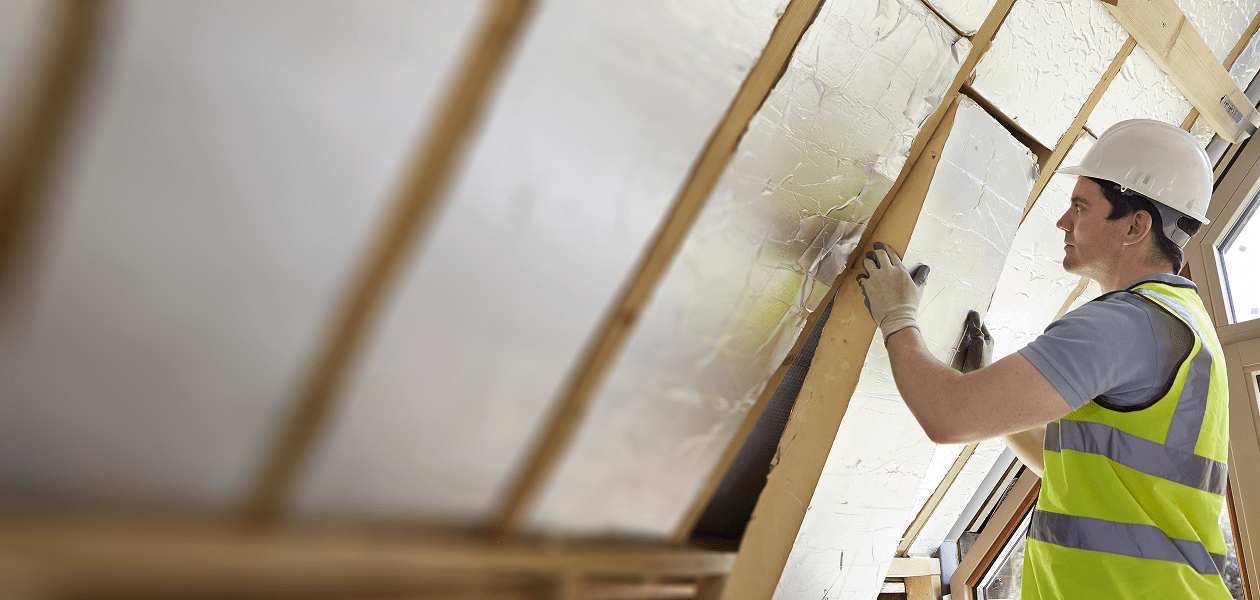
ODE LUNAflex Loft Roll Ultra 42 is a glass mineral wool roll for cold pitched roofs, laid between and over the ceiling joists rather than up at the rafters. It friction fits into place, cross-lays cleanly on top of itself, and carries the top Euroclass A1 fire rating throughout the range.
Insulation UK stocks it in three thicknesses, 100mm, 150mm and 200mm. Every thickness shares the same declared thermal conductivity of 0.042 W/mK, the same Euroclass A1 non-combustible fire rating, and the same recycled glass content of more than 80%.
Here is how the range compares, which thickness suits which job, and the detail worth knowing before you order.
This range is mid rebrand, from STARflex to LUNAflex. A pallet may still arrive with STARflex on the packaging. It is the exact same product to the exact same specification, only the name on the wrapper has changed.
The range at a glance
Coverage runs the opposite way to thickness. A 100mm pack covers more area than a 200mm pack, so pricing a job on pack count alone rather than total m² required will throw the numbers off once thicknesses are being combined.
| Thickness | Roll size | Coverage per roll | Thermal resistance | Coverage per pallet |
|---|---|---|---|---|
| 100mm | 7.2m x 1.2m | 8.64m² | 2.38 m²K/W | 276.48m² |
| 150mm | 7.0m x 1.2m | 8.40m² | 3.57 m²K/W | 201.60m² |
| 200mm | 6.0m x 1.2m | 7.20m² | 4.76 m²K/W | 172.80m² |
Which thickness should you choose?
- 100mm, the entry point. Most coverage per pack at 8.64m² and the most rolls per pallet. The economical choice for a base layer under a cross-laid second roll, or as a standalone top-up on a loft that already has thin, ageing insulation in place.
- 150mm, the flexible middle. Works on its own for a straightforward single-layer job, cross-laid with a 100mm roll for 250mm total, or with a second 150mm roll for 300mm. The one to reach for when the exact combination has not been decided yet.
- 200mm, the deepest single-roll R-value. The natural top layer when cross-laying past 270mm, for example paired with a 100mm or 150mm base, or the choice where a single deep layer is preferred over stacking two thinner ones.
All three thicknesses are in stock, with free UK delivery on orders over £500 ex VAT.
Shop LUNAflex Ultra 42Why LUNAflex Ultra 42 stands out
Loft roll is a crowded category and most of it looks alike on a spec sheet. Three things are worth knowing here.
- Fire performance. All three thicknesses carry a Euroclass A1 reaction to fire classification under EN 13501-1, the highest rating on the scale. The material itself does not burn and adds nothing to a fire, worth having in a space that is often unheated and rarely checked once boarded over.
- Sustainability. Made from more than 80% recycled glass content, with a BRE Green Guide rating of A+. It will not degrade, decompose or become mouldy over time, so it is built to last the lifetime of the building rather than needing replacement.
- Packaging. Supplied in Hyperpack palletised packaging, which loads more product per pallet, reduces stocking costs, and can be stored outdoors if site conditions call for it, useful when the loft is not the first job scheduled.
Thermal performance and reaching 270mm
Every thickness shares a declared thermal conductivity of 0.042 W/mK. Thermal resistance scales with thickness from there: 2.38 m²K/W at 100mm, 3.57 m²K/W at 150mm and 4.76 m²K/W at 200mm. These R-values are calculated from thickness and declared conductivity rather than stated separately, which is standard practice across the category.
Current UK guidance from the Energy Saving Trust and Approved Document L points towards a minimum depth of around 270mm of mineral wool at ceiling level in a cold loft. In practice that depth is almost always built up from two layers, one between the joists and a second cross-laid on top at right angles, rather than a single very thick roll. Scotland, Wales and Northern Ireland have their own equivalent guidance, and the figure that matters for any given job is the one in that project's specification or SAP calculation, not a generic number.
None of the three thicknesses reaches 270mm on its own, so most jobs combine two rolls. As simple totals of thickness and resistance, not a tested figure for the finished build-up, the available stock combinations are:
| Combination | Total depth | Combined resistance |
|---|---|---|
| 100mm + 150mm | 250mm | ≈5.95 m²K/W |
| 150mm + 150mm | 300mm | ≈7.14 m²K/W |
| 100mm + 200mm | 300mm | ≈7.14 m²K/W |
| 150mm + 200mm | 350mm | ≈8.33 m²K/W |
| 200mm + 200mm | 400mm | ≈9.52 m²K/W |
The finished U-value of the roof or ceiling depends on the whole construction, joists, boarding and air gaps included, not on insulation depth alone. Treat the totals above as a starting point for pricing a job rather than a substitute for a proper calculation.
Installation
- Lay the first layer between the joists, cut to fit snugly with no gaps at the edges.
- Cross-lay a second layer at right angles over the top where one is being added, covering the joists themselves and breaking the cold bridge they would otherwise create.
- Keep a ventilation gap at the eaves rather than pushing insulation hard up against the roof covering, to avoid trapping moisture in the roof space.
- Do not compress the insulation under loft boarding. Where the loft is used for storage, raised loft legs keep the boards clear of the full insulation depth rather than crushing it flat.
- Wear a suitable dust mask, gloves and eye protection when handling glass mineral wool, and work from a board spanning the joists rather than stepping between them.
Always follow the current manufacturer's installation guidance before fitting, alongside the project's own specification. See our guide to working out how much loft insulation you need if you're estimating quantities across an irregular loft shape.
Fire performance
All three thicknesses are classified Euroclass A1 to EN 13501-1, the highest reaction to fire rating available, meaning the material is non-combustible and makes no contribution to a fire.
Worth keeping the distinction clear when specifying. Reaction to fire (Euroclass A1) describes how the material itself behaves. Fire resistance, measured in minutes, is a property of the completed construction, driven by the boarding, joists and detailing as much as the insulation. Filling the loft with A1 mineral wool does not on its own give the ceiling below a fire resistance rating, but it does mean nothing in the roof space is adding fuel.
Sustainability and packaging
LUNAflex Ultra 42 is manufactured from more than 80% recycled glass content and holds a BRE Green Guide rating of A+. It will not degrade, decompose or become mouldy over time, and is designed to last the lifetime of the building once installed and left undisturbed.
Supplied in Hyperpack palletised packaging, which loads more product per pallet than looser packaging, lowers stocking costs, and can be stored outdoors if needed, useful on sites where the loft is not the first job scheduled.
STARflex to LUNAflex: same product, new name
Buyers ordering across this range at the moment may notice packaging that does not match the product name on the website. That is expected. ODE is partway through rebranding this loft roll from STARflex to LUNAflex, and stock arriving during the transition can carry either name on the wrapper.
Nothing about the product itself changes with the rebrand. The specification, thermal conductivity, fire classification and recycled content are identical under either name, so a pallet marked STARflex and a pallet marked LUNAflex can be mixed on the same job without any difference in performance.
How LUNAflex compares to the other loft rolls we stock
You are not limited to LUNAflex for this job. Here is how it sits against the other cold loft rolls in the range.
| Product | Lambda (W/mK) | Fire rating | Note |
|---|---|---|---|
| ODE LUNAflex Ultra 42 | 0.042 | Euroclass A1 | Best lambda of the standard mineral wool rolls we stock |
| Knauf Loft Roll 44 Combi-cut | 0.044 | Euroclass A1 | Combi-cut perforations for 400mm/600mm joist centres |
| Superglass Multi Roll 44 | 0.044 | Euroclass A1 | Same lambda as Knauf, lower price point |
| Thermafleece CosyWool | 0.039 | N/A, natural fibre | British sheep's wool blend, itch-free handling |
Price per roll only tells half the story since pack sizes differ, so it's worth comparing on price per m² covered instead. Against Knauf Loft Roll 44 at current online prices, LUNAflex works out roughly on par at 150mm and around 14% cheaper per m² at 200mm, while carrying the better 0.042 W/mK lambda at every thickness in the range. Knauf's 100mm roll, a much longer 13.89m² pack, edges ahead on price per m² at that thickness specifically. Since 150mm and 200mm are the rolls doing most of the work in a cross-laid build-up past 270mm, that makes LUNAflex a genuinely strong pick on performance and price together, not just a lambda upgrade at a premium.
If price per roll matters more than price per m² at a given thickness, it's worth checking Superglass too. Browse the full loft roll insulation range to compare stock and pricing directly.
Any drawbacks?
- No single roll reaches 270mm on its own. Not unusual for a loft roll range, but it means budgeting for two thicknesses rather than one if the job is aiming for that benchmark.
- Proper handling required. As with any glass mineral wool product, a dust mask, gloves and eye protection are worth having on hand, particularly for anyone tackling their first loft job.
- Coverage per pack falls as thickness rises, from 8.64m² at 100mm down to 7.20m² at 200mm, easy to miss when costing a job by pack count rather than total area required.
- Mid-rebrand packaging. Expect either STARflex or LUNAflex branding to turn up for now. It makes no difference to what's inside the roll, but flag it to anyone unpacking a delivery who isn't expecting it.
Our expert verdict
ODE LUNAflex Loft Roll Ultra 42 is a straightforward glass mineral wool range built around a consistent 0.042 W/mK conductivity and a Euroclass A1 fire rating across all three thicknesses, which keeps specifying it simple regardless of which roll ends up in the loft. At 150mm and 200mm in particular, that lambda advantage comes without a price penalty against the other mineral wool rolls we stock, and at 200mm it's genuinely the cheaper option per m² too, which makes it a strong default rather than just a premium alternative.
The 100mm and 150mm rolls do the heavy lifting as base layers or economical top-ups, the 200mm roll gives the strongest single-roll performance for cross-laying past 270mm, and the sustainability position holds up across the whole range. The one thing to keep in mind is the ongoing STARflex to LUNAflex rebrand: expect either name to turn up on the packaging for now, and know that it makes no difference to what's inside the roll.
Not sure which thicknesses to cross-lay for your loft? Our team has over 50 years of insulation experience behind them. Call 03003 034 578 and we'll talk it through.
Shop ODE LUNAflex Loft Roll Ultra 42