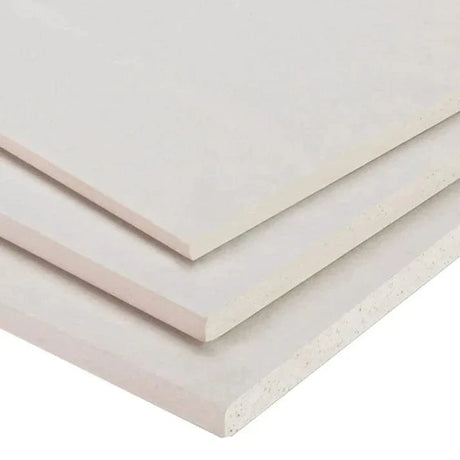
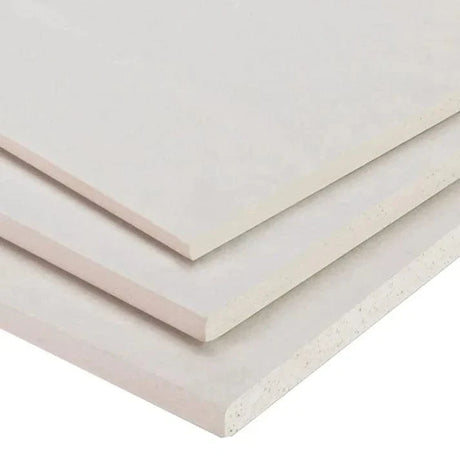
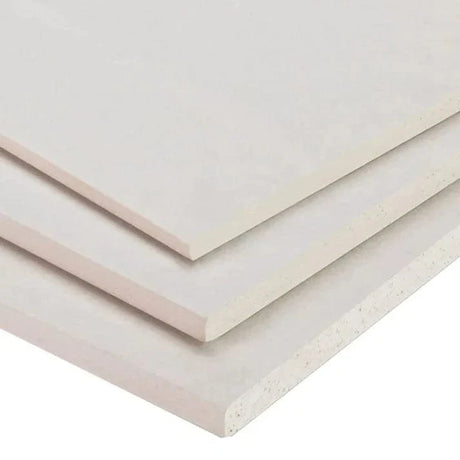
Plasterboard is the board almost every internal fit-out starts with. Standard plasterboard, sometimes called wallboard or drywall, is the baseline board for lining internal walls and ceilings before skimming or decorating. It is plain gypsum board, without the extra performance of a moisture-resistant, fire-rated or acoustic board, and for the bulk of dry internal work it is all a job needs.
The board is a gypsum core sandwiched between two sheets of lining paper. The gypsum core is non-combustible and holds chemically bound water, which is where plasterboard gets its useful behaviour in a fire. It is fixed to a timber or metal frame, or dot-and-dabbed to masonry, then taped and jointed or skimmed to a finish.
Insulation UK stocks the standard range in 9.5mm, 12.5mm and 15mm, in tapered and square edge, and in the full 2.4m x 1.2m sheet plus a smaller 1.8m x 900mm board for tighter access. The thickness, edge and size you pick come down to where the board is going, how it will be finished, and how much you want to lift.
The standard plasterboard range at a glance
Every board shares the same plain gypsum core and non-combustible make-up. What changes is the thickness, the sheet size, the coverage per board, and the edge profile that decides how the boards join. The range comes in two edge profiles: tapered edge for a taped and jointed finish, and square edge for skimming.
Tapered edge
| Thickness | Sheet size | Coverage per board | Best fit |
|---|---|---|---|
| 9.5mm | 2.4m x 1.2m | 2.88m² | The lighter board for ceilings and overhead lining work. |
| 12.5mm | 2.4m x 1.2m | 2.88m² | The all-round wall board for a flush tape-and-joint finish. |
| 15mm | 2.4m x 1.2m | 2.88m² | The heavier board for added rigidity, sound and where 15mm is specified. |
Square edge
| Thickness | Sheet size | Coverage per board | Best fit |
|---|---|---|---|
| 12.5mm | 2.4m x 1.2m | 2.88m² | Everyday walls and ceilings that will be plaster skimmed. |
| 12.5mm | 1.8m x 900mm | 1.62m² | A smaller, easier-to-handle sheet for tight access and repairs. |
*Coverage is per board. The 9.5mm 2.4m x 1.2m sheet weighs 17.28kg, with weight increasing as the board gets thicker. Confirm exact board weights and the reaction-to-fire class on the product page or Declaration of Performance before specifying.
Why standard plasterboard is the board most jobs start with
Standard plasterboard earns its place by being the straightforward, lower-cost board that covers most internal work. It takes a plaster skim or a tape-and-joint finish, cuts with a knife and a straightedge, and fixes with screws or adhesive. There is no specialist handling and no premium for performance you do not need.
The gypsum core does more than provide a flat surface to decorate. It gives a solid, knock-resistant lining, a degree of sound reduction within a built-up partition, and non-combustible core behaviour that contributes to a wall or ceiling's fire performance. For dry internal rooms, that combination is usually all that is called for, which is why standard board is the default and the specialist boards are the exception.
Board thickness and what it changes
Thickness is the first choice, and it changes weight, rigidity and how the board performs in a build-up. 9.5mm is the lightest board and the easiest to lift overhead, which is why it is a common choice for ceilings, though a thinner board can be more prone to sagging where joists are widely spaced. 12.5mm is the everyday wall and ceiling thickness, the one most jobs reach for, with more rigidity and a little more mass than 9.5mm. 15mm is the heaviest of the three, chosen where extra rigidity, better sound reduction or a 15mm board is specified, for example on some ceiling systems, service risers and higher-spec partitions.
Thickness is usually set by the specification or the system being built, not picked freely. Always fix at the centres and board layout the system or specification calls for.
Fixing and site practicality
Standard board is cut by scoring the paper face with a sharp knife along a straightedge, snapping the board back, then cutting the reverse paper. It is fixed with drywall screws to timber or metal studs, or bonded to masonry with adhesive using the dot-and-dab method, after which the joints are taped and filled, or the whole board is skimmed.
On ceilings, run the boards perpendicular to the joists, stagger the end joints so they do not all land on the same joist, and screw into the centre of the timber. The paper face goes outwards: it is designed to key with the plaster or take direct decoration. Store the boards flat, off the ground and dry, as plasterboard is easily damaged on its edges and corners and does not tolerate getting wet before it goes in.
Fire performance
The gypsum core is non-combustible, and when heated it releases the water held within it as steam, which slows the passage of heat and fire through the board. That is why plasterboard is a core part of most fire-rated wall and ceiling systems.
Standard plasterboard is not the same as a fire-rated board, though. Boards made to BS EN 520 are classified for reaction to fire under BS EN 13501-1, and standard wallboard generally sits at A2-s1,d0, meaning it makes very limited contribution to a fire. Where a specific fire resistance is required, a dedicated fire-resistant (Type F) board is used, on its own or in additional layers, as part of a tested system. One honest distinction is worth drawing: reaction to fire describes how the board itself behaves, while the rated fire resistance in minutes belongs to the full tested construction, not the board alone. Confirm the reaction-to-fire class for the exact board on its product page or Declaration of Performance before you rely on it.
Standards and sustainability
Standard plasterboard is manufactured to BS EN 520, the harmonised European standard for gypsum plasterboards, and is CE or UKCA marked against it. As an own-brand line, the definitive figures for any given board, including its reaction-to-fire class, live on that board's Declaration of Performance and datasheet, so check those before specifying.
Gypsum is also one of the more recyclable construction materials. Plasterboard offcuts and waste can be recycled back into new board through dedicated waste streams rather than going to landfill, provided they are kept separate and clean on site.
Which thickness should you choose?
9.5mm: the lighter board
9.5mm is the lightest board in the range and the easiest to handle overhead, which makes it a popular ceiling and lining board where lifting weight matters. Bear in mind that at wider joist centres a thinner board can be more prone to sagging, so many installers step up to 12.5mm where joists are spaced further apart or extra rigidity is wanted. Stocked as a 9.5mm tapered edge 2.4m x 1.2m board.
12.5mm: the all-round choice
12.5mm is the thickness most walls and ceilings are lined with. It offers more rigidity and mass than 9.5mm while staying manageable, and it is stocked in the widest choice of formats: 12.5mm tapered edge and 12.5mm square edge in the full 2.4m x 1.2m sheet, plus a smaller 1.8m x 900mm square edge board for tight access, stairwells and repairs.
15mm: the heavier board
15mm is the heaviest board here, for jobs that call for extra rigidity, improved sound reduction within the build-up, or where a 15mm board is specified. It is the board to reach for on higher-spec partitions and certain ceiling and service-riser systems. Stocked as a 15mm tapered edge 2.4m x 1.2m board.
Tapered edge or square edge?
The edge profile decides how the boards join and how you finish them. Tapered edge boards have a slight recess along the long edges, so when two boards meet the joint sits just below the board face. That recess is filled with jointing compound and tape to give a flush, seamless surface ready for direct decoration, which is the tape-and-joint method. Tapered edge suits work that will be decorated straight onto the board without a full skim.
Square edge boards have a straight, flat edge that butts up to form a simple joint with no recess. Square edge is the choice where the whole wall or ceiling is going to be plaster skimmed, since the skim coat covers the joints anyway, and it is often used behind tiling or where the finish is less critical. On the product pages you will see these marked TE and SE: if you are taping and jointing, choose tapered; if you are skimming the lot, either works and square edge is common.
Any drawbacks?
The main thing to keep in mind is what standard board is for. It is the plain, dry-internal board, so it is not the right choice for wet rooms, for applications that need a specific fire rating, or for demanding sound insulation. For those, a moisture-resistant, fire-resistant or acoustic board is the correct tool, and standard board is used everywhere else.
It also needs a frame or dabs to fix to rather than working as a structural sheet, and the thicker 15mm board is a genuine lift, so plan handling on ceilings and overhead work. Like all plasterboard, it damages easily at the edges and does not tolerate getting wet before installation, so keep it flat, dry and off the ground on site.
Our expert verdict
Standard plasterboard is the board to start with for the bulk of internal walls and ceilings: plain gypsum board that takes a skim or a tape-and-joint finish, fixes to a frame or masonry, and keeps costs down where you do not need a specialist board.
Pick the thickness for the job: 9.5mm for lighter ceiling and lining work, 12.5mm as the everyday all-rounder, and 15mm where extra rigidity, sound or a specified thickness is called for. Choose tapered edge for a tape-and-joint finish and square edge where you are skimming throughout, and drop to the smaller 1.8m x 900mm sheet where access is tight.
For dry internal drylining, standard plasterboard belongs at the top of the list, with the moisture-resistant, fire-resistant and acoustic ranges there for the jobs that need them.
Shop the Standard Plasterboard range today, or speak to the Insulation UK team on 03003 034 578 if you need help choosing the right thickness, edge or sheet size for your walls and ceilings.